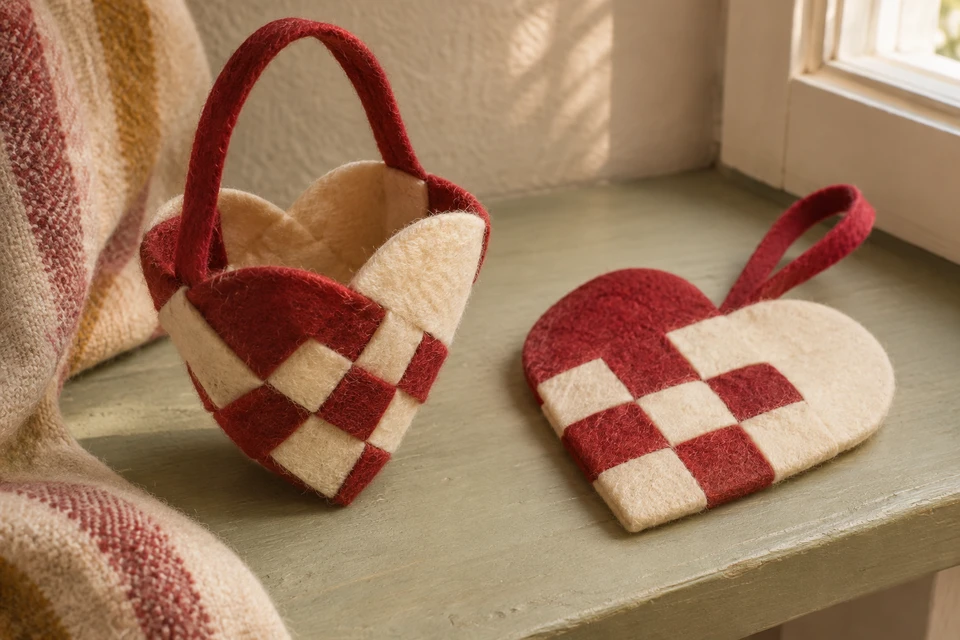
A woven Christmas heart may be a flat decoration or a small open basket. From the front, both can show the same alternating squares, so a catalogue photograph may not reveal which construction is being offered. Buyers should decide whether there must be a usable cavity before approving the weave, hanging loop or packaging. This article concerns textile decoration; it does not establish carrying capacity, food-contact suitability or a children's product classification.
Identify the intended form before choosing the pattern
An open top is a functional difference
Ask the maker to show the item from the front, side and open top. For a basket version, identify where its two walls separate and how the interior is reached. For a deliberately flat ornament, confirm whether its layers are joined or simply lie together. Do not accept the word basket as proof of an interior, or the word ornament as proof that the construction is flat. Put the intended form on the purchase line.
Kunin Felt's own woven-heart project illustrates folded strips interlaced into a basket. That source supports the distinction between a woven surface and an open construction; it is not a licence to copy a particular published pattern for commercial production. Use an original or appropriately authorised drawing for the project. Retain its source and permission separately from the supplier's proposed manufacturing specification.
Follow the folded loops through the weave
A checkerboard face alone is insufficient
Request a development sample in contrasting colours so the paths are easy to inspect. Ask the maker to identify how the folded portions pass through one another and which parts remain free to form the walls. Trace several intersections rather than judging only the central square. A strip laid across another can imitate a woven appearance in a photograph while producing a different assembly. Clarify whether the offered construction is interwoven, stitched, bonded or a combination.
If bonding or stitching is used to retain the arrangement, have the maker show its location and explain its purpose. Inspect that location on the completed item instead of assuming it is invisible or unnecessary. The buyer should not prescribe an adhesive from a craft tutorial. Component compatibility, application and any required evidence belong to the actual production proposal, with the relevant technical owner deciding how the agreed construction is achieved.
Check the cavity without forcing the heart
Opening should not destroy the accepted silhouette
For a basket proposal, open it in the way an ordinary user would. Observe the upper shoulders, lower point and the intersections beside the opening. Note whether the front loses its intended pattern or the walls remain stuck together in an unintended place. Define the opening required by the proposed decorative use, but avoid treating an attractive cavity as evidence for a particular payload. Any contents or carrying use must be specified and assessed separately.
Compare the open and resting states against the same reference. A soft felt heart will not have the geometry of a rigid box, so the buyer should agree what variation is acceptable. If the item is intended only to hang empty, say that plainly. If an insert or gift is contemplated, establish the complete product scope and relevant requirements before presenting that use in marketing. Do not add sweets as a photograph prop and allow the image to imply an unverified intended use.
Review the weave where the heart changes direction
Small strip differences can change the outline
Inspect the curved shoulders, the central cleft and the lower tip. Ask the maker to explain the pattern's finished outline and how it differs from the flat cut components. Compare strip width and spacing in a consistent viewing position. A narrow remaining section at an end may look accidental even when the central checkerboard is orderly. Keep the full heart and a close junction view together so inspection is not based on one flattering crop.
Confirm the actual felt composition, thickness reference and finish proposed. The material name does not establish that every sheet handles or cuts identically. Review exposed cut edges, local fuzz and the way layered areas sit against each other. Ask for a revised sample if a material change alters the weave or silhouette. Do not assume that a heavier felt is automatically more suitable; it may produce a different opening and a bulkier intersection that needs its own acceptance.
Give the hanging element a defined role
Decorative suspension is not a transport handle
Identify the loop's material, attachment positions and visible length in the hanging state. On a basket version, check whether the attachment connects the intended walls without closing the opening. On a flat version, observe whether the ornament twists or hides its principal face. The sample should hang naturally from the intended display arrangement rather than being pinned into a preferred position for photography. Record the resting angle and the acceptable presentation.
Keep attachment evidence proportionate to the specified use and market. A visual hanging check is not a load test or a safety certification. If a retailer changes the intended use, reassess the component and the supporting evidence instead of keeping the same approval by default. Avoid claims about suitability near heat, suitability for children or universal decorative use. The supplier and buyer should understand the boundaries of the actual order before approving public descriptions.
Make the packed unit explain the product
Do not let flattening conceal a missing feature
Trial the intended retail pack with the agreed number and colour mix. For a basket sold flat, establish whether the customer is expected to open it and what the ordinary unpacked result should look like. Check the heart after that normal handling, including the cavity and loop attachment. If instructions are needed, have an unfamiliar reviewer use them. A display sample that only the maker can open correctly is not yet a clear retail proposition.
An FY Bedding enquiry can include the authorised heart drawing, required open or flat form, material proposal, hanging view and pack quantity. Ask for a construction sample and confirmation of minimums, development stages and feasible timing. Keep rejected flat and basket variants distinctly identified so they are not mixed as equivalent stock. The Christmas theme describes the assortment's visual direction; it does not confirm availability or arrival before a seasonal selling date.
Approve the heart's form from the side and open top as well as the front. Identify interwoven loops, retained joins and the hanging role, then verify the ordinary unpacked article against that same reference.
Method references: Kunin: interwoven felt heart basket construction.