A Christmas throw assembled from gathered fabric circles can be bought as an open decorative layer or as part of a backed textile. The two options may share the same red, green and ivory face yet behave differently in use and in a retail photograph. Settle that choice before comparing quotations or promising the coverage of a conventional blanket.
Identify what the customer will receive
The word quilt can hide an open structure
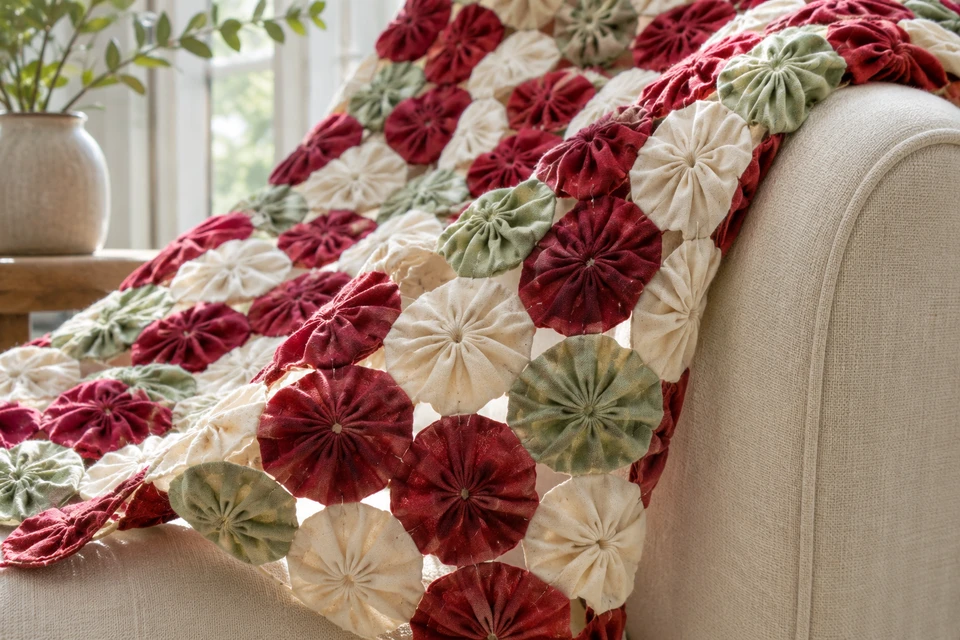
Yo-yos, sometimes called Suffolk puffs, are gathered fabric circles flattened into small rosette-like units. They can be joined to one another with gaps between them or applied to a supporting textile. Designed to Quilt's own construction tutorial describes both open and backed approaches. That is a useful explanation of the distinction, not evidence that a proposed FY project uses either method or is available from stock.
Write the supply description in physical terms: an open-linked decorative coverlet, a yo-yo face attached to a backing, or another explicitly sampled assembly. Identify whether any filling is present. Do not infer insulation, warmth or continuous coverage from the label quilt. For a Christmas sofa presentation, an open design may intentionally let the upholstery show through; a backed version will introduce another visible colour behind every gap.
Set circle size and joining pitch together
Count the assembly rather than measuring a pile of pieces
Measure a finished gathered circle in its relaxed state and record its intended shape. Then measure several connected circles as a group. The overall width depends on the distance between their centres and the way the joining points are formed, not simply on multiplying the diameter of a loose circle by a quantity. A supplier's proposed unit count therefore needs to be checked against an assembled sample.
Ask for a representative patch containing interior units and an outside edge. Inspect the size and consistency of the gaps, the orientation of gathered centres and the visible joining stitches. An intentionally irregular handmade-looking effect still needs an agreed reference range. The buyer should distinguish accepted variation from a missed junction or a circle pulled so far out of shape that it changes the surrounding openings.
Choose the reverse without losing the intended effect
Backing changes more than opacity
Place an open patch on the intended sofa or bed background and view it from normal room distance. Repeat on a contrasting background. If the gaps are a central part of the Christmas colour story, the background is effectively another design component. Retail images should show that relationship honestly instead of presenting an open-linked piece as if it were an opaque blanket.
For a backed proposal, request a construction sample showing how the circles are attached and how the edge is finished. Check whether the backing bunches between attachment points or draws the circular units into an unintended pattern. The relevant comparison is the complete assembly after handling, not an attractive face laid loosely on a separate backing for a photograph. Retain the unassembled references as well so that component substitutions remain visible.
Review drape, handling and care on a full piece
A small patch cannot establish finished usability
Lay the full sample over the intended chair arm or at the foot of a bed. Lift and reposition it using ordinary handling rather than pulling on a single circle. Observe whether gaps open unevenly, whether the perimeter twists and whether the weight concentrates at isolated joins. Define the planned use and any handling limitations before deciding how the piece should be described to a retail customer.
Discuss care with the maker using the actual assembled materials. If a laundering claim is proposed, agree a relevant trial and inspect both the joined geometry and the dimensions afterwards. An attractive unwashed sample does not establish wash durability. Avoid unsupported claims about suitability for children, sleeping use or heavy everyday wear; the decorative concept and a substantiated functional product are different approval decisions.
Make the Christmas assortment and pack measurable
Preserve the colour map through assembly
Provide a colour-position map for the intended cranberry, green and neutral sequence. State whether random placement is allowed and, if so, what balance the buyer expects across a complete piece. A handful of loose circles cannot demonstrate that balance. Inspect the finished throw laid out fully, then view the portion that remains visible in its planned folded retail presentation.
Trial the individual pack with the agreed construction and record whether the circles become flattened or the joins are caught during unpacking. Compare prices only after backing, unit arrangement, edge finish and pack are aligned. Share the open-versus-backed decision and full-piece sample requirements with FY Bedding for project review. Sampling availability and delivery plans require confirmation; a festive prototype is not a promise that the finished assortment can arrive before a specific Christmas selling window.
Choose open-linked or backed supply explicitly. Approve the connected-circle pitch, gaps, reverse and full-piece drape, and make the retail description match the actual coverage rather than the product's traditional name.
Method references: Designed to Quilt: open and backed yo-yo construction.