Dining-chair seat pads are often ordered as if one width and one color were enough. In practice, the rear of a chair seat may taper, frame members can interrupt the outline and a soft pad changes shape when someone sits on it. The starting point should be a documented chair and a complete padded sample. This guide concerns removable textile seat pads for ordinary dining use, not full-chair covers, restraint equipment or products making pressure-relief or accessibility claims.
- 1. Capture the usable seat outline, not the chair's widest point
- 2. Approve the padded assembly at the dining table
- 3. Place ties where the actual frame can accept them
- 4. Control chair variants with a fit matrix
- 5. Decide whether the entire pad or only its cover is cared for
- 6. Release identified units, not an undifferentiated carton
Capture the usable seat outline, not the chair's widest point
Front width, rear width and obstructions belong on one template
Make a stable physical or accurately scaled digital template of the area intended to support the pad. Mark front and rear, the seat centerline and places where back uprights or arms meet the seat. Record whether the desired pad stops short of the edge or follows it closely. Photograph the bare chair from above and from the side, then identify the exact chair model so another room's similar-looking chair is not substituted.
IKEA's MALINDA product listing separately states maximum and minimum widths, illustrating why a chair pad need not be a simple square. Those dimensions are specific to that product and should not become your purchasing standard. Unlike a full banquet-chair cover, a seat pad must be assessed at the sitting surface and attachment points, not by how fabric falls to the floor.
- Record front, rear, depth and any corner shaping.
- Keep the template tied to a named chair model and revision.
Approve the padded assembly at the dining table
Uncompressed thickness is only one part of fit
Ask for the proposed cover and filling as a complete assembly. Place it on the actual chair and use ordinary supervised sitting and movement to assess the intended dining experience. Observe the pad's position, whether an edge folds unexpectedly and how the added height relates to the table. Do not conclude that a thicker filling is better simply because the unoccupied sample looks more generous.
Describe the filling type and construction, cover shape and any internal retention detail in the sample record. The cover-and-insert relationship provides useful vocabulary, but a dining seat requires its own assessment because it is loaded differently from a decorative pillow. Do not transfer decorative cushion observations into unsupported seating performance or health claims. Resolve the actual use brief with the buyer.
Place ties where the actual frame can accept them
Attachment positions should come from the chair, not symmetry alone
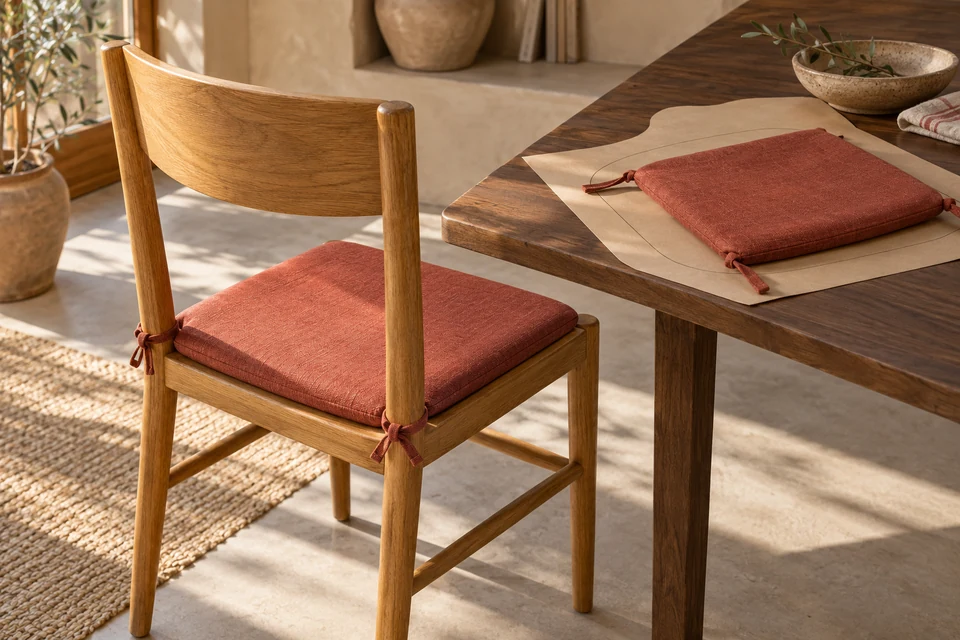
Show the proposed tie positions on the template and fit a sewn sample to the real frame. Confirm that a suitable attachment point exists at each location and that the tie does not have to cross a hard seat edge to reach it. A neat photograph from the front can hide a poor route behind the chair. Check the underside and rear view before deciding that a standard pair of ties will work.
Keep loose ends controlled under the buyer's approved setup and confirm that ties are not routed near moving parts or creating avoidable snag points. They are intended to position this pad, not restrain an occupant or lift the chair. If the selected chair cannot accept the proposed ties, review a different construction with the supplier rather than improvising a fitting in the room. Record attachment sewing through the seam specification.
- Photograph the installed attachment from the rear and underside.
- Reject a tie arrangement that needs an improvised frame route.
Control chair variants with a fit matrix
A sample that fits one chair does not approve the whole venue
List every chair model and the rooms or locations where it is used. Compare the templates before combining quantities. A small difference at the rear corners can matter even when two chairs share the same nominal front width. Decide which models truly accept the same pad and which need a separate outline or attachment layout, then identify those versions without relying on color alone.
Use a size-set approval record for the actual variants being purchased. Have the buyer sign off installed samples on representative chairs rather than accepting one loose pad as proof for all models. If the chair model changes before delivery, reassess fit. Keep a retained template and sample so a later replacement order can be linked to the original furniture rather than a memory of its size.
- Map each chair model to its approved pad version.
- Keep quantities by version visible in the purchase order.
Decide whether the entire pad or only its cover is cared for
Removable construction must be practical to remove and refit
If a removable cover is proposed, open the sample, take the filling out and refit it using the agreed handling method. Check that the opening is usable and that the pad returns to its approved shape. Do not assume a discreet zipper makes a cover removable in practice. Confirm whether the filling is intended to be cleaned, replaced or protected during the cover's care route.
Process the complete item or separate cover according to the proposed instructions, then reinstall it on the reference chair. Check dimensions, attachment reach and the covered shape again. Use the sample approval stages to keep fit, care and production identity distinct. If replacement covers will be sold or stocked, quote them explicitly and retain the filling specification against which they were approved.
Release identified units, not an undifferentiated carton
Packing should preserve the link between chair and pad
Agree whether pads are packed individually or as venue sets, and mark each package with the controlled product and chair-version reference. Check that packing does not mix visually similar outlines. If compression is proposed, examine a sample after unpacking and the agreed recovery period rather than accepting only the compact shipping appearance. State how the buyer should identify a replacement without exposing internal development notes to guests.
Ask for material, filling, sewn-version and packaging minimums separately, and confirm which sample approvals must precede delivery scheduling. Explore broader soft-home directions without assuming every chair-specific pad is an existing stock item. A focused sample enquiry to FY Bedding should contain the template, chair photographs, care route and quantities by variant, making the fit decision traceable from first sample to replenishment.
Release only the pad versions demonstrated on the actual chair models, with approved attachment routes, care and refitting results, and package identification linked to each outline.
Method references: IKEA: MALINDA example listing separate maximum and minimum pad widths.