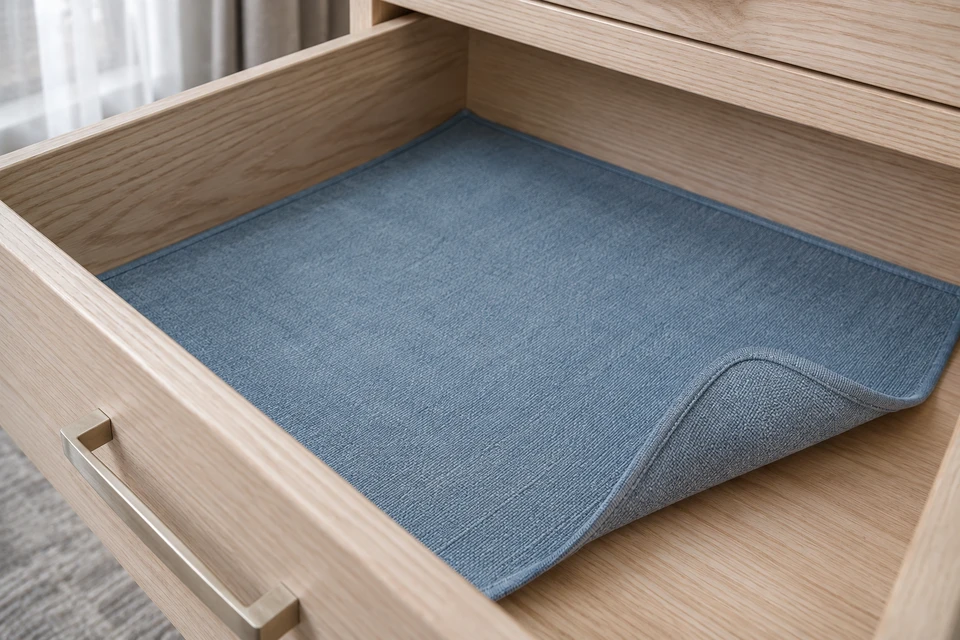
A removable textile liner should sit inside the drawer without becoming an obstacle. Approving only its flat cut size misses the practical questions: whether an edge curls into stored items, whether the drawer still closes freely and whether the liner can be removed for care.
- 1. Measure the usable interior rather than the furniture label
- 2. Identify the loose construction and both contact surfaces
- 3. Test the bound edge in the drawer, not only on the table
- 4. Check opening, closing and removal
- 5. Review care and furniture contact as separate decisions
- 6. Order by interior family and finish the pack trial
Measure the usable interior rather than the furniture label
Corners and fittings define the actual footprint
Start with the inside bottom surface of the intended drawer. Record its shape, corner treatment and any fitting that intrudes into the usable area. A furniture catalogue's external width is not a liner dimension. If a property uses several drawer models, group them by actual interior geometry before deciding whether one liner size can reasonably serve more than one model.
Agree a deliberate clearance between the liner and the drawer walls. Too little can cause the textile to bunch; a visibly large gap may conflict with the desired presentation. The right decision depends on the construction and the buyer's appearance requirements, so specify the approved relationship rather than applying a universal allowance. Include a simple full-size template or clearly dimensioned drawing when a corner is rounded or the bottom is not a straightforward rectangle.
Identify the loose construction and both contact surfaces
Do not infer non-slip or protective properties
Confirm that the item is a removable, non-adhesive textile liner and describe its proposed layers and edge finish. Inspect the underside that contacts the drawer as carefully as the visible face. A soft-looking upper fabric does not establish that the reverse is suitable for the furniture finish. If a backing, coating or gripping treatment is proposed, obtain its identity and the appropriate compatibility assessment for the actual application.
Keep marketing claims narrow until evidence is available. A visual fit trial does not prove that the liner is non-slip, stain-proof, antimicrobial or protective against every kind of scratch. The buyer may simply be purchasing a decorative removable layer. Name that limited purpose clearly and ask for any additional evidence separately. Avoid scented treatments or other additions unless the project brief specifically calls for them and their suitability has been reviewed.
Test the bound edge in the drawer, not only on the table
Curl can appear at the most inconvenient location
Lay the sample in the intended drawer without stretching or fixing it down. Observe the corners and the front edge after it has rested in the agreed condition. Check whether binding, turning or an internal layer causes an edge to lift. Record the position and extent of the lift with a side view. A top-down photograph can make a raised corner look flat, so retain both viewpoints in the approval record.
Place representative intended contents inside, remove them and observe whether the liner shifts, folds or catches. Use clean items and protect the furniture during development. The purpose is a practical handling comparison, not an improvised destructive test. If the liner is repeatedly displaced, decide whether to adjust size, construction or the use brief. Adding adhesive after approval would create a different product and should not be treated as a harmless installation shortcut.
Check opening, closing and removal
An attractive layer still needs ordinary access
Open and close the drawer with the liner and representative contents in place. Inspect the front clearance, any runner-related intrusions and the position of folded corners. Stop the trial if the textile interferes with movement; do not force the drawer shut to demonstrate fit. Check each relevant furniture variant rather than assuming the result transfers from one model with a similar nominal width.
Remove the liner using the method a housekeeper or customer would use. Note whether it comes out as a manageable piece or drags its contents into an awkward fold. Decide whether removal is intended only after the drawer is emptied, and reflect that in the care or use instructions. Any handling feature must be part of the agreed design, not a loose accessory added by a photographer to make the sample easier to lift.
Review care and furniture contact as separate decisions
A clean liner is not necessarily a compatible liner
Request a care proposal for the actual construction and assess a sample after the agreed procedure. Compare the relaxed dimensions, edge curl and layer relationship with the original condition. If the liner is not intended to be washed, make that limitation explicit and confirm the approved maintenance route. Do not extrapolate a lifetime claim from one care trial or prescribe a cleaning chemical without a material-specific basis.
Ask the responsible technical owner how to evaluate contact with the furniture finish, including any transfer or surface-change concern relevant to the materials. Keep the substrate identity in that record. A result on one wood finish does not automatically apply to painted, lacquered or synthetic surfaces. The procurement file should distinguish a decorative fit acceptance from a documented compatibility assessment, so one is not mistaken for the other during purchase approval.
Order by interior family and finish the pack trial
Reopened shape belongs in the specification
List quantities by confirmed drawer family, liner construction and colour. Ask whether the proposed fabric, backing or binding creates separate minima. Compare quotations against the same finished dimensions and pack arrangement, then reopen a sample from that pack to check whether a fold introduces an unacceptable ridge or curl. Flat supply and folded supply may produce different first-use presentations even when the sewing specification is identical.
Send FY Bedding the interior drawings, intended contents, removal expectations and quantity split through the project enquiry. Request a fit sample and a clearly scoped material proposal. A sound approval retains the in-drawer photographs, the care observations and any contact evidence alongside the dimensional record, giving receiving staff more to work with than a loose rectangle and a colour name.
Approve the liner inside the actual drawer with representative contents. Keep loose-fit clearance, edge curl, removal, care and furniture-finish compatibility as separate checks.