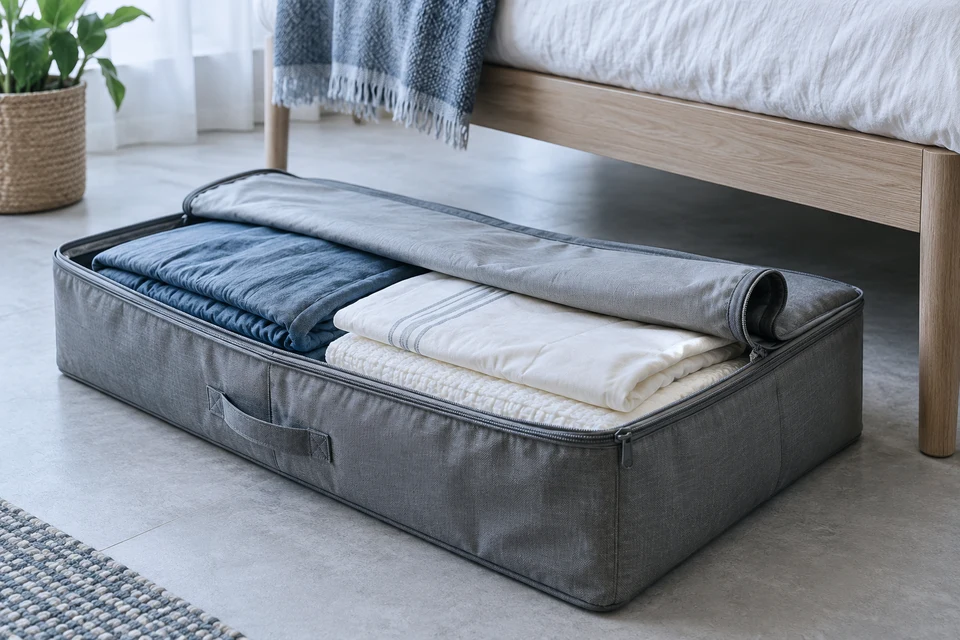
A soft-sided storage case changes shape when filled. Its advertised empty dimensions may not describe the height of the closed case or the space needed to pull it from under a bed. Buyers should develop the product around a stated bedding load and an actual clearance route. This guide concerns fabric storage cases, not vacuum compression systems or rigid furniture. It does not assume that a zipper makes the case waterproof, airtight, mothproof or suitable for long-term storage of damp textiles.
Define the load before the outside size
A capacity claim needs named contents
List the bedding items, fold sizes and condition used for the development trial. A duvet and a stack of flat sheets create different shapes even when they occupy a similar nominal volume. Photograph the loading arrangement and record whether compression or special folding was used. The repacking trial guide provides a useful starting point, while the underbed program adds a separate furniture-clearance constraint.
Specify empty dimensions and closed loaded dimensions as different observations. Measure the highest point of the filled case, not only the side-panel height on the pattern. If the retail range makes a capacity statement, keep it tied to the approved contents and avoid general claims such as fits every duvet. A change in bedding loft or case construction should trigger a review of that statement.
- Name the exact trial contents and fold.
- Record maximum closed loaded height separately.
Map the clearance route under the bed
The entry gap may be lower than the space behind it
Measure the lowest part of the route, including the bed rail, legs, center supports and any floor transition. Check the width needed to approach and turn the case, not only the open space directly beneath the mattress. Identify which furniture models the fit trial represents. The technical brief should include a simple route sketch so the maker can understand why a particular dimension matters.
Try moving the closed loaded sample through that route without forcing it under a rail or trapping a handle. Record the position of any bulge, zipper pull or seam that catches. This is a practical fit trial, not evidence that dragging is an approved carrying method. The responsible technical owner should define how the item is intended to be moved and what performance evidence is required for that handling.
- Measure the narrowest entry and turning space.
- Include handles and zipper pulls in clearance checks.
Review the complete shell and closure
Material layers determine more than appearance
Identify the outer textile, lining, any stiffener, base and transparent panel if one is proposed. Confirm the actual material description rather than inferring a woven construction from a printed texture. Record those components in the bill of materials. Ask how the case maintains its shape empty and how the seams behave when loaded with the specified contents.
Open the lid fully and check whether the user can reach the bedding without folding a sharp or bulky panel into it. Inspect the closure path for fabric capture using the actual loaded shape. The zipper approval guide supports component selection, but only a finished-case trial shows the route around corners. Avoid translating a closed appearance into an unsupported moisture or pest barrier claim.
- Identify the base and any stiffening components.
- Check the zipper around loaded corners.
Assess handling and storage condition separately
A sewn handle is not a load rating
Ask the technical owner to define the intended contents, handling routine and evidence needed for any handle claim. Inspect attachment and seam condition under that approved process. Do not assign a carrying capacity from a photograph or an informal pull. If the product is intended to slide on a floor, evaluate that interface separately from lifting; the two actions place different demands on the assembly.
State the intended condition of textiles going into storage and the care instructions for the case, subject to material review. The moisture-control discussion explains why packing and storage conditions matter, but it does not certify this case as protective. Keep observations about dust coverage, odor or surface contact descriptive unless the proposed public claim has appropriate supporting evidence.
- Define handling before making capacity claims.
- Keep storage-condition guidance within the approved materials.
Quote empty packing and loaded use as separate states
Avoid a misleading retail demonstration
Confirm whether the case is delivered folded, assembled or with removable inserts. Open the proposed retail pack and perform the ordinary setup before repeating the loading and clearance trial. Record any time or handling needed for the case to recover its intended shape. The pack-dimension review should identify the empty product pack, not the loaded demonstration dimensions.
Ask suppliers to quote the same component construction, finished size, closure and included inserts. Discuss minima for special fabric or hardware separately from the finished-case quantity. Share the intended bedding load and bed-clearance sketch with FY Bedding to scope sampling and commercial feasibility. Release only the configurations that were actually reviewed, keeping untested larger loads and furniture combinations outside the approved capacity description.
- Separate empty retail pack dimensions from loaded use.
- List exactly which inserts and accessories are included.
The useful underbed dimension is the closed loaded case moving through the actual entry route. Empty pattern measurements and a staged capacity photograph cannot replace that trial.