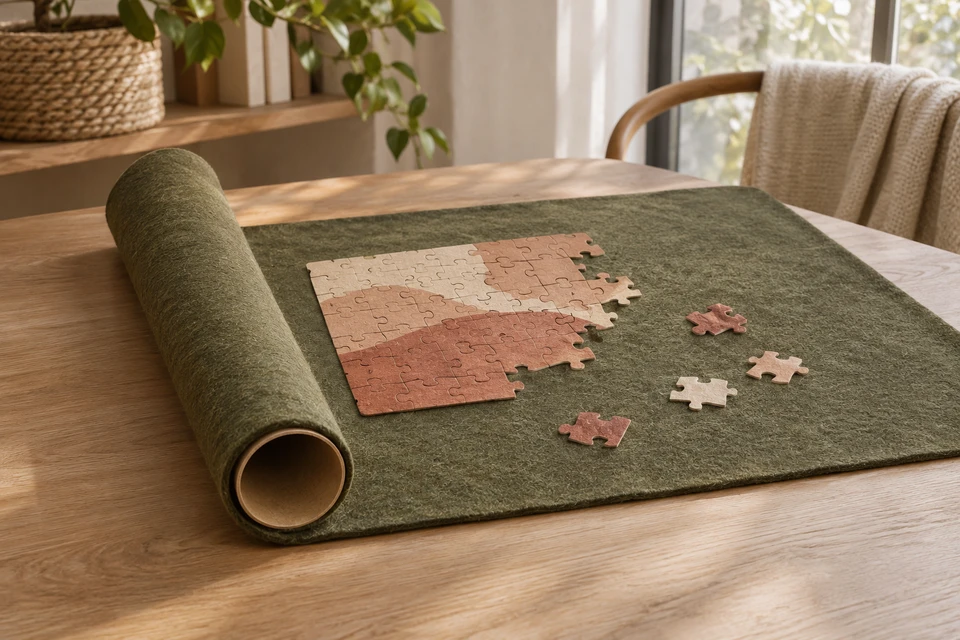
A felt puzzle roll mat is purchased for a sequence, not simply for a rectangle of fabric: build an unfinished puzzle, roll it with the supplied support, store it, then return to the layout. The useful procurement question is how much the arrangement changes through that sequence. A smooth photograph of an empty mat cannot answer it. Review the textile, cylinder, closure and instructions together, and keep claims limited to the puzzle types and conditions actually assessed. This is a development brief, not a promise that every puzzle remains perfectly undisturbed.
Define the working area and puzzle reference
Piece count alone does not establish fit
Specify the usable flat area after accounting for any border, markings or closure attachments. Record the physical dimensions of the puzzle selected for the trial rather than relying on its advertised piece count. Two puzzles with the same count can have different finished dimensions and piece thicknesses. Leave the planned starting space for rolling visible in the layout drawing. State whether loose pieces are intended to stay on the mat or be stored separately before the user rolls it.
Choose representative unfinished arrangements deliberately. One connected central patch, several disconnected islands and loose edge pieces challenge the storage sequence differently. Photograph each arrangement from above before rolling, using identifiable piece groups to make the comparison possible. Keep the puzzle reference and its condition recorded; worn or damaged pieces should not be quietly substituted during a repeat trial. Where a range is advertised for multiple puzzle formats, define which were examined and which remain outside the evidence collected.
Compare the felt surface and flatness
Approve the working textile before adding the cylinder
Lay the mat on the specified level table and allow only the preparation described in the proposed instructions. Inspect persistent folds, curled edges and local thickness changes that interfere with the working area. Ask for the actual fibre composition, thickness and edge construction. A general description such as soft felt is insufficient to identify a reorder. Review the finished edge so loose fibres or rough trimming are not dismissed as irrelevant because the product will eventually be rolled.
Move representative pieces across the surface and connect them in the trial layout. Observe excessive catching, visible lint transfer and difficulty repositioning a group, without turning those observations into unsupported performance claims. A surface that grips strongly is not automatically better if ordinary assembly becomes awkward. Compare candidate textiles using the same puzzle and tabletop. Keep the selected sample rather than relying on colour alone, because a visually similar felt can interact differently with the pieces and the rolling sequence.
Specify the cylinder and closure as components
Do not approve a mat with a borrowed support
Record the cylinder's supplied construction, usable length, diameter and assembly state. A rigid tube and an inflatable support are different offers with different setup instructions and packing requirements. If the proposed sample uses a temporary workshop tube, identify it as a development aid and obtain the production-intent component before release. Check that its working length supports the intended mat width without leaving one side of the roll unsupported. Do not infer the supplied cylinder from the concept photograph.
List closures and their positions relative to the rolled mat. Apply them using the normal method described to customers, without extra straps or improvised pressure. Inspect whether an attachment creates a concentrated ridge or forces the roll into an uneven shape. Separate the closure's role in keeping the roll together from any claim about carrying or impact protection. If a storage bag is included, describe it as a separate component and repeat the sequence with that bag rather than assuming it has no effect.
Run and record the storage sequence
Compare piece positions before corrective handling
Follow the proposed rolling direction and pace, with the selected puzzle arrangement in place. Record the cylinder, textile revision, closure setting and any person-dependent actions. Store the roll in the orientation and conditions being evaluated, with an agreed review interval. These are project trial conditions, not universal recommendations. Keep the sequence consistent between candidates so a difference in handling does not become an apparent difference in textile performance. Record exceptions instead of quietly repeating until a favourable example appears.
Unroll onto the same level surface and photograph the layout before touching the pieces. Compare disconnected islands, edge rows and loose pieces separately. Note shifted groups, lifted connections and any locations where the mat fails to return to a workable flat state. Agree acceptable outcomes with the buyer before bulk approval. Do not publish an absolute no-movement promise from one successful trial, and do not conceal a required repositioning step in promotional demonstrations. The customer-facing description should match the evidence and ordinary use sequence.
Approve the retail pack and instruction scope
Keep the demonstrated assembly reproducible
Open a production-intent packed sample and repeat the setup from the instruction sheet. Check that the cylinder, closures and textile are all present, identifiable and consistent with the retained reference. Confirm whether a puzzle is included or shown only to demonstrate use. If the mat is folded for shipping, assess the supplied condition and the stated preparation before starting the puzzle trial. A sample shipped flat cannot establish the experience of a retail product delivered with several tight folds.
Send FY Bedding the target working area, puzzle references, preferred cylinder format, quantity and packaging direction for feasibility assessment. Request a component-defined sample and a quotation that identifies what is supplied. Minimum quantities, production capability and lead time need project confirmation. Release only the textile-and-support combination that completed the recorded trial, and repeat the relevant review when the felt, cylinder, closure or packing method changes. The useful outcome is a clear evidence-bound storage offer, not a guarantee based on an attractive empty mat.
Photograph the unfinished layout before rolling and immediately after reopening; approve the actual mat, support and closure as one supplied assembly.