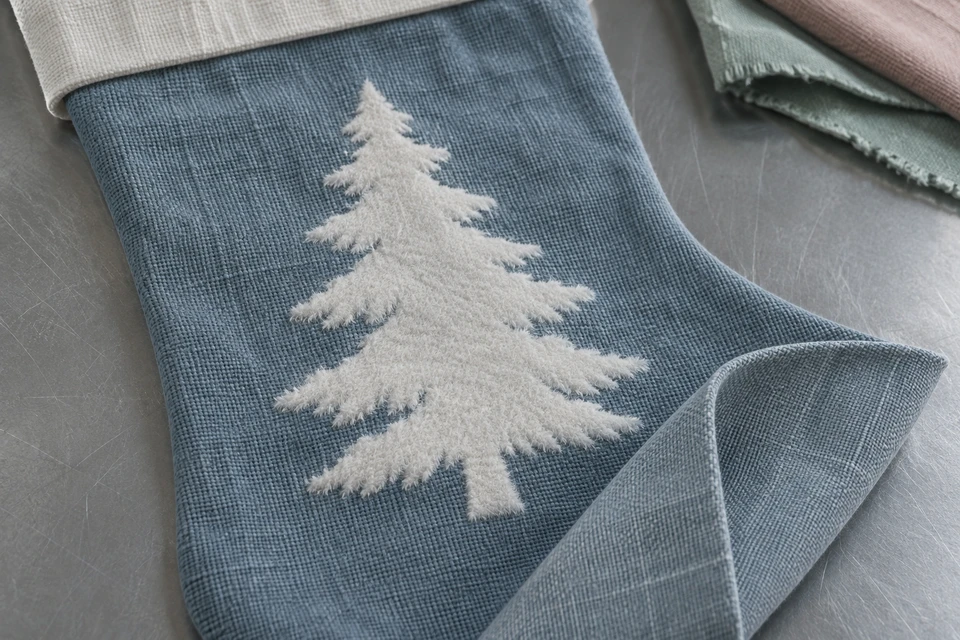
A soft tree silhouette on a Christmas stocking may be made from fibres applied to the surface rather than embroidered thread or a sewn fabric patch. For a flocked proposal, the buyer needs to identify that applied layer and how it is attached to the actual stocking material. The motif's texture is a design choice; it is not evidence of adhesion, care performance or a complete product specification.
- 1. Name the applied fibre construction
- 2. Define the motif boundary on the actual ground
- 3. Review coverage without mistaking thickness for quality
- 4. Inspect the finished stocking around the motif
- 5. Link adhesion and care evidence to the complete material stack
- 6. Put the decorative route into the commercial agreement
Name the applied fibre construction
Separate flock from an existing plush surface
The Flock Association of Europe's textile guidance distinguishes direct flocking, in which fibres are applied to an adhesive pattern, from transfer routes using pre-flocked material. This supports a useful purchasing question: what exactly is being offered on the stocking? Ask the supplier to identify the substrate, adhesive system at an appropriate product-reference level, flock material and application route. A surface that looks velvety could have another construction entirely.
Keep direct and transfer proposals as separate sample identities. Neither should be described as inherently superior without evidence relevant to the intended product. An embossed plush motif changes an existing surface; flock adds a fibre layer to the chosen area. That difference matters when comparing appearance, boundaries and the material information supplied for the finished article. Do not infer fibre composition, adhesive chemistry or regulatory status from the colour or softness of the motif.
Define the motif boundary on the actual ground
Fine branches need a production-sized reference
Use the complete intended tree, star or other original seasonal motif at its final size. Identify narrow points, small internal spaces and the transition from flocked to unflocked cloth. Ask for a strike-off on the actual proposed stocking material, not a smooth substitute chosen only because it photographs well. Examine whether the design remains legible where the underlying weave, texture or colour is visible around the applied fibres.
Agree examples of the intended edge character. A soft tactile boundary need not resemble a printed vector edge, but unintended spreading, incomplete areas or stray fibres should not be hidden behind a vague handmade appearance claim. Record those observations on identified samples under consistent lighting. If a motif is simplified to suit the process, approve the revised artwork and sample together. The original drawing should not remain the purchasing reference after the production shape has changed.
Review coverage without mistaking thickness for quality
Uniformity belongs to the chosen design
Inspect broad filled areas and small detailed areas separately. Look for unwanted changes in visible coverage, bare patches or locally different appearance, and ask the maker to explain the intended finish. Compare multiple parts of the same motif rather than approving only its fullest central section. The buyer's target may be a restrained low-profile surface, so a thicker or fuzzier sample is not automatically the better commercial option.
Keep the observations tied to the actual substrate colour and construction. A light fibre on a dark ground may reveal different visual gaps from the same fibre on a pale ground. If the collection has several colourways, review representative combinations rather than assuming that one approved motif resolves every contrast. Photographs can document the locations under discussion, but the retained material should remain available for tactile review and for distinguishing real surface variation from lighting effects.
Inspect the finished stocking around the motif
Sewing and folds are part of the supplied article
Request a completed stocking with the motif in its intended position relative to seams, the cuff and any hanging arrangement. Confirm which face carries the decoration and whether the reverse is plain. Observe the motif across normal folds and the proposed display shape. A flat strike-off cannot establish how a decorated area will appear when the product is assembled or folded into its packaging. Keep the exact assembled version identified in the approval file.
Do not interpret a decorative hanging loop or a filled display photograph as a load rating. Establish the intended use and any safety or performance evidence required for that market with the responsible specialists. Similarly, an informal handling review of the flock should not be advertised as an abrasion or shedding test. If those issues are material to the programme, agree appropriate assessments on the actual completed construction and identify the tested sample and acceptance criteria.
Link adhesion and care evidence to the complete material stack
A component document is not a finished-product result
Ask what evidence supports the intended adhesion and care claims for the offered combination of ground cloth, adhesive and flock. Review the scope of any supplied document: it should identify what was evaluated, the sample preparation and the relevant conditions. A manufacturer's general description of a flocking process does not establish that the stocking passed a particular assessment. Do not combine favourable claims from unrelated components into a promise about the finished article.
Where care is intended, retain an untouched comparison and review the same motif after the agreed procedure. Record visible coverage, boundary changes, texture and any other relevant observation separately. Leave process recipes and equipment settings to qualified production personnel. A buyer's specification should state the required finished outcome and evidence, not copy generic application temperatures or chemicals into instructions for an unverified material system.
Put the decorative route into the commercial agreement
Keep a transfer alternative visible as an alternative
Compare quotations on the same stocking dimensions, substrate, motif size, application route, finishing and pack format. Clarify whether development includes artwork adjustment, the actual-material strike-off and a complete sewn sample. Ask which colour or application choices affect minimum quantities and what remains to be confirmed. A direct-flocked proposal and a transfer proposal can be evaluated side by side, but should not share an ambiguous sample code that allows unreviewed substitution.
For the Christmas range, send FY Bedding the artwork you are entitled to use, intended ground fabric, dimensions, quantity split and proposed display context. Request confirmation of a feasible development route and current milestones without assuming stock or festive arrival. Release only the selected material stack and assembled reference. That keeps the attractive soft motif connected to a defined product rather than allowing a surface description to stand in for construction, evidence and supply commitments.
Does the approved stocking identify the ground, adhesive-applied fibre route, final-size motif and complete material evidence, with any changed application method treated as a new sample decision?
Method references: Flock Association of Europe: textile flock application routes.