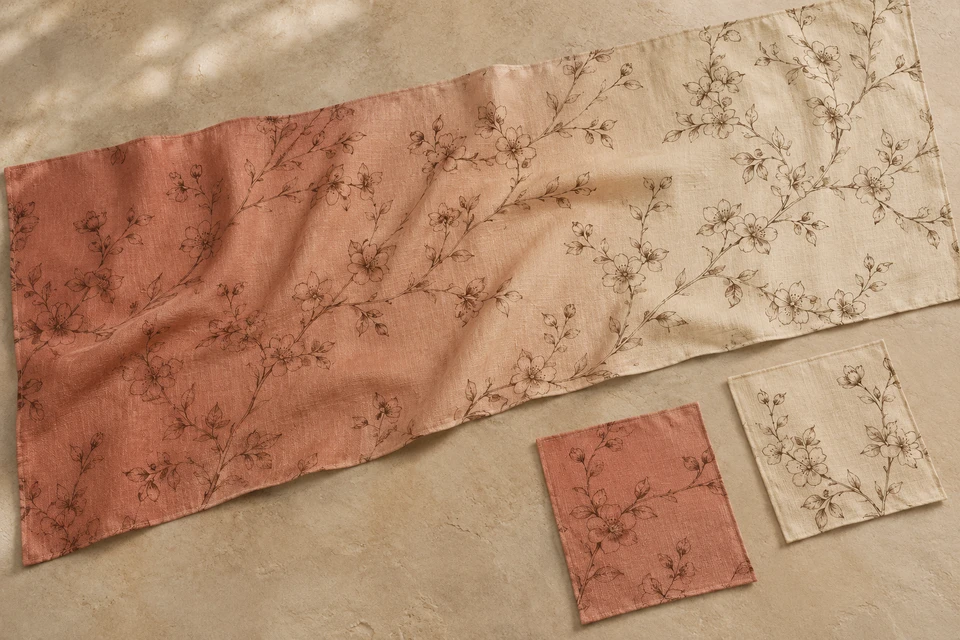
An ombre ground changes colour across the fabric rather than repeating one uniform background beneath every flower. That makes position part of the design specification. Two panels cut from different points in the transition may carry similar botanical linework yet look unrelated when assembled. For floral bedding, approve the gradient's direction, visible start and end zones and relationship to seams before cutting is released. Keep this work separate from matching a flat colour swatch: a single swatch cannot describe the whole transition or explain where it belongs on the finished bed.
Draw the transition on the finished component
Define direction from the user's view
Start with a finished duvet or pillow outline and mark the intended light and dark ends. Use a clear orientation reference such as head-to-foot or left-to-right rather than a photograph whose rotation is uncertain. Record whether the gradient runs through the full visible face or stops before a border. Include the botanical artwork on the same map so a later colour adjustment does not accidentally reverse the flowers. The buyer should be able to describe the intended bed view without relying on the supplier's screen orientation.
Identify which reference belongs to the floral direction and which defines the proposed gradient. The floral collection and a specific page such as FR-01 can anchor a design discussion, but they do not establish an ombre construction, material or production method. Treat the gradient as a separate development request unless its details are confirmed. Do not infer dyeing, printing or colourfastness performance from a photograph that merely shows a tonal transition.
Record more than the two end colours
Make the middle of the transition reviewable
Request a continuous actual-size or clearly scaled working proof showing the full change, supported by a physical fabric trial appropriate to the proposed process. Mark several agreed reference positions along its length. Compare the transition at those positions and inspect the areas between them for abrupt bands, unintended pale zones or a shift in the botanical contrast. Two attractive endpoint swatches can coexist with an unsatisfactory middle, so the endpoints should not be the only retained colour evidence.
Agree how the sample is viewed and photographed. Keep lighting, surface and orientation consistent when comparing revisions, and retain the physical reference rather than relying only on compressed images. Describe observations without inventing universal colour tolerances. If instrumental colour limits are required, have the responsible technical parties define the measurement approach for the relevant positions and material. A continuous gradient is not well described by a single pass-fail colour name, and a generic statement that it matches the approved coral leaves too much unspecified.
Resolve joined and paired panels
Decide where continuity matters and where variation is allowed
Place the proposed panel boundaries on the transition map. If a seam joins two pieces, identify which gradient positions meet and compare the assembled junction. Decide whether visual continuity is required across that seam or whether a deliberate break belongs to the design. The cutting team needs a repeatable location rule, not an instruction to choose pieces that look close enough. Keep the fabric direction and the ground-colour position together so the two are not independently corrected into an incompatible arrangement.
For pillow pairs, determine whether they should match each other, mirror the transition or occupy deliberately different tonal zones. Show the choice on a made-bed mock-up. Compare that relationship with the duvet rather than approving each component in isolation. If several bed sizes are offered, decide whether the same visible transition is rescaled or whether the larger size exposes more of it. Record the intended option for each size. A larger panel should not silently acquire a darker end simply because it requires more cloth.
Ask for a cutting and quotation proposal
Connect the visual choice to usable material
Give the supplier the preferred map and ask how it can be produced and cut with the proposed material. Request an explanation of any restricted zones, panel placement requirements or unused portions that affect yield. Keep that discussion distinct from a general usable-width calculation: the cloth may be physically wide enough while only part of the gradient is suitable for a particular component. Ask whether the planned quantities and size mix can be accommodated before treating a sample layout as a bulk commitment.
Compare alternatives transparently if the preferred transition creates a difficult cutting plan. A modified gradient length, a changed panel relationship or a smaller assortment may have different consequences. Ask for those differences in the quote and sampling scope without assuming any saving or minimum quantity. Preserve the approved visual map alongside the commercial offer. If a later order changes the balance between sizes, review the affected layout and material allocation rather than assuming the first programme's cutting arrangement remains appropriate.
Confirm the complete set and retail view
Prevent a correct swatch from becoming a mismatched product
Review the assembled sample on a bed with its orientation stated, then inspect paired pieces and seam junctions closely. Photograph the full transition before folding the set for the proposed pack. Decide which tonal zone is visible in the pack window or top fold so it represents the contents honestly. Keep the pack image, product description and approved sample linked. A pale folded corner should not be used to imply that the entire duvet has a pale uniform ground when the design intentionally becomes darker.
Send FY Bedding the gradient map, botanical reference, component dimensions, quantity mix and preferred material direction for development review. Request confirmation of feasible processes, sample timing, MOQ and the evidence needed for intended care or market claims. No specific process, stock or test result is established by the illustration. Release cutting only after the supplier and buyer agree where every panel belongs within the transition and how a changed material, layout or colour revision will be reapproved.
Approve the complete transition and its panel map; two endpoint swatches alone cannot define an ombre bedding set.