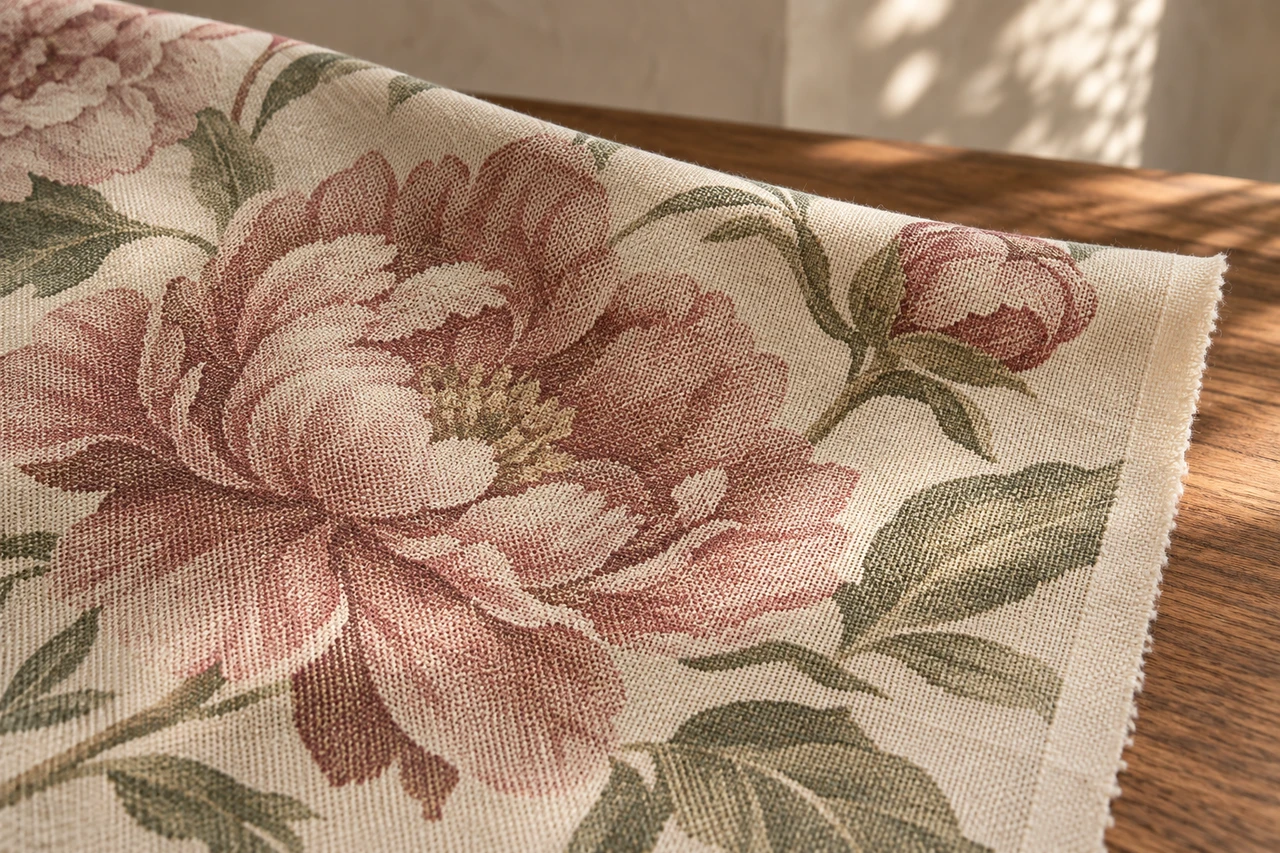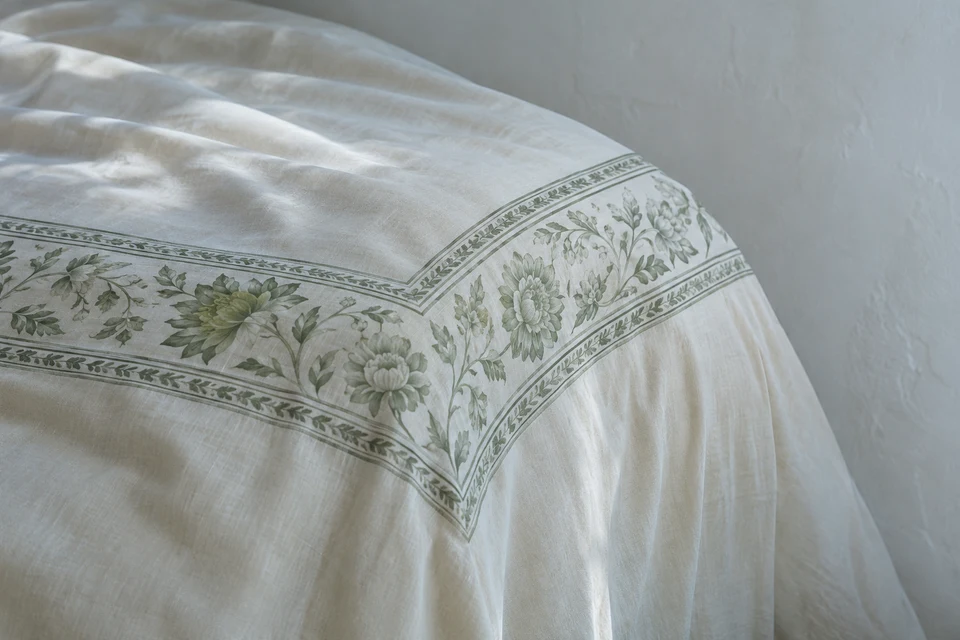
A floral border is more than four straight strips placed around a rectangle. At each corner, stems, leaves and blooms must either continue, meet deliberately or stop at a designed junction. The decision becomes more visible when a collection spans several bed sizes. Extending a straight run may be simple, but stretching the entire artwork can change the flowers and distort the corner. Buyers should decide the corner language before approving a full size range, keeping the visual design separate from the chosen manufacturing route.
Choose the corner relationship
Continuous branch or a deliberate junction
Compare two useful approaches at the intended scale. In one, a botanical line appears to turn around the corner. In another, the straight borders meet a separately composed corner flower or leaf cluster. Neither is inherently better; the choice depends on the design's rhythm and the desired amount of emphasis at the perimeter. Ask for a clearly marked corner study rather than approving only a long straight section of the print.
Use the FY Bedding floral collection and a reference such as FR-01 to discuss visual direction, not to assume an existing product has this border construction. Confirm authorised artwork and the proposed textile process for the specific project. A reference photograph does not establish the fabric, printing method, stock status or availability of a matching border variant. Those details need a separate supplier response.
Keep botanical direction intentional
Resolve stems before adjusting the rectangle
Follow the line through each corner and identify which way flowers face. A straight border rotated into a second side can create a natural turning effect, but it can also produce an abrupt collision of stems or an upside-down bloom. Review all four corners, not only the one shown in the hero image. If the top edge is deliberately different from the sides and foot, make that distinction visible in the approval drawing.
Mark the start and end of each repeating segment. Where the available length does not fit an exact number of repeats, ask how the remaining space will be resolved. Options may include a revised spacing rhythm or a separately drawn transition, subject to the offered production method. Avoid accepting an unexplained compressed flower near a corner simply because the outer border dimensions are correct. The botanical transition is part of the artwork decision.
Prepare size-specific layouts
Do not enlarge every flower with the bed size
Place each required finished size in a common review sheet with the motif scale stated. Compare the border width, distance from finished edges and location of corner features. Decide which properties remain constant and which may change deliberately. A larger bed may need more repeated elements along the sides rather than larger flowers everywhere. Conversely, a collection may intentionally change scale, but that choice should be explicit and sampled accordingly.
Check the smallest and largest layouts first, then review the intermediate versions for unplanned compromises. Retain the same corner identifiers across the size set so comments can be traced precisely. A note such as the bottom left leaf is crowded should identify the size, artwork revision and actual corner. Without that structure, a correction to one size can be copied into another where the spacing problem never existed.
Review the finished edge and bed drop
Flat layout and visible placement answer different questions
Identify the finished seam or hem boundary on the artwork. Check which parts of the border will remain on the top surface and which will fall over the side or foot of the bed. The intended corner may be visually interrupted by the mattress corner even when it is perfectly drawn. Use a representative made-bed trial to decide whether that interruption supports or weakens the desired framed appearance.
Separate artwork continuity from sewing alignment. A seam that cuts through the border creates a construction question; a continuous printed panel with an awkward botanical turn creates a design question. Record them independently so the proposed correction addresses the cause. If a supplier offers a sewn border instead of a printed frame, review the junction and quotation as a changed construction, not an equivalent interpretation requiring no further approval.
Release the border as a complete layout system
Keep size, corner and sample references together
The approved set should identify each finished size, artwork file, corner treatment and relevant physical sample. Include full-panel views and corner details, with the intended top and face clearly recorded. Ask the inspection team to check both the complete frame and the specific botanical transitions. Measuring overall dimensions alone cannot confirm that the corner artwork remains the released version.
Send FY Bedding the size matrix, selected corner approach and target material direction for a development discussion. Ask which sizes need physical sampling and what preparation or minimum quantities apply to the proposed route. Keep timing subject to those approvals and do not promise an unconfirmed delivery date. The useful outcome is a family of correctly resolved layouts, not one attractive master image that leaves the other sizes to be improvised during production.
Approve each size with its own border layout, all corner transitions and the intended finished-bed view; do not treat a stretched master as a size set.