A thread stretching between two embroidered flowers can be an intended stem, an unwanted connection or a feature of an unfinished sample. Those are different purchasing decisions. A buyer who asks only for a clean floral design may approve the drawing while leaving the finishing condition unresolved. Define which connecting lines belong to the botanical composition and which must be absent from the delivered article. Then inspect a finished sample that represents the actual proposed work, not only the stitch preview.
- 1. Start with the lines the designer intends to keep
- 2. Ask what stage the sample represents
- 3. Inspect the face without confusing thread with artwork
- 4. Turn the article over before accepting the finish
- 5. Compare a corrected sample at the same locations
- 6. Put finishing into the purchasing conversation
Start with the lines the designer intends to keep
Mark relationships between separate flowers
Give the design owner a full-size illustration and ask them to mark the intended stems, tendrils and decorative connections. Include isolated buds that should have clear ground around them. A thin line can be visually important even when it is small in the overall bouquet. Do not let an inspector decide that every fine connection is waste, or assume that every thread visible on a trial is part of the design. The purpose of the marked drawing is to remove that ambiguity before production review.
References from FY Bedding's floral collection can guide the botanical mood, but a photograph of a printed or otherwise unspecified product is not an embroidery instruction. If FR-01 is used as a visual starting point, develop and approve a separate embroidery interpretation for the project. Record the finished motif size and intended ground. Keep this article's question narrow: whether a particular connection is intentional. The separate decisions about simplifying small buds, selecting backing or placing a bouquet still need their own approvals.
Ask what stage the sample represents
Machine output and finished goods are not interchangeable
An embroidery machine can move between separated stitched areas, leaving thread that needs appropriate trimming or finishing. Brother's documentation shows that jump-thread trimming depends on data settings and the particular machine, and that colour-end trimming is a separate function. This is a reason to ask about the proposed process, not a recommendation for a universal setting or evidence that FY Bedding uses a particular machine. A statement that trimming is automatic does not describe the appearance of the supplied sample.
Ask whether the trial is shown directly after stitching, after a finishing operation or in the condition intended for packing. Retain that answer with the photographs. If the quotation assumes additional finishing, request a sample after that step. If it excludes it, clarify the commercial and quality implications before comparing prices. The buyer should not silently approve an unfinished trial as the delivered standard, nor reject a process-development piece as defective without understanding why it was supplied.
Inspect the face without confusing thread with artwork
Review the spaces as well as the flowers
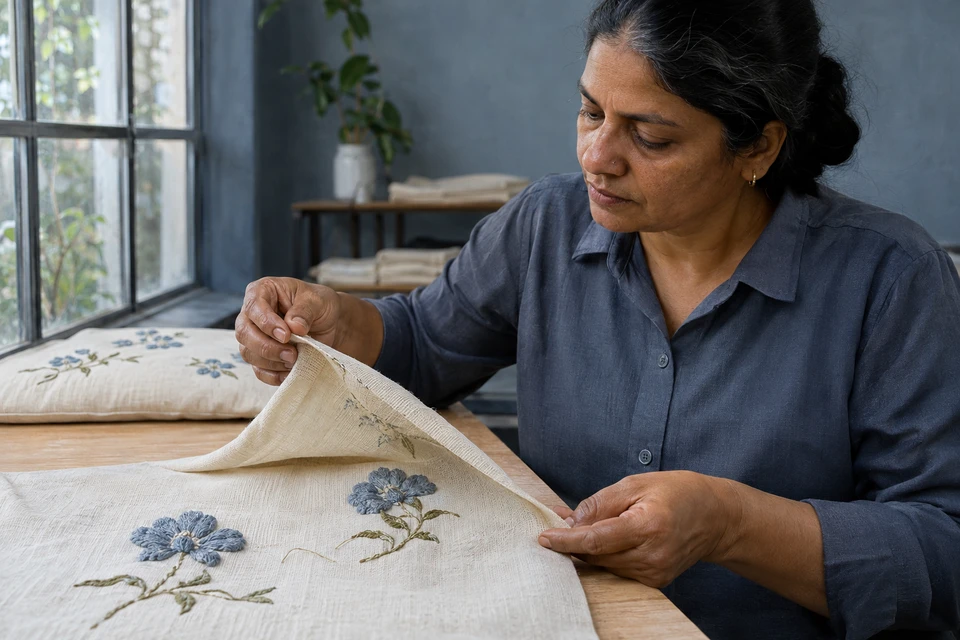
Lay the sample naturally on a contrasting support that makes the ground visible without stretching the embroidery. Compare it with the marked design. Look between separated buds, across an open centre and along the edge of each branch. Identify a questionable connection by its two endpoints and photograph it close enough to distinguish the stitched botanical line from a loose bridge. Include a wider view so the technician can locate the same feature within the composition.
Write a specific observation such as a connection between two isolated flower heads that is absent from the approved drawing. Avoid using a vague instruction to remove all excess threads. Do not pull or cut an unidentified thread during the buyer review; have the responsible technician determine its role and the appropriate correction. Unauthorised trimming could alter a genuine stem or damage the sample used for comparison. Preserve an untouched example when investigating a recurring difference, then review a separately corrected piece.
Turn the article over before accepting the finish
Decide how the reverse will be encountered
The reverse may be accessible on a napkin, concealed within a cushion or partly exposed when bed linen is handled. Record the actual article construction before deciding what finish evidence is relevant. Photograph the same motif from both sides and ask the supplier to identify remaining thread connections. A neat face does not establish how the reverse has been finished, and a backing layer does not explain every thread visible around it. Keep the two observations separate in the sample record.
Agree the appearance expected at the proposed delivery stage, including any reverse areas that remain visible or accessible. Ask for project-specific handling and care evaluation where necessary, with the method and outcome recorded rather than assumed. A photograph can show a thread connection; it cannot establish durability, skin comfort or suitability for every use. If the proposed construction changes to conceal the reverse, review that as a construction revision, including its effect on the article, rather than treating it as proof that the original finish was acceptable.
Compare a corrected sample at the same locations
Resolve the cause before multiplying the bouquet
Request a revised trial that retains the motif size, ground and thread specification unless the correction requires a declared change. Revisit each marked location. Confirm that unwanted connections have gone and intended stems remain continuous in the approved way. Examine nearby ground for visible damage introduced during correction. The approval should describe the resulting finished appearance, not dictate a machine setting that has not been validated for the supplier's equipment and design data.
If several sizes or floral arrangements are ordered, identify which ones the corrected sample actually represents. A change that resolves travel between widely separated flowers does not automatically settle every smaller branch or denser layout. Ask the supplier to explain the scope of the revision and propose a proportionate sampling check. Retain the original issue, corrected face and corrected reverse together. That set is more useful at receiving than a single attractive photograph with an unqualified approved stamp.
Put finishing into the purchasing conversation
Name the sample and the delivery condition
An enquiry to FY Bedding should include the authorised floral artwork, intended connected and isolated elements, article type and the finish condition you want evaluated. Request confirmation of feasible sampling, quantities and any finishing work included in the quotation. Where the production route is not yet confirmed, describe the required result rather than implying a capability. Schedule approval time for the finished trial and ask how a correction would affect subsequent work; no generic festive or retail deadline proves capacity.
At release, link the purchase specification to the approved sample revision and the marked connection map. At receiving, use that map to recognise intended botanical lines instead of treating every fine thread as a defect. Record deviations by location and finished condition so that the supplier can respond to the actual concern. This keeps aesthetic approval and workmanship review connected without allowing either one to replace the other.
Approve a marked map of intentional floral connections, then compare the finished sample's face and reverse; do not use a stitch preview or an automatic-trimming claim as the delivery standard.
Method references: Brother: model-dependent jump-thread trimming.