A floral tile can look balanced on its own and form unwanted stripes when repeated. Before deciding where to cut a duvet panel, review the larger field created by the repeat itself; cutting cannot reliably hide a band that continues across every copy.
Confirm how the repeat is meant to be assembled
Do not apply the offset twice
Spoonflower's repeat guidance describes a half-drop as a vertical half-step between neighbouring columns. That is a useful visual distinction from a basic grid or a horizontal half-brick arrangement. In a buying brief, however, the important question is how the particular artwork has been supplied. A file may be one tile intended for an offset setting, or an already assembled repeat unit that should subsequently be tiled on a basic grid.
Ask the artwork provider for a reference layout showing adjacent copies and the exact intended repeat dimensions. Confirm the setup with the proposed printer before ordering a strike-off. Applying another half-drop to an already resolved unit can create an unintended layout. Keep the reference assembly beside the production file so the recipient does not have to infer the arrangement from the word seamless in a filename.
Expand the view beyond a single tile
Judge the rhythm at the finished flower scale
Build a layout broad enough to represent the intended bedding face and long enough to show several neighbouring repetitions. Keep the flowers at their proposed physical size. A reduced overview is useful for finding large-scale rhythm, while a full-size crop is needed for detail; identify which view is being reviewed. Do not enlarge the entire layout to fill a presentation slide and then mistake that display size for the fabric scale.
Look for lines formed by similar flower centres, repeated gaps, parallel stems and dark leaf clusters. These can create a perceived stripe even when tile edges join smoothly. View the field from a distance comparable to a room view, then return to the individual motifs to identify the cause. Record whether the rhythm is intentional. A deliberate diagonal movement may suit the range, while an accidental vertical channel may conflict with the desired scattered-garden effect.
Inspect the joins and the internal rhythm separately
Seamless edges are only one part of approval
Check all tile boundaries, including the corners where several copies meet. Look for clipped stems, repeated partial flowers and changes in ground tone. Then inspect the interior of the tiled field without concentrating on the boundaries. This second pass matters because an obvious band can be created by motifs wholly inside each tile; correcting an edge alone would not remove it.
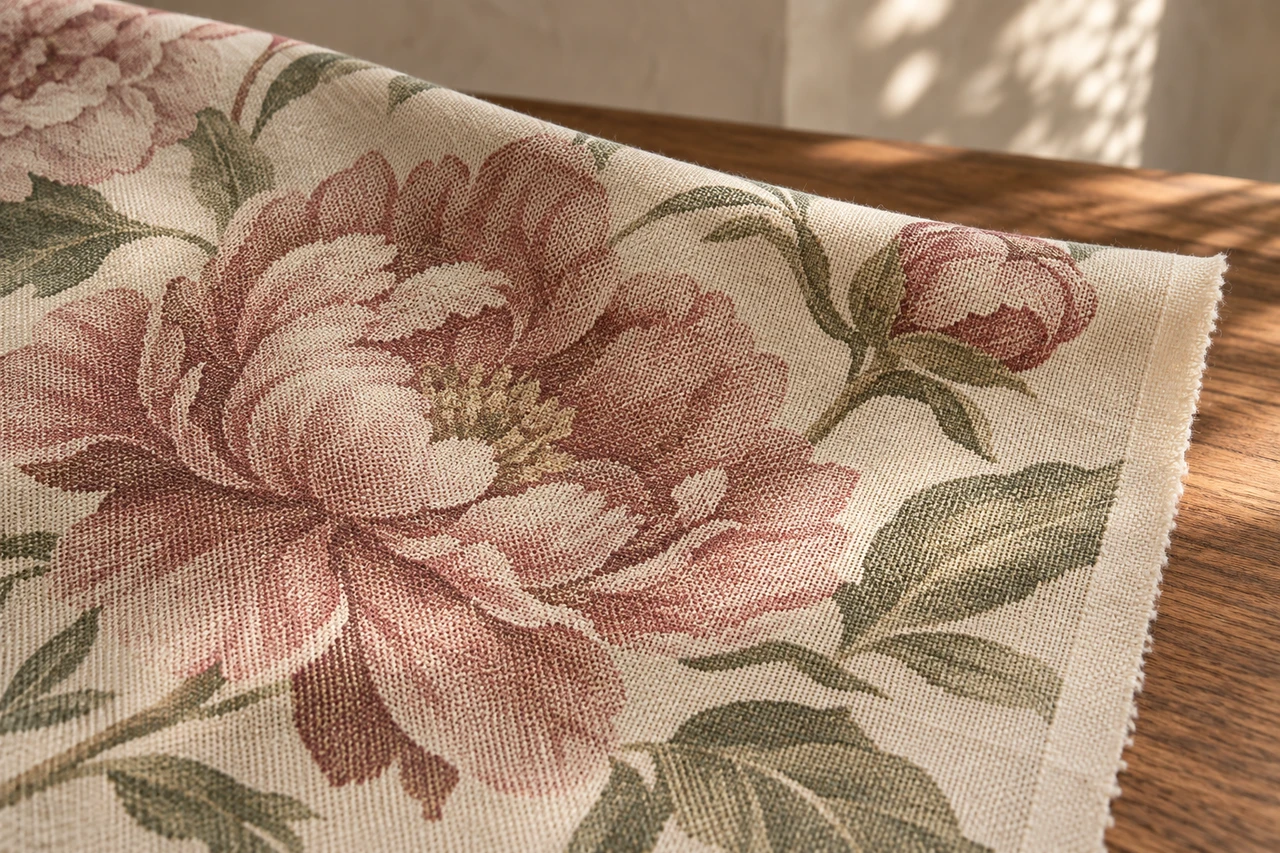
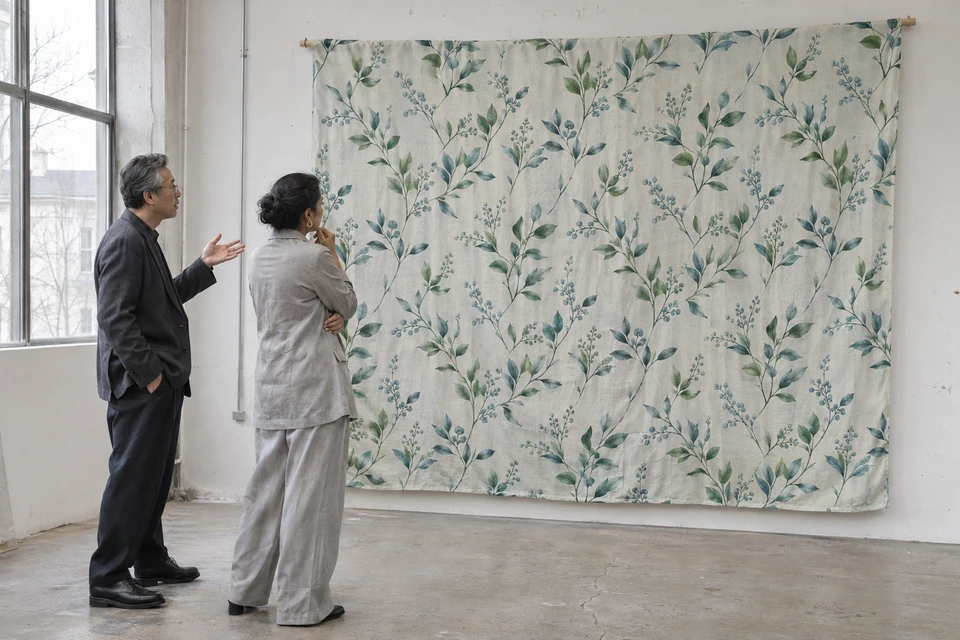
Use the floral collection and FR-01 as visual discussion references, not as evidence of a particular repeat construction. The actual authorised project artwork must establish its own layout. An editorial photograph can communicate the kind of review being performed, but it does not prove that the shown pattern is a technically approved production repeat.
Make a targeted artwork revision
Move the cause rather than disguising the symptom
If a line of dark blooms is responsible for a band, ask the designer to propose a bounded change to those elements. Keep the flower scale and general palette stable while evaluating the result. Shifting every motif, changing the background and reducing contrast at the same time can produce an attractive alternative without revealing whether the original problem was solved. Compare the revised field with the earlier one at the same dimensions.
Review the new tile boundaries after any internal edit. Moving a motif close to an edge may require corresponding changes to its continuation, and a fix for one band may create another rhythm elsewhere. Maintain a small set of named alternatives with the specific purpose of each. Once a direction is selected, remove superseded previews from the manufacturing handoff while retaining them in the private development record.
Print enough area to see the relationship
A tiny strike-off cannot settle a large-field question
Agree the strike-off area with the supplier according to the repeat dimensions and the problem being checked. A crop showing one flower is useful for colour and detail but cannot prove the larger layout has no unwanted bands. If a full-width sample is not available at an early stage, record that limitation and keep repeat-field approval open. Do not turn a partial sample into an unrestricted production release.
Review the sample under the intended viewing conditions and compare the actual printed repeat dimensions with the approved layout. Keep print execution and artwork arrangement as distinct observations. A visible line caused by a production issue requires a different response from a deliberate but unwanted line in the design. Ask the responsible technical team to investigate the cause rather than requesting an unqualified colour adjustment that may leave the layout issue unchanged.
Only then move to pillow and duvet cutting
Product placement is the next decision, not the same decision
After accepting the repeat field, apply the proposed pillow and duvet windows at the agreed scale. Decide which motif crops and orientations are acceptable for each product. This downstream placement check should not reopen the entire pattern casually; if it reveals that a central element is unsuitable, document the resulting artwork change and repeat the affected field review. The two approvals must remain connected but separately identifiable.
For a quotation discussion with FY Bedding, send the authorised tile, assembly reference, intended repeat size and a marked full-field preview through the project enquiry. Add the product sizes, quantity structure and the exact concern you want sampled. This gives the supplier a clearer development scope than a request for a more natural floral repeat, and it avoids attributing unconfirmed printing methods or materials to an existing reference product.
Approve tile assembly, boundary continuity and large-field rhythm separately. A seamless tile is not enough: view several repeats at the intended flower scale before moving to product cutting.
Method references: Spoonflower: Repeat options.