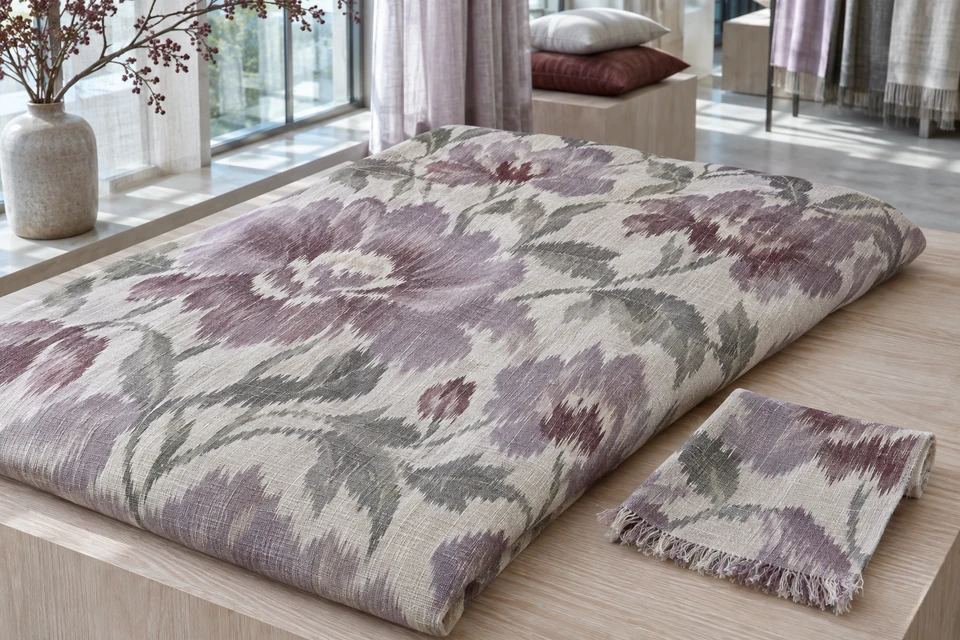
A softly feathered flower can suggest ikat without identifying how it was made. When sourcing floral bedding, distinguish a pattern placed in yarn before weaving from a print that interprets the same visual effect. Both may be design options, but they should not share an ambiguous construction description.
Ask which yarn system carries the pattern
Warp, weft and double ikat describe different proposals
The Australian Museum explains ikat through yarns bound to resist dye before weaving and distinguishes warp, weft and double-ikat routes. That definition supports a specific supplier question: which yarn direction has been patterned in the offered cloth? Ask the maker to identify the route and connect the answer to the submitted material. Do not infer it solely from a blurred-looking edge or a regional name in a mood board.
Record the construction independently from the flower drawing. A floral design can be woven from patterned yarns, printed onto already woven cloth or developed through another textile method. Keep those alternatives clearly labelled during sampling. If the supplier offers an ikat-look print, describe it as that alternative rather than treating it as a hidden downgrade or calling it genuine ikat without evidence. The buyer should choose the route knowingly, using the actual requirements of the collection.
Request evidence that relates to the offered cloth
A loose yarn photograph cannot identify a finished lot
Ask for an appropriate construction explanation and available development references showing the patterned yarn system associated with the sample. The technical reviewer may need a close examination of the cloth and its yarn directions. Keep any yarn-stage photographs tied to the actual material reference and supplier record. An attractive image of bound yarn somewhere in a supply chain is not enough to establish how this particular fabric was produced.
Where the evidence is incomplete, keep the process description provisional. Avoid making origin, handcraft, cultural-authenticity or sustainability claims merely because ikat has a recognised craft history. Those statements need their own documented basis and authorisation. The practical buying file should distinguish confirmed facts, supplier proposals and the visual direction being explored. That separation lets the team continue development without publishing a stronger claim than the available material evidence supports.
Define the intended feathered boundary
Distinguish design character from uncontrolled variation
Choose the flower outlines and colour boundaries that matter to the design, then compare their appearance on the proposed cloth. Record the degree and direction of feathering the buyer accepts using physical examples. A general request for a blurry flower is too vague for receiving inspection, while a digitally sharpened reference may contradict the intended character. Ask the maker to explain realistic consistency for the nominated construction and size rather than imposing an arbitrary universal tolerance.
Examine more than one repeat and more than one position in the sample length. Note where a petal loses its identity, adjacent colours merge unexpectedly or a stem no longer reads as intended. These observations should be related to the agreed design, not used to claim that every irregular boundary is defective. If a more controlled printed interpretation is proposed, review it as a separate route with its own accepted reference and product wording.
Carry yarn direction into the bedding layout
Turning a panel can change the design's reading
Mark the intended fabric direction in the development record and show how the floral repeat sits on the duvet cover, pillowcase or other selected item. Check whether the planned cutting orientation preserves the desired direction of the pattern character. A small square swatch can hide this issue because it is easy to rotate on a desk. Once the cloth becomes a long bed panel, the directional relationship is more visible and harder to treat casually.
Ask the supplier to show the proposed panel arrangement before approving the complete set. Compare the face, foldback and paired pieces in the intended use state. If different products need different orientations or repeat placements, record them explicitly instead of demanding that every flower occupy an identical position. Keep any matching requirement within the maker's confirmed scope and quotation. A coordinated set should have a deliberate visual relationship, not an assumed cutting rule inferred from a staged bed photograph.
Approve colour and care on the finished construction
The technique name is not a performance result
Request the declared fibre composition and completed finishing route alongside the construction identity. Then agree the colour and care evidence appropriate to the intended bedding use and market. The fact that yarns were patterned before weaving does not, by itself, prove colourfastness, strength or dimensional stability. Use identified finished samples and relevant assessments rather than transferring an expectation from another ikat fabric or a museum object.
Review appearance after the agreed care procedure, documenting the same motif locations where possible. Separate changes in shade, dimensions and pattern reading so the maker can investigate them usefully. If a new yarn source, dye route or finish is proposed, decide which parts of the evidence need repeating. A similar first impression does not automatically make a revised construction equivalent to the original approved material, especially when several products in the bedding set depend on it.
Compare quotations by the chosen patterning route
Keep the reference image separate from the order standard
Ask each supplier to quote a named construction and finished-product scope, including sample stages, minimum quantities and any limits on repeat placement. Identify whether a price concerns fabric length or sewn bedding, and which development work remains unresolved. Do not infer a fixed premium or lead-time difference between ikat and print from the names alone. The useful comparison is between complete, supported proposals for the same intended product and quantity structure. The FR-01 floral direction can support a botanical design discussion, not establish ikat yarn preparation or weaving.
For FY Bedding, provide the authorised floral direction, preferred construction route, sizes, market and the features that must remain recognisable. Request confirmation of feasibility before describing any reference style as available in ikat. Keep the selected physical material and assembled sample as the order standard, while retaining the original image only as the design starting point. This allows retail copy, photography and reorders to describe what is actually supplied rather than what the early reference appeared to suggest.
Identify the patterned yarn direction or label the proposal as an ikat-look print. Link construction evidence, accepted boundary character, cutting orientation and finished-product care to the same material reference before ordering.
Method references: Australian Museum: resist-dyed yarns in ikat.