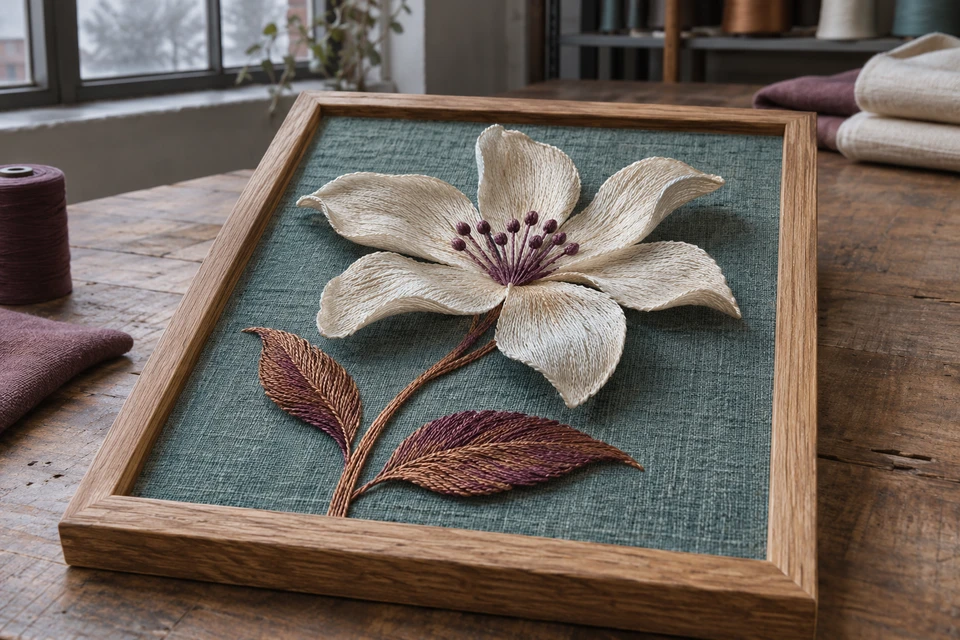
Raised embroidered petals can give a floral wall panel depth that a flat photograph cannot fully explain. Before approving a decorative range, buyers need to establish how those petals are formed, attached and protected, including any internal supports hidden inside the finished work.
Keep the intended product explicit
A decorative panel is not a bedding-contact specification
This development brief concerns decorative wall panels. It should not automatically be extended to pillowcases, bedding or products intended for frequent body contact. Raised elements and concealed supports introduce questions that differ from those for a flat printed fabric. State where and how the panel will be displayed, whether it will be framed, and who is expected to handle it. Ask the supplier to assess the proposed construction against that use and the requirements of the intended market.
Stumpwork is a raised embroidery direction, not a complete bill of materials. The Royal School of Needlework's illustrated project demonstrates one approach using separately worked, shaped elements, including wired forms. That example does not mean every stumpwork petal contains wire, or that a supplier's proposed panel uses the same method. Ask the maker to identify which elements are detached, which are worked directly on the ground, and whether any shaping support is used. Keep the answer attached to the sample revision.
Request a construction view before enclosure
Understand the petal beneath its finished face
A finished petal may conceal its edge treatment, support and base attachment. Ask for a suitable intermediate sample or documented construction view that explains those features before the backing or frame makes them inaccessible. The purpose is to understand the proposed product, not to prescribe a craft recipe from an unrelated tutorial. Identify the materials that remain inside the finished panel, including any stiffening component, and distinguish them from temporary tools or supports removed during production.
If wire or another rigid support is proposed, ask how its ends and edges are contained and what evidence is required for the intended use. Do not accept a general assurance based only on the absence of visible metal in a front photograph. At the same time, do not invent a universal wire specification or imply a safety certification that has not been obtained. The supplier should provide a construction-specific explanation and the appropriate assessment; the buyer should retain it with the approved article rather than treating it as informal correspondence.
Approve attachment at the petal base
A convincing shape still needs a defined connection
Examine where each detached element joins the ground or another embroidered component. A petal can have a beautifully worked edge yet sit awkwardly because its base is attached at the wrong angle. Review the full flower from the front and from a low side view, then inspect the relevant attachment area. Decide which petals should lift, which should overlap and where the ground should remain visible. Record these relationships in a physical sample rather than relying on a single dramatic lighting angle.
Discuss ordinary handling with the maker and agree what checks are appropriate for the completed panel. Any observation should identify the sample and the condition used; it is not a general strength rating. If the buyer notices a loose-looking base or an exposed support during review, isolate the concern and request a revised construction for assessment. Do not solve it by simply pressing the petal into a flattering position for photography. The approved appearance must be the one the assembled product can reasonably retain under its agreed conditions.
Judge relief with the intended frame
Clearance changes the finished flower
Place the sample in the actual proposed frame or a representative frame construction. Check the depth available above the highest petal and the relationship to any glazing, backing or spacer. A flower that looks balanced on an open worktable may be compressed when enclosed. Conversely, a much deeper frame may change its visual presence. The frame specification and embroidery approval should be connected, so a later frame substitution cannot silently alter the accepted relief.
Review the wall-facing and side-facing presentation too. Ask how the panel is secured within the frame and which components are included in the supplied product. Mounting hardware, if any, needs its own clear declaration and assessment for the intended installation. Do not infer that a photographic frame is part of the quotation. Separate styling props from actual supplied components in the sample record and product description. This prevents a collection image from promising an assembly that has never been costed or approved.
Design packing around the approved volume
Avoid flattening the product to fit an assumed box
Review the packed panel with its complete raised structure, not a flatter development sample. Ask how the proposed packaging keeps other components from resting on the petals and how the buyer will remove the item. Examine the unpacked presentation after an agreed evaluation of the pack. That review can reveal a need for a different support or clearance, but it should not be presented as a universal transport guarantee. The packaging evidence must relate to the actual product and distribution plan.
For a coordinated range, record whether every floral variant has the same relief envelope. A taller flower may need a different packing arrangement even if the outside frame dimensions are unchanged. Clarify the cost and quantity basis of those differences before grouping the products under one retail pack. Do not approve a low-relief sample and assume that a later, more sculptural version will fit the same packaging. Changes to petal shape, attachment or frame depth should trigger a review of the packed configuration.
Make the floral reference a starting point
Freeze the developed object before placing quantities
Existing floral imagery can help a buyer communicate a botanical mood, colour balance or petal character. It cannot establish that the referenced style is made with detached embroidery, wire or a particular ground fabric. Keep the authorised design direction separate from the new construction proposal. For each developed panel, retain the final physical sample, declared materials, intermediate construction record, frame configuration and packing reference. Any product-page claim should be traceable to those project-specific facts. Use FR-01 for a botanical discussion only; the raised-panel construction remains a separate development proposal.
Ask the supplier to confirm sample charges, minimum quantities and timing for the selected arrangement of raised elements. A more elaborate flower is not merely a colour variation if its construction changes. FY Bedding can review a brief containing the desired decorative use, panel size, botanical direction and quantity split, then discuss the evidence needed for a feasible proposal. Until those details are confirmed, do not describe the concept as a stocked item, an existing technique used by a displayed collection, or an independently certified finished product.
Approve detached elements, declared supports, enclosed ends, base attachment, frame clearance and packing as one assembly. Keep this decorative-panel approval separate from any proposed use on bedding or other body-contact products.
Method references: Royal School of Needlework: an example of raised detached embroidery elements.