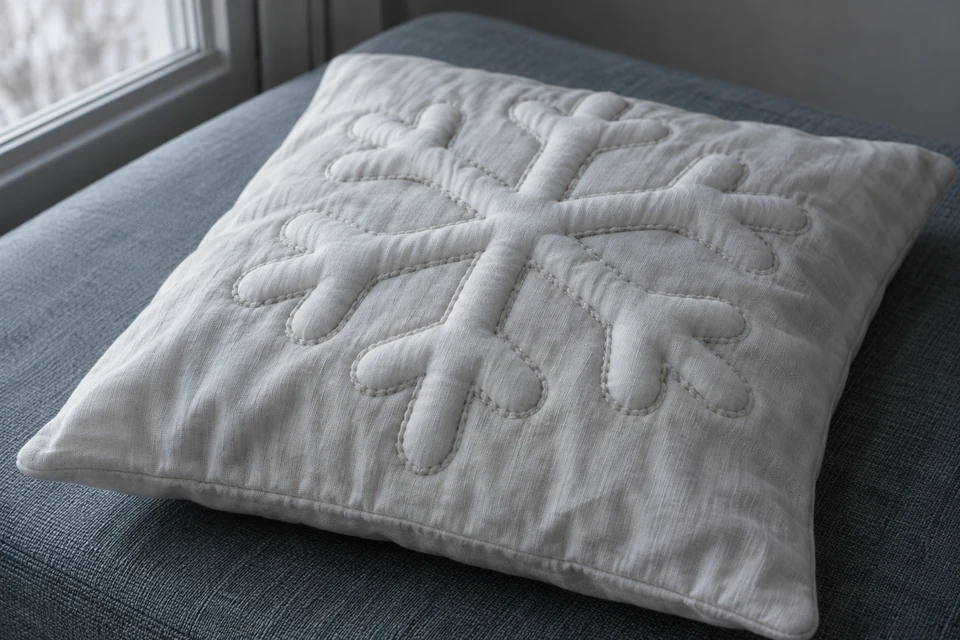
A snowflake cushion can look convincingly dimensional in a close photograph yet lose its shape once the cover is filled or packed. For a Christmas trapunto program, the buying decision concerns a locally padded motif rather than simply a quilted surface. Agree which parts should stand above the ground, which channels should remain flat, and how the finished cover will be sold. An approved drawing is useful, but the relief needs a physical sample viewed on the intended insert.
Draw the padded areas, not only the snowflake outline
Separate raised branches from the quiet background
Start with a full-size face drawing showing the central junction, each main arm and the smaller branches. Identify the padded zones separately from the stitch lines and from the unfilled channels between them. A supplier should not have to infer whether a narrow branch contains additional filling, shares the surrounding layer or is represented only by stitching. Ask for the proposed construction to be described before a quotation is treated as comparable.
The word trapunto is not a complete manufacturing specification. Request a section sketch and a sample showing how the local padding is enclosed and how the surrounding cloth is held flat. For a coordinated Christmas range, decide whether a smaller cushion repeats the original motif at full size or uses a redrawn snowflake. Scaling every line mechanically can change the space left between branches and make a formerly clear motif difficult to construct.
- Mark the outermost point of every branch from the finished face center.
- Keep the relief map and the decorative stitch artwork as separately identified files.
Approve the relief in ordinary room light
Use an oblique view as well as a straight-on photograph
Review the cushion face under diffuse light, then under light from the side. The first view reveals the outline; the second makes differences in height and uneven padding easier to discuss. Use the same insert and a repeatable camera position when comparing revisions. Do not approve from a strongly edited photograph whose shadows have been deepened to make shallow relief appear more substantial.
Assess the center before the tips. Several raised branches meeting in one small area can create a visibly harder or bulkier junction than the rest of the motif. Ask the supplier to show a less densely padded alternative if the center dominates the face. The objective is an agreed visual and tactile balance, not the greatest possible height. Record the chosen sample and the lighting conditions so inspection does not depend on a different showroom arrangement.
- Check all branches, not just the most photogenic upper half.
- Record unwanted folds that cross otherwise flat channels.
Review the relief after the face becomes a cover
Leave room for the seam, opening and intended insert
A loose decorated panel is only an intermediate approval. Sew it into the intended cover with the actual backing, opening and edge treatment. The perimeter can draw the motif outward or change the apparent spacing of the tips. Measure from the finished seam rather than from the raw cutting edge, and inspect the face with the cushion standing upright as it would on a retail display.
Turn the cover inside out and review the enclosure of the local padding. Document any openings used during construction and how they are closed in the final piece. A decorative sample with temporary finishing must not become the bulk reference by accident. If the offer includes an insert, identify its size and fill separately; if it is cover-only, make the sample insert a fit reference rather than an implied part of the shipment.
- Approve a completed cover, not a loose face panel alone.
- Keep seam allowances and closure hardware outside the visible relief design.
Compare the sample before and after the proposed handling
Packing and care are separate approval questions
Fold or pack a completed sample in the proposed retail presentation, then unpack it using a recorded procedure. Compare the raised center, tips and flat ground against the retained reference. If the relief needs hand arranging, decide whether that is acceptable for a store team and realistic for a customer. A beautiful unpacked studio sample does not establish how the product will emerge from a tight shipment pack.
Agree a care trial for the actual fabric, local padding, backing and sewing combination. Do not copy the care instructions from the face fabric alone. Compare puckering, channel definition and localized filling movement after the chosen process, without describing the results as a certified performance claim unless the relevant evidence exists. A trial that preserves the ground but flattens the snowflake still needs a commercial decision.
- Photograph the same face before packing and after unpacking.
- Keep proposed care wording pending until the complete construction has been reviewed.
Quote the motif work separately from assortment choices
Release the sample that the collection will actually use
Ask the quotation to identify the face fabric, backing, padding method, decoration setup, cover assembly and packaging. When a range includes different snowflake drawings, establish which require separate setup and whether the proposed minimum applies by artwork, color or finished size. A shared white fabric does not by itself mean every motif can be combined into one small production run.
Before releasing the Christmas collection, reconcile the chosen face sample, the finished cover size, the retail image and the pack specification. Show the relief honestly in the listing rather than promising an unsupported handmade process or a particular factory capability. Send FY Bedding the motif map, expected quantities by variant and a photo of the intended display; the next useful step is a scoped feasibility and sample discussion, not an assumed stock reservation.
- Record the current sample identifier on the purchase specification.
- Confirm the production and delivery plan separately from the seasonal marketing date.
Release only when the snowflake relief is approved on a fully assembled cover, the flat channels remain readable after the agreed handling trial, and every offered variant is tied to an identified sample and quotation scope.