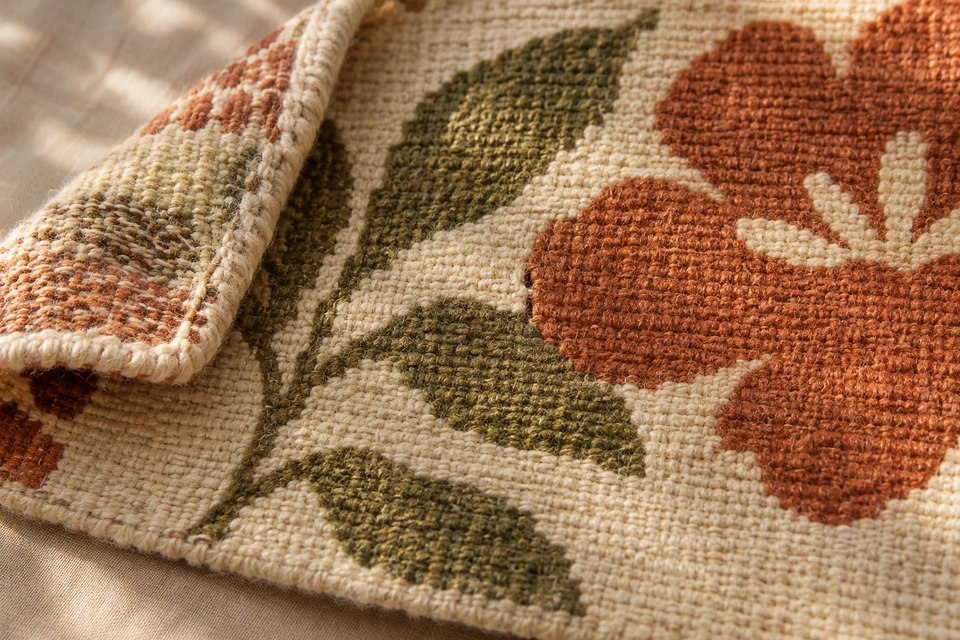
The outline of a woven petal is also a meeting place between areas of cloth. In a floral tapestry panel, the buyer should decide how those boundaries are formed and presented rather than approve only the distant flower silhouette.
Establish what tapestry means in the offer
A woven picture is not a complete construction description
The V&A explains tapestry through discontinuous wefts that work within particular colour areas, rather than each weft crossing the entire width. This is a useful distinction when reviewing a proposed wall panel. Ask the maker to identify the actual technique and show a representative face and reverse. A jacquard-woven floral picture or a printed tapestry-style image may be a legitimate alternative, but it should have its own description and sample approval instead of inheriting the same technical wording without confirmation.
Record the proposed yarn and ground structure as supplied by the maker, together with the intended panel dimensions and mounting format. Do not infer wool content, hand production or a particular geographic origin from a textured photograph. The purchasing question is how the offered textile is built and how its colour boundaries behave in the intended display. Keep any process or provenance claims supported separately. A museum explanation of a technique does not authenticate a commercial supplier or establish the construction of a specific FY collection image.
Mark the important petal and leaf boundaries
Some outlines matter more than others
Use a full-size or otherwise clearly scaled design reference to name the boundaries that need review. Include a long near-vertical stem, a rounded petal edge and a narrow gap between leaves if they occur in the design. These areas can pose different appearance questions. A small swatch taken from the centre of one solid flower cannot demonstrate the transitions the buyer needs to approve. Ask the maker to propose sample sections that include the actual difficult boundaries rather than generic colour blocks.
Review those sections both close up and from the intended display distance. A small structural opening may disappear against one background and become prominent against another. Decide which boundaries should read as a continuous outline and which may contain an intentional gap or stepped transition. Keep the decision tied to named locations. An instruction such as smooth flowers everywhere can conflict with the selected woven character and gives the maker no clear reference for accepting or revising a particular junction.
Ask how adjacent colour areas are connected
Do not confuse an intentional slit with an unnoticed gap
The V&A's discussion of tapestry details describes both deliberately open boundaries and dovetailing used to avoid slits. Those examples show why the treatment is a design and construction choice, not simply a matter of eliminating every visible opening. Ask the maker which boundary approach is proposed in the sample and whether any joining is completed after weaving. Request a clear explanation using the actual sample, including areas that will later be hidden by a backing or mounting system.
Compare proposed treatments on the same relevant floral boundary where practical. Record the resulting outline, local thickness and appearance from the reverse. Procurement should not invent a universal permissible slit length or direct an unfamiliar weaving operation from a photograph. Instead, ask the technical owner to explain the construction and agree the visible acceptance reference. If a joint is revised, retain the earlier and revised sections together so the buyer can understand what changed rather than judging two differently lit images from memory.
Inspect the panel before its reverse is concealed
Mounting must not hide an unresolved construction decision
Request a review stage at which the relevant reverse areas remain accessible. Identify later backing, lining or frame components separately from the woven panel. A finished framed photograph can make the face look complete while preventing the buyer from seeing how a boundary was treated. Ask the maker to document any joining work that becomes concealed during finishing. The record should be specific enough to connect the final item to the approved sample without requiring destructive inspection of every delivered piece.
Then review the complete panel in its intended mounted state. Check whether tension, hanging direction or the background changes the appearance of the named boundaries. Avoid pulling the textile into a favourable shape only for the approval photograph. The display arrangement should be the one actually proposed for supply or installation. Keep fixing suitability and structural support questions with the responsible product owner; a woven boundary sample does not establish that a particular frame or hanging system is suitable for every setting.
Manage size and yarn changes as boundary changes
A larger floral image is not automatically the same cloth
When a panel size changes, ask how the maker will translate the colour areas and their connections. A wider petal or longer stem may change the length and visibility of a boundary even if the overall image is recognisable. Require the affected section to be shown at the proposed scale. Do not approve a large wall panel solely from a smaller version and assume that all local joins can be enlarged without changing their appearance. Identify which references remain valid and which need a new decision.
Apply the same discipline to yarn substitutions. A different thickness, surface or colour contrast can make a previously subtle junction conspicuous. Ask for the material reference and a worked boundary sample rather than a loose shade card alone. Keep handling and care requirements attached to the complete panel and supported by relevant evidence. Neither a traditional weaving description nor a visually strong join proves a service life, cleaning performance or suitability for an application outside the agreed decorative wall-panel brief.
Release a boundary map with the floral composition
Make the approved variation understandable
The final reference should connect the complete design, named junctions, actual material proposal, reverse documentation and mounted appearance. Mark any intentional openings and permitted visual variation. A receiving reviewer should not have to guess whether a small gap is a design feature or a discrepancy. Use a manageable set of close photographs together with the whole-panel view, retaining the approved physical sample where feasible. This gives the supplier and buyer a common basis for discussing later differences in the same locations. Refer to FR-01 for a visual conversation only; a tapestry construction and its colour-area joins require separate development evidence.
Send FY Bedding the botanical direction, panel size, boundary questions and quantity plan for a feasibility review. Treat existing floral collection pages as visual starting points, not proof of tapestry construction or available yarns. Ask the proposed supplier to confirm technique, sampling stages, minimum quantities and commercial timing against the actual design. If another woven or printed route is suggested, evaluate it as a separate proposal. The aim is an honestly described floral panel whose local construction supports the intended overall image.
Approve the named colour boundaries from face and reverse, identify intentional openings and review the complete mounted panel. Keep construction, material and size changes visible before a revised floral design is released.
Method references: Victoria and Albert Museum: tapestry and discontinuous colour areas; Victoria and Albert Museum: intentional slits and dovetailing in tapestry.