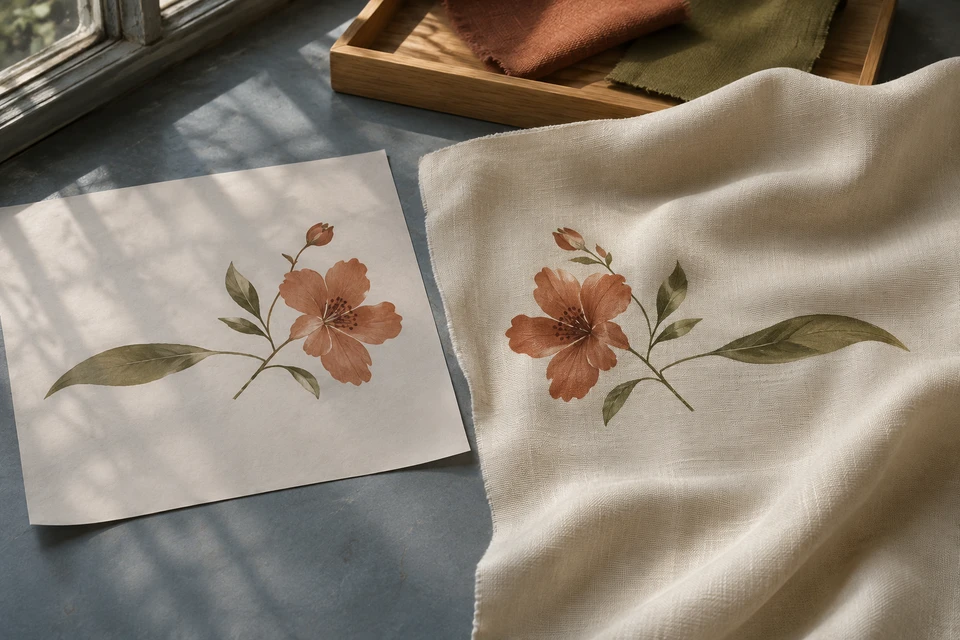
A bouquet leaning left on transfer paper may correctly lean right on the finished fabric. That difference can be intentional, but it can also hide a double reversal or an unapproved artwork change. For a buyer considering a transfer-printed floral textile, orientation should be accepted on the finished face. Keep the transfer-paper view as process evidence, clearly distinguished from the customer-facing design. Otherwise, a team can approve a beautiful paper sheet and still receive a floral arrangement facing the wrong way.
Establish the final face before discussing settings
Use an asymmetric reference
Select a recognisable feature that makes left and right unambiguous: a long branch extending to one side, a single flower outside the main bouquet or a leaf turning outward. Mark that feature in the private approval record and identify the intended top edge. A nearly symmetrical rose cluster is a poor test because reversing it may escape notice. The reference should show the intended fabric face as a customer will see it, not a photograph taken through the back of a translucent sample.
FY Bedding's floral series and the FR-01 page can serve as visual references for an enquiry, but do not establish that a particular listed product uses transfer printing. Ask whether a suitable production route can be proposed for your intended material and article. If the route changes, review the relevant proof sequence again. This guide addresses process orientation; choosing whether two pillowcases should deliberately mirror each other is a separate range-design decision that must already be clear in the approved final-face artwork.
Assign the mirroring operation to one owner
Avoid two well-intended reversals
Brother's sublimation guidance instructs users to produce a reversed paper image so that the transferred result has the intended orientation. That is a documented example of why paper and fabric can look opposite. It does not establish settings for every transfer method, substrate or machine. Ask the proposed producer to explain which file it expects to receive and where any required reversal occurs in its workflow. Do not issue a universal instruction to mirror every floral file regardless of the process.
Record whether the designer supplies final-face artwork or a process-ready reversed file. Name the party responsible for any conversion. A designer may reverse an image before delivery while an operator applies another reversal in output; the two actions can cancel each other. Prevent this with explicit file descriptions and a sample check, not with an assumption that everyone uses the same software defaults. Keep the final-face reference beside the process instructions so that ownership remains clear even if an operator or print studio changes.
Compare three states without mixing them
Original, paper and transferred fabric
Retain the approved final-face artwork, the actual paper output and a corresponding transferred fabric sample. Identify the same asymmetric feature in all three. Photograph the paper from its printed side and the fabric from its intended face, with their top edges consistently identified in the record. Do not flip a photograph merely to make a presentation look tidy; that can erase the evidence needed to understand the process. Capture an unaltered reference image before any marketing retouching.
When the paper appears reversed but the finished face matches the authorised design, record that relationship rather than requesting an unnecessary correction. When the finished face is reversed, stop approval and ask the responsible team to trace the file and output steps. If only one flower has moved or changed direction, investigate an artwork edit instead of assuming the whole image was mirrored. These observations distinguish a workflow error from a composition revision and help avoid repeating a sample that addresses the wrong problem.
Confirm the result in the proposed textile construction
A paper proof cannot answer every question
Use a sample made on the proposed substrate through the proposed process. Ask the supplier to confirm material suitability and the preparation, transfer and finishing stages represented by the sample. Do not prescribe a generic heat, pressure or time setting from another product's instructions. The producer should propose and validate its process for the specific article. Record the finished sample identity so that an orientation approval cannot later be attached to a different fabric or an unrelated trial.
Inspect the asymmetric feature on the visible side of the assembled panel as well as on the flat sample. If the component will be folded, joined or turned during assembly, make sure the approved face remains the intended outward face. Treat changes in print appearance, colour or workmanship as separate observations with their own acceptance evidence. Correct orientation alone does not prove wash performance, colour consistency, compatibility with a filling or fitness for a particular market. Keep those requirements in the broader specification.
Release one orientation record for each different layout
Make the commercial approval traceable
A range may share floral artwork while using different placements on duvet panels, pillowcases and cushions. List the final-face file for each distinct layout and identify the transferred sample that verifies it. Do not reuse a passing cushion proof as evidence for a separately prepared duvet file. Where layouts share exactly the same controlled conversion, ask the producer to document that relationship and agree the appropriate checks. This makes the approval proportional to actual file differences rather than the number of product names.
For an FY Bedding quotation discussion, send the authorised final-face reference, proposed components, substrate requirements and expected quantities. Ask for confirmation of the available development route, sample sequence and ownership of file conversion. Clarify any additional sampling or correction work before agreeing the commercial schedule. At receiving, compare the distinctive branch or leaf against the final fabric standard, not the paper print. Preserve both views in the project record so a correctly reversed intermediate is not mistaken for an incorrect delivered design.
Name who performs any required mirroring, then verify an asymmetric floral feature on the actual finished fabric face before approving the layout.
Method references: Brother: mirrored paper and final transfer orientation.