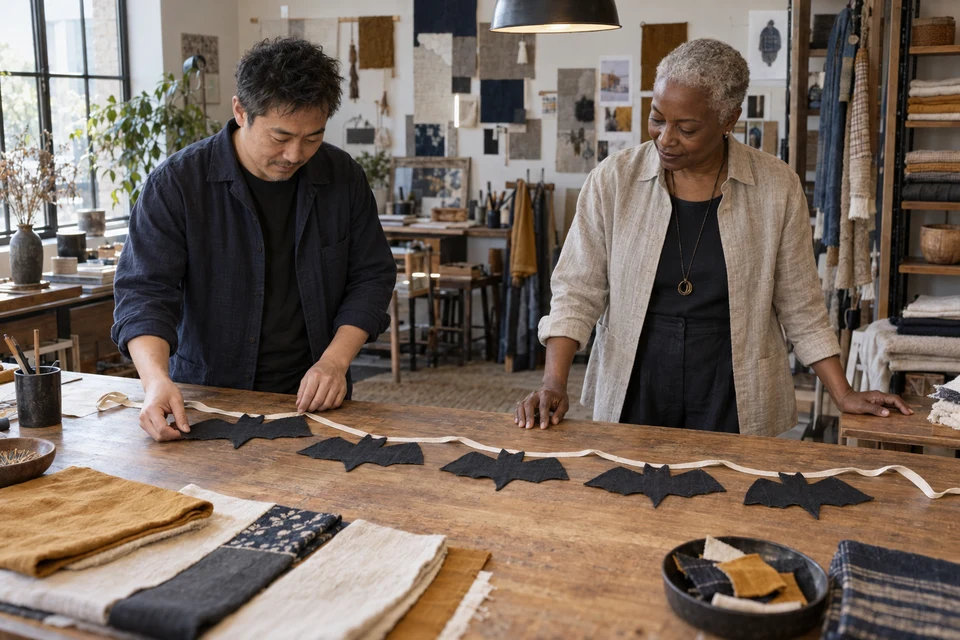
Fabric bat bunting is a sequence, not a single motif. Buyers need to review how the silhouettes repeat along the tape, how the wings sit after unpacking and how the finished strand is presented. A neat close-up of one bat cannot establish that the whole decorative run works.
Draw the complete strand
Separate decorative span from spare ends
Specify the number of bats, their order, the visible span occupied by the motifs and the free tape at each end. A quoted total length can include generous empty tails while the decorated section remains shorter than the buyer expects. Record whether spacing is measured between bat centers or between the nearest wing tips; those methods produce different results when bat sizes vary.
Lay out the entire run at full scale before approving the silhouette. Include the intended drape in a second view, since a straight tabletop arrangement does not represent a hanging strand. This differs from a single wall-hanging panel and sleeve, where one large surface is supported as a unit. Here the buyer is controlling a rhythm of separate shapes along a flexible support, so end spacing and repeated orientation deserve explicit review.
- List motif count, decorated span and free tape length separately.
- Choose one spacing measurement convention and use it throughout.
Choose the wing behavior
A sharp drawing does not guarantee a crisp textile shape
Request a sewn or otherwise production-representative bat sample in the intended fabric. Compare the wing tips, central body and lower scallops with the approved outline. A design may be intentionally soft and floppy or expected to hold a flatter profile; write down which result is wanted before discussing construction options.
Inspect the bat lying flat, hanging freely and after a light handling sequence representative of unpacking. Do not use concealed supports for the approval photograph unless those supports are part of the supplied product. Narrow wing tips that look elegant in artwork may fold differently from the central body. Use the approach in decorative attachment inspection to distinguish shape approval from attachment approval. The relevant acceptance example should show the entire wing, not only a magnified seam.
- Approve a physical silhouette with the chosen fabric and construction.
- Identify any permitted curl or softness at the wing tips.
Review how each bat meets the tape
Check position, direction and end finish
Record whether bats are sewn through the tape, suspended from a loop or attached by another agreed method. Inspect a front and rear view of the complete run. Ask whether every bat should face the same direction and whether any alternate size or color follows a fixed sequence. A reversed motif near one end may be easy to miss when samples are reviewed individually.
Check the exposed tape ends and the points where handling repeatedly occurs. Cut-end fray containment is a useful related review, but the final method must match this tape and decorative application. Do not infer a hanging-load rating from a tidy seam or pull a sample to an improvised destructive threshold. Agree any required attachment test and acceptance criterion with the relevant technical reviewer, separate from ordinary visual inspection.
- Record attachment location relative to the bat body center.
- Inspect both tape ends and the rear of each motif in the strand.
Pack without trapping the wings
Compare folding routes on the finished run
Trial the proposed fold sequence and any separating sheets with a complete bunting strand. Check whether one bat folds over another, whether a pointed wing catches under a tape loop and whether the final pack lets the customer identify the opening end. A flat pack can still damage presentation if the motifs are stacked in an awkward order.
After the agreed storage period, unpack using the intended customer method. Record how much arranging is needed to recover the accepted wing profile and spacing. The ribbon-pressure and unpacking guide helps frame local pressure marks as a pack-design question. Avoid promising immediate perfect recovery unless the actual packed sample demonstrates it under the agreed conditions. If a preparation step is needed, decide whether it is reasonable for this retail or display program.
- Photograph the fold sequence and the first unpacked condition.
- Keep the storage conditions and recovery observation time in the record.
Release a display-specific product
Keep decorative approval within its scope
For a store display, identify the intended mounting arrangement and let the responsible site team review it. For a retail product, confirm which tape, loops or other components are included and which mounting items are not supplied. Keep imagery away from flames, moving equipment or scenes implying an unassessed use. Decorative appearance approval is not evidence that the strand is suitable as a toy or for every installation location.
Retain one full approved run rather than only a loose bat. Link its outline, spacing sheet, attachment details and pack sequence to the purchase specification. Use preproduction sample scope to agree what the supplier will demonstrate before bulk release. FY Bedding can discuss a scoped seasonal textile brief based on the complete strand; production feasibility, quantities and delivery timing still need confirmation for the specific project.
- Release the whole strand and pack together as the reference.
- Keep installation and any performance evidence separate from design approval.
Does a complete packed strand recover to the approved bat sequence and wing profile using only the preparation steps intended for the customer?