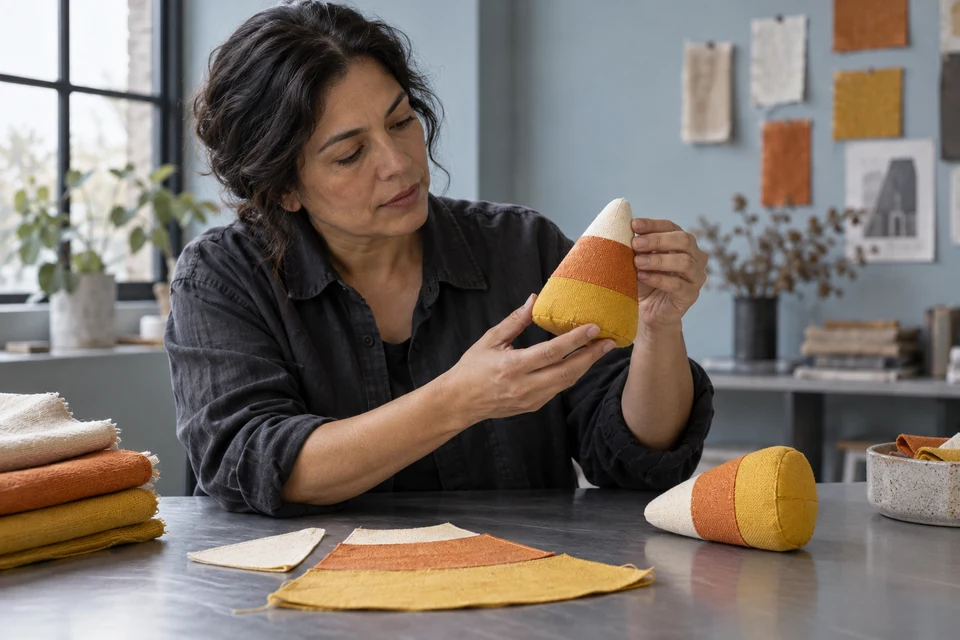
A candy-corn ornament depends on the relationship between three colored zones, not just the presence of yellow, orange and cream fabric. A narrow cream point can disappear into the turning seam, while a broad yellow base can make the same pattern look like a different object after filling. For a seasonal home-accessory order, approve the assembled cone and its ordinary display position before using a flat color sketch as the production reference.
Separate color proportions from cutting dimensions
Measure the finished object in its intended position
Start with a simple side elevation showing the visible cream tip, orange middle and yellow base. Give the overall finished height and width separately from the heights of those visible zones. Seam allowances consume different amounts around the pointed top and curved base, so three flat strip widths are not an adequate finished specification. Ask the sample maker to explain which dimensions refer to cut pieces and which refer to the filled shape.
The technical brief should contain both references. A buyer comparing two sizes should decide whether the color proportions stay constant or change deliberately. Review each offered size rather than stretching a photograph of the larger cone. Identify the ordinary front view so inspectors do not tilt every piece until its proportions appear acceptable.
- Record the visible height of each color zone.
- Approve the smallest offered size as a physical sample.
Choose how the colored zones meet
Sewn bands and printed bands are different offers
Clarify whether the three colors are separate joined fabrics or one printed cloth. Separate bands introduce joining seams and may create small ridges; printing moves the challenge toward color placement and cutting. Neither construction should be substituted silently after an attractive sample is approved. Ask for an unfilled shell to reveal how the bands meet at the long seam and whether their boundaries step around the back.
Use the fabric-face identification checklist when the selected cloth has a distinct face or surface direction. Match texture as well as shade across the three components. A coarse yellow fabric and a smooth orange fabric may be intentional, but that decision belongs in the sample record rather than in an unnamed material replacement.
- Identify sewn or printed color construction in the quotation.
- Photograph the reverse junction where all bands meet.
Approve the point and base together
Filling changes the apparent taper
Review the cone empty, lightly supported and finally filled to the proposed production condition. A pointed pattern can produce a blunt top if seam bulk is crowded into the tip. Conversely, an exaggerated hard point may not suit the intended soft decorative appearance. Define what the buyer wants to see without inventing a universal stuffing weight or a dimensional tolerance that the supplier has not agreed.
The fill-weight review helps distinguish a controlled filling proposal from hand-adjusting every photo sample. Inspect the base closure and the transition into the yellow band. If the ornament is meant to stand, observe it on the actual display surface without hidden supports. A standing trial is not evidence of suitability as a toy or for use by children.
- Review the cone unsupported from front, side and base.
- State whether the supply includes filling and any hanging loop.
Build an assortment that can be counted
Separate size mix from color variation
A retail set may combine several cone sizes or repeat one shape. Write the required count by size and specify whether the three colors are fixed across the set. Otherwise, an assorted offer may be interpreted as permission to use leftover cloth or change the zone sequence. Include a simple unpacked set photograph with the order-line identifiers outside the consumer-facing product image.
The assortment verification process is relevant when several sets share one master carton. Check that the pack does not flatten the tips or force all cones into different resting shapes. Keep any decorative props shown in photography separate from the agreed supplied components, and do not imply that an unquoted basket or display tray is included.
- List the exact number of cones at each size.
- Review the complete set after opening its intended pack.
Release the seasonal order against a defined sample
Confirm component minimums before promising a launch
Request minimums for the three fabrics, filling, sewing and packaging rather than assuming that a small ornament has a small production minimum. Ask whether existing material options can meet the intended palette and what changes would trigger a new sample. The quotation should distinguish development work from bulk supply and should identify who approves any change to the point, bands or base.
Refer to component MOQ planning when the cones sit within a broader Halloween collection. Consolidating a fabric color with another item may be useful, but it does not automatically establish matching texture or delivery readiness. Confirm the actual production and dispatch plan after sample approval; do not advertise a guaranteed holiday arrival from a concept-stage image.
- Obtain written sampling, MOQ and packaging scope.
- Reapprove the silhouette after changes to cloth or filling.
Share the intended cone sizes, color proportions, display position and set count with FY Bedding. Request a complete development sample and its unfilled shell so the three-zone appearance can be reviewed before bulk terms are confirmed.