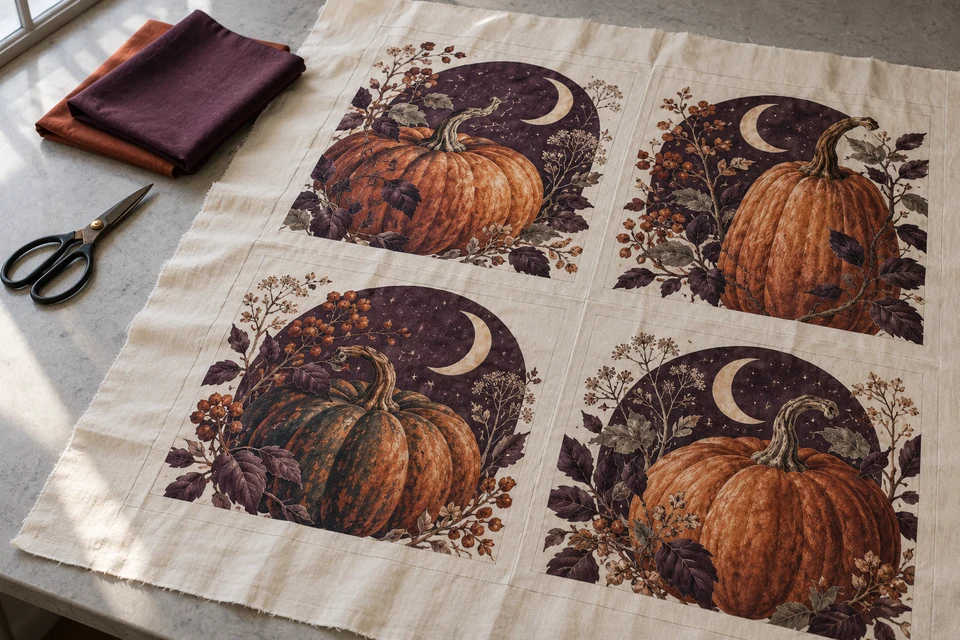
An unfinished printed panel for a sewing kit is not a miniature finished quilt. The buyer needs enough usable fabric around the Halloween design for the intended cutting and assembly route, plus a clear account of what the kit actually contains. A beautiful pumpkin picture can still create a poor kit if the usable border is unclear. Approve the cuttable panel and its instructions together, without implying that the cloth is ready-made bedding.
Separate the picture from the cut line
Three boundaries belong in the brief
Show the motif boundary, intended cut boundary and supplied panel edge on one drawing. Explain which border remains visible after assembly and which area is intended for the sewer's process. Do not express all three as one finished size. The technical pack checklist provides a useful place to keep those definitions and their units consistent.
Ask the supplier to identify any selvage, registration area or irregular edge that is outside the usable panel. If a panel is sold by repeat rather than as individually cut pieces, describe how repeats are separated. Give the supplier the buyer's actual assembly plan instead of expecting an unspecified allowance to work for every sewing method or skill level.
- Distinguish artwork, usable cut area and supplied edge.
- Identify any fabric area excluded from the usable measurement.
Use a paper layout before ordering fabric
The motif must survive the intended assembly
Place the proposed cut pieces over the full-size artwork and simulate the assembly sequence. Check whether a pumpkin stem, face or border corner enters a seam or trimming area. If the design includes several small blocks, map each block separately rather than approving only the outside rectangle. Keep orientation marks in the instructions or permitted margin, not accidentally inside the final visible motif.
The strike-off approval process should cover print scale and local detail. Pair that reference with the cutting layout because a correct print can still be positioned badly for the kit. Record any buyer-approved alternative layout so the supplier cannot substitute a narrower usable border without reopening the assembly review.
- Test the actual cutting layout against full-size artwork.
- Review small motif features nearest seams and trimming lines.
Make the kit contents explicit
A panel-only order needs a different label
List whether the offer contains one printed panel, coordinating fabric, backing, filling, binding or instructions. State what remains for the customer to source. Avoid product imagery that presents a completed quilt without explaining that the purchased item is unfinished material. Where several panel designs share one collection name, give each its own content list and reference code.
Use the product program overview to distinguish a finished home-textile project from a component or development request. Any proposed fiber description should refer to the actual supplied materials, not the appearance of an illustrated sample. If instructions are included, assign responsibility for checking their measurements, language and assembly sequence before the kit is packed.
- List included and excluded components beside the kit reference.
- Do not carry a finished-quilt claim onto an unassembled panel.
Have someone assemble the approval sample
A flat inspection cannot replace a sewing trial
Ask an appropriate sample maker to follow the proposed instructions without relying on undocumented corrections from the designer. Record where extra trimming, fabric substitution or interpretation is needed. Review the resulting design together with the unused margins and offcuts. The aim is to discover mismatches between the supplied component and the promised project, not to declare a universal sewing-performance result.
Retain the component references and trial record within the sample approval file. If different sizes or language editions use different layouts, check them separately. Proposed care and preparation guidance should be reviewed for the actual materials and intended project; do not invent a fixed shrinkage allowance without evidence from those materials.
- Record every deviation from the printed assembly instructions.
- Keep both an uncut reference panel and the assembled trial.
Buy usable panels rather than anonymous yardage
Quote the inspection and packing unit clearly
Confirm whether quantities are counted as individual usable panels, repeat lengths or fabric length. Agree how incomplete edge repeats and damaged components will be handled in acceptance. For kits, define the packing unit and the count of every component. A nominal roll length is not automatically the same as a confirmed number of complete kits.
Use the quotation scope guide to separate printing, cutting, kit assembly and instruction preparation. Ask which minimums apply to each design and coordinating color. Freeze the accepted layout and content list before production planning, and confirm timing from the actual development and supply schedule rather than assuming that a Halloween design guarantees seasonal availability.
- State the acceptance unit: complete usable panel or complete kit.
- Request separate minimums for printed panels and coordinating fabrics.
Bring FY Bedding the intended finished project, cutting layout and proposed kit contents. Request a component-level quotation and an assembly trial before approving bulk panels; keep finished-product imagery clearly identified as an illustration of the possible result.