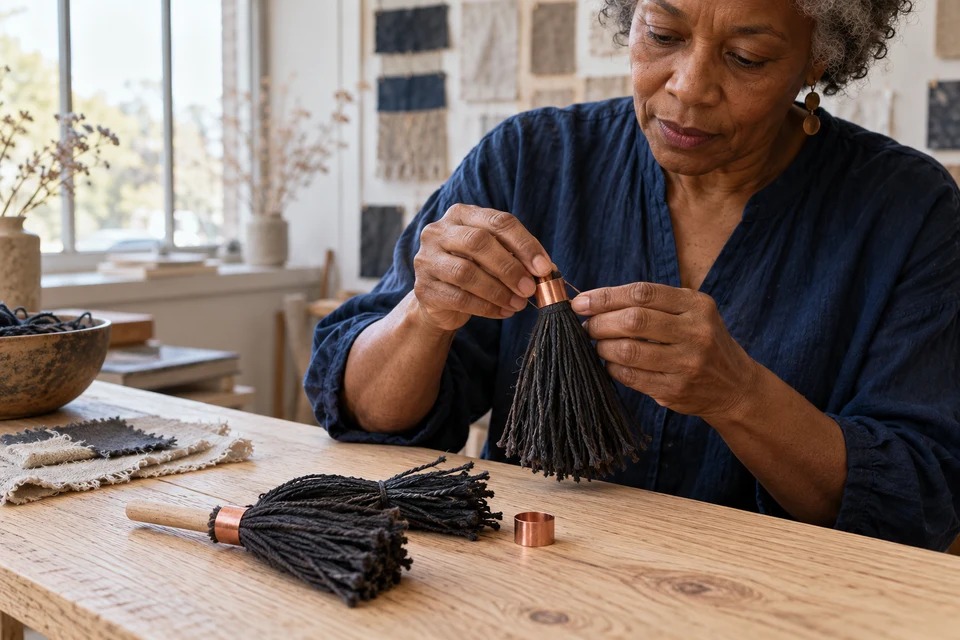
A miniature Halloween broom ornament uses a textile tassel to suggest a broom without supplying a cleaning tool. The yarn bundle, its gathered collar and any handle form the complete decorative assembly. Buyers should identify those parts and review the natural fall of the ends before approving the retail assortment. A copper-colored collar in a design reference does not establish whether it is fabric, metal or another material; the supplier must describe the actual proposal.
List the complete assembly
A textile tassel may include non-textile components
Identify the proposed yarn, collar, handle and any hanging connection separately. State whether the order includes a handle or only a tassel attachment intended for another assembly. Record the overall dimensions and the measurement condition in the technical pack. Keep material descriptions based on supplier information rather than assuming that every visible brown handle is the same wood or that every colored collar is cloth.
Ask for a component view beside the finished sample so the buyer can understand what is assembled. If the supplier proposes alternative collars or handle materials, keep them as distinct options until approved. A visual resemblance is not enough to treat them as equivalent in cost, construction or evidence. The final retail description should reflect the selected components without adding unverified handmade, natural-material or sustainability claims.
- List textile and non-textile components separately.
- Confirm handle and hanging-component inclusion explicitly.
Define the tassel bundle before gathering
Finished fullness needs a reproducible reference
Describe the proposed yarn construction and the finished bundle appearance, including its length in a natural hanging or resting condition. Ask the maker how the offered assembly controls fullness and keep the chosen reference sample. Do not invent a universal strand count when yarn size and construction have not been fixed. If a count or other production measure is used, connect it to the actual approved material and sample.
Review the bundle from more than one direction to distinguish a full assembled tassel from a fan arranged for a photograph. Observe how the ends fall without combing them into a temporary shape. The design version record can retain the accepted silhouette and color. A yarn substitution should trigger a new appearance review rather than being accepted solely because its color name matches.
- Use the approved material to define repeatable fullness.
- Review natural end fall without photographic restyling.
Inspect the collar and its actual connection
Color does not identify material or assembly method
Ask how the collar gathers the bundle and how that assembly meets the handle. Record the offered material, finish and connection with front and reverse views. If a fabric collar is proposed, document its edges and joins; if another material is proposed, identify it accurately instead of forcing it into a textile seam description. The seam method is relevant only to the sewn parts actually present.
Identify any required connection or handling evaluation in the product evidence plan. A neat collar can hide the connection, so appearance approval should not be presented as proof of attachment strength. Keep the intended decorative use explicit and avoid toy, child-use or sweeping-function claims without a separate product assessment. Recheck the complete assembly whenever the collar or handle connection changes.
- Describe the real collar material and connection.
- Separate appearance approval from attachment evidence.
Approve the end profile as received
A natural tassel need not look like a rigid brush
State whether the yarn ends are intentionally uneven, shaped or trimmed to a defined profile. Compare the sample after the agreed handling and unpacking sequence rather than only immediately after trimming. Record any permitted variation in a physical reference that the buyer and maker can use. A soft decorative tassel should not be judged against the rigid bristles of a functional broom unless that is a separately developed construction.
Check for local clumps, trapped strands or a visible connection that changes the intended silhouette. Ask the product owner which observations require correction and which are accepted characteristics of the selected yarn. Do not promise resistance to shedding or repeated handling from a visual review alone. The buyer resource checklist can keep outstanding material and use evidence separate from the accepted cosmetic profile.
- Define the intended trimmed or natural end appearance.
- Review the unpacked tassel before arranging it for display.
Pack complete decorative units
Protect the bundle without concealing missing components
Specify the number of complete ornaments in the selling pack and any color or size mix. Keep spare yarn, demonstration handles and styling props out of the retail contents count unless they are explicitly supplied. Apply the assortment verification approach to the actual units. A pack should make it possible to identify each complete broom ornament without reconstructing an unspecified kit.
Agree how handles and tassel bundles are positioned to avoid an unacceptable received shape. Compare quotations only after yarn, fullness, collar, handle, hanging connection and packing are aligned. Ask which options introduce separate minimums or sample work and request actual production milestones. Keep Halloween delivery planning conditional on the confirmed order and transport arrangements, not on the availability of a styled sample image.
- Count complete assemblies rather than loose components.
- Review the packed and unpacked tassel with the selected collar and handle.
Send FY Bedding the intended miniature-broom size, tassel appearance and component scope. Request a component view and packed assembly so the collar, handle and natural yarn profile can be confirmed before ordering.