A textile countdown panel with one moving marker is not a pocket calendar with fewer pockets. Its usefulness depends on a clear daily position, an understandable movement and a marker that remains visually associated with that position. Buyers should develop the interaction alongside the textile artwork. The scope here is an adult decorative display concept; intended-user classification and any component-safety requirements need separate professional assessment before marketing.
Choose the daily interaction first
The marker should communicate one position unambiguously
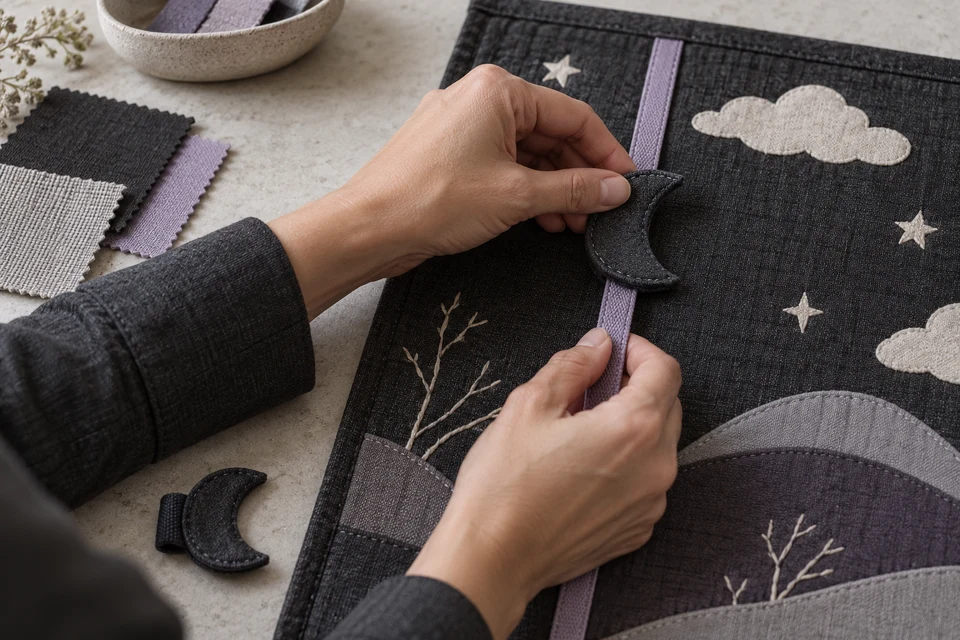
Decide whether the marker slides along a tape, moves between defined locations or uses another proposed textile mechanism. Describe what a user does each day and what the finished position means. A moon-shaped tab can be decorative while still leaving doubt about whether its top, center or lower edge indicates the selected date. Resolve that ambiguity in the development brief before choosing the final motif.
Make a plain functional prototype without seasonal numbering. Ask an unfamiliar adult reviewer to show how they would change the position, using only the proposed instruction. Record confusion or unintended movements instead of coaching the person through the desired result. This observation informs design; it does not prove reliability, safety or suitability for an audience that was not assessed.
- Define the action and the exact indicated position.
- Observe an unfamiliar reviewer without hidden coaching.
Build the marker and guide as a pair
A loose swatch does not represent the working assembly
Specify the marker's dimensions, seam, loop or attachment and the guide material it works against. Review the complete assembly in its intended hanging orientation. A sample that moves easily on a flat table may behave differently when the fabric panel hangs freely. Record whether the backing needs support and identify that support in the offer.
Compare the arrangement with the display-support guide, while keeping marker movement a separate approval. Do not rely on a pin, temporary adhesive or stiffener absent from production. If movement pulls the backing out of shape, revise the paired components rather than simply tightening the marker. Ask the technical owner to define any further functional evaluation and its acceptance criteria.
- Review the quoted guide and marker together.
- Test presentation in the actual supported orientation.
Map numbers to reachable positions
Artwork approval follows the functional layout
After the movement works as intended, lay out the countdown positions and review the sequence. Specify the first and final displayed states and whether the panel counts toward a date or through calendar days. Include the starting instruction so the customer does not have to infer the system from a photograph. Keep the numbering file distinct from the unnumbered prototype used for mechanism review.
The pocket-calendar guide addresses a different interaction involving gifts and access. Do not reuse its pocket dimensions or loading assumptions for a moving-marker product. Here, verify that every printed position remains readable and reachable without obscuring adjacent positions. A larger moon or more elaborate seasonal motif may require another layout review even when the panel size stays unchanged.
- Verify the intended counting sequence and starting state.
- Check every position with the actual marker in place.
Inspect the ends and supplied components
The complete retail object needs a defined scope
Show how the guide begins and ends and whether the marker is intended to be removable. Identify all separate parts included in the pack, including any replacement marker. Have the responsible product reviewer assess intended users, components and market requirements rather than describing a small decorative part as universally suitable. Do not imply that an adult styling concept is automatically a children's activity product.
Keep the component list and open evidence requests in the buyer record. Review care and storage for the complete assembly, including whether the marker must be removed or placed in a defined position. If a prototype loses its indicated position during ordinary approved handling, document that issue for redesign; do not photograph only the moment before it moves.
- Identify removable and separately packed parts.
- Keep intended-user review independent of visual approval.
Quote the working panel rather than its printed area
Include assembly and user information in comparison
Request prices against the same backing, guide, marker, decoration, support scope and retail pack. Ask which changes create separate setup or assembly work, and confirm minimums for the actual offered designs. A printed rectangle without the working marker is not a comparable quotation. Preserve the approved prototype and instruction so receiving staff can identify what the complete supplied object should do.
For a countdown-panel sample review, share the interaction sketch, intended display location, market and design quantities. Agree the evidence plan and sample milestones before discussing a production window. Do not promise arrival for a particular countdown start until the supply plan is confirmed. Keep illustrative pictures clearly separate from documentation of an approved production assembly.
- Compare complete assembled-panel scope.
- Retain the working reference and its starting instruction.
Release the marker, guide, backing and numbered layout as one identified assembly. Approve the daily interaction explicitly, with separate review of intended users, components and any claimed performance.