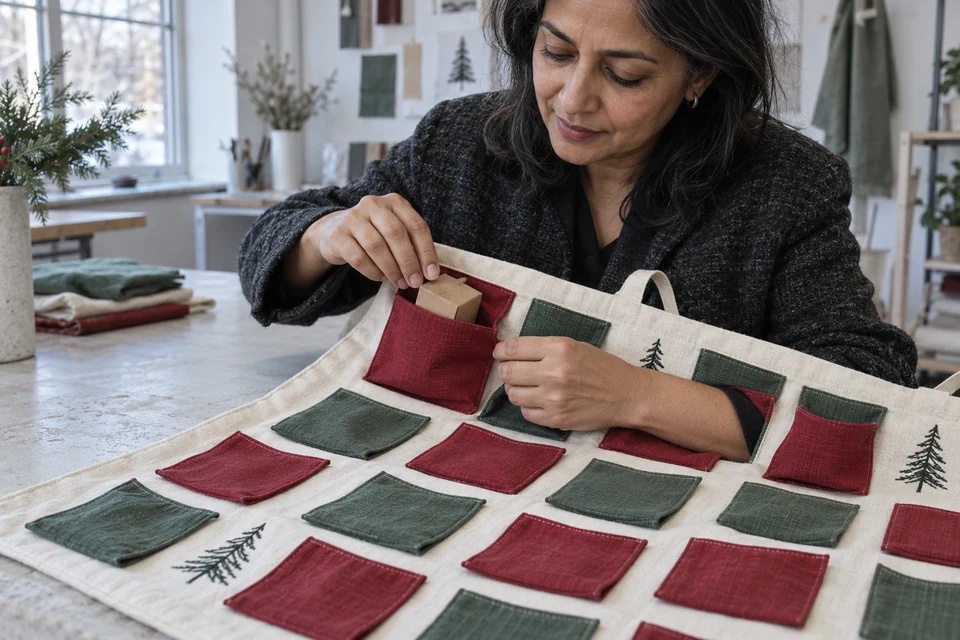
The useful size of an advent-calendar pocket is not the size of the square seen on the front. Hem depth, seam placement, fullness and gift shape all affect what can be inserted and removed. Buyers developing refillable Christmas fabric calendars should start with that usable space before approving a decorative grid. This guide addresses a textile calendar prototype and its buying brief. It does not establish suitability for children, direct food contact or particular gift contents; those questions require the intended market, users and components to be assessed separately.
Define the intended refill assortment
Measure the gift route, not only its front face
List the representative objects or packages the buyer intends to place in the pockets. Record width, depth and height, and identify any rigid corners or awkward shapes. Use clean empty packaging for development trials where appropriate. Do not assume that a pocket accepting a flat card will also accept a small box with the same front dimensions. Keep the refill examples linked to the technical brief.
Decide whether all pockets need the same usable capacity or whether specific positions are intentionally larger. If the range will be sold empty, make that explicit. Marketing photography may show gifts to explain use, but the pack description must distinguish illustrative contents from supplied items. Avoid promising universal compatibility with treats or toys when only a limited set of sample packages has been reviewed.
- Record the depth and rigidity of intended refill examples.
- State clearly whether the calendar is supplied empty.
Specify opening and depth independently
A decorative square may hide a narrow entrance
Measure the clear opening between the finished seams without forcing it wider. Record the usable depth from that opening to the inside base. Note whether a gusset or gathered front creates extra volume and whether the pocket is intended to hold a package visibly above its edge. Draw those details instead of quoting one external pocket size. Compare the offered assembly with the component record.
Insert and remove each representative package through the ordinary route. Look for a folded hem catching the box or an opening that requires distorting the back panel. Record observations with the sample revision. A photograph with the gift already inside does not show whether daily refill and retrieval are convenient, and a larger pocket front does not necessarily resolve a narrow opening.
- Measure clear entry width and usable depth separately.
- Trial insertion and retrieval, not only the filled photograph.
Review the loaded grid as a whole
Repeated pockets can change the backing shape
Fill the agreed positions using the approved demonstration contents and support the calendar only in the intended arrangement. Observe the backing, pocket rows and lower edge. Compare the empty and loaded presentation. This is a product-layout review, not a load-rating claim or a substitute for assessing the hanging system. Ask the responsible technical owner to define any required performance evidence.
The seam specification should identify pocket attachments and the backing assembly. Check whether neighboring pockets remain accessible when one contains a deeper item. Keep upper and lower rows in the trial: a convenient tabletop prototype may be less practical when hanging vertically. Record the actual supported arrangement and avoid hidden pins or temporary stiffeners that are absent from the quoted product.
- Inspect empty and representative loaded layouts.
- Review access in both upper and lower rows.
Control numbering and decoration separately
A correct pocket count can still carry the wrong sequence
Once the physical layout works, approve the number sequence and any motifs against a clear artwork map. Count every position and inspect the sequence in the intended reading direction. A prototype may be deliberately unnumbered for fit review; that is not a final artwork approval. Keep these stages distinct in the artwork revision record.
Check whether embroidery, applique or a label reduces pocket access or changes the clear interior. Review the reverse where decoration passes through the backing. If the buyer offers multiple languages or regional layouts, identify each approved variant as a separate artwork version rather than asking packers to infer it from color. Do not treat a festive motif as evidence that the calendar's complete intended use has been assessed.
- Count positions and verify sequence against an artwork map.
- Recheck access after final decoration is added.
Quote a complete calendar and its disclosed accessories
Packing must preserve the approved layout
List backing, pockets, heading, supplied supports and any separate accessories in the quotation. Distinguish buyer-provided installation hardware and refill items. Confirm the offered care instructions for the complete assembly, then review pocket shape and backing alignment after the agreed process. For a reusable seasonal product, keep the stored and reopened condition within the sample discussion rather than promising an unspecified service life.
Use the pack-out checklist to verify the calendar and any included accessories. Trial the fold so pocket fronts are not trapped or turned inside out on opening. Share the intended users, refill examples, pocket layout, artwork variants and order quantities with FY Bedding for a feasibility review. Confirm materials and evidence needs before accepting a production or delivery plan.
- Identify supplied supports and refill exclusions.
- Approve the reopened calendar as well as its flat prototype.
Buy usable pockets, not nominal squares. Keep refill fit, loaded layout, artwork sequence, intended-user review and supplied accessories under distinct documented approvals.