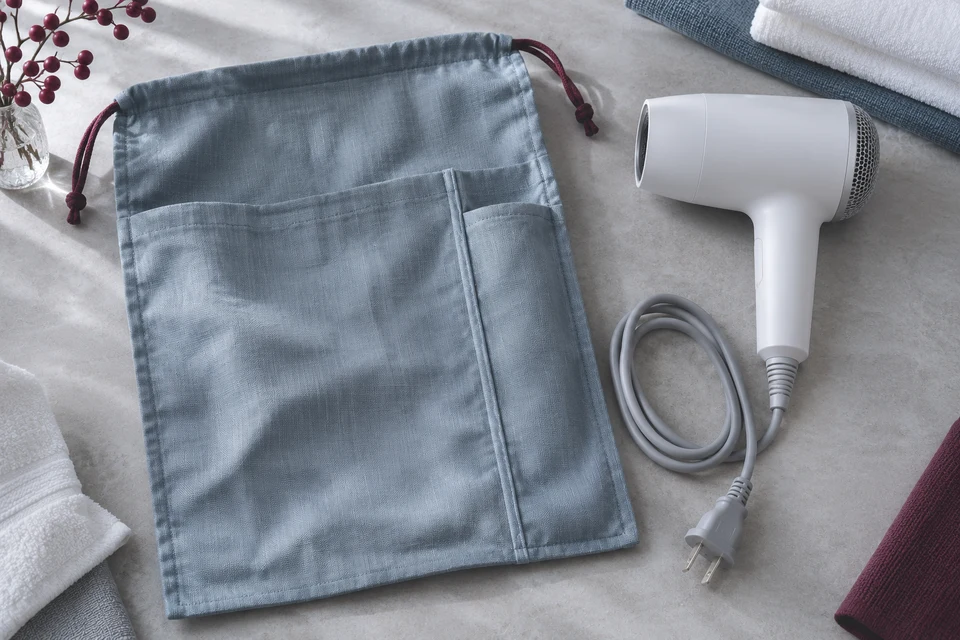
A hotel hairdryer pouch should be developed around the appliance that housekeeping actually stores, including its cable and any approved attachment. A bag that fits the dryer body but leaves the cable trapped in the closure is not a complete fit approval. This brief is for textile storage of an unplugged, fully cooled appliance according to its manufacturer's instructions. It does not establish heat resistance, electrical protection or suitability for enclosing an appliance while it is operating.
Define the stored appliance set
Measure the real body, handle, plug and supplied accessories
Record the dryer model or an identifiable dimensional reference, the handle position used for storage and the accessories intended to accompany it. If the hotel uses more than one appliance, compare the actual sets before choosing a common pouch. The longest body is not necessarily the most difficult item to load; a wider nozzle or a differently shaped plug can determine the needed opening and cable space.
Photograph the complete stored set with the cable loosely arranged in the manner the hotel intends to use. Do not derive the pouch from a tightly wound cable or a compressed configuration that staff will not reproduce. Establish whether the nozzle is removed for storage and whether a separate accessory pocket is required. Keep those decisions in the fit brief so the sample and receiving checks use the same configuration.
- List the appliance and accessories included in the fit trial.
- Use the manufacturer's handling and cooling instructions as the operating boundary.
Separate cable storage from the appliance body
Keep the opening usable after the pouch is loaded
Ask for a pocket layout that shows the main compartment, the cable area and any divider. Review a filled sample rather than approving only a flat bag dimension. The cable space should be assessed with the actual plug and the proposed loose coil. If the side pocket bulges into the main opening, the nominal pocket width may not describe the usable arrangement.
Try loading and removing the cooled appliance without pulling on the electrical cable. Observe whether the nozzle catches on a divider, whether the plug drops into the body compartment and whether the closure crosses the cable route. Record the sequence housekeeping is expected to follow. If a single-compartment pouch is selected instead, make that choice explicit and approve how the complete set is arranged inside it.
- Check the opening with all intended contents present.
- Do not use the cable as a lifting handle during the review.
Choose the textile for the storage job
Review lining, seams and loose fibers without inventing protective claims
Evaluate the proposed outer fabric and any lining against the intended dry storage environment. Inspect the inside seam finish, thread tails and loose fibers where the appliance will contact the cloth. Ask whether the lining is included in every quotation or offered as an option. A thick fabric or padded appearance should not be described as heat-resistant without relevant evidence for the actual construction.
If the hotel wants a logo, review its reverse side inside the pouch and its position on the filled bag. Dense decoration near the opening can change how the mouth closes or how the pouch lies on a shelf. Keep any drawcord, stopper or other trim identified in the component list. Agree the appropriate product and market review with the responsible team rather than borrowing claims from a similar-looking accessory.
- Inspect the pouch inside out before approving the filled presentation.
- Keep heat, electrical and waterproof claims outside this storage-only brief unless separately substantiated.
Check the cupboard and reset routine
Include removal, inspection and cleaning in the sample decision
Place the loaded pouch in the actual drawer or cupboard and verify that the furniture can close normally. Review how a staff member finds the opening, removes the dryer and returns the complete set. The usable shelf depth and the access angle matter as much as the pouch's flat dimensions. Include a sample that has been through the proposed cleaning process, not only a newly sewn showroom sample.
Agree how housekeeping will inspect the empty pouch, identify a missing accessory and segregate a damaged bag. This is an operational workflow, not a claim that the pouch sanitizes or protects the appliance. Keep the textile care procedure separate from the appliance cleaning instructions. If the hotel plans to replace only the pouch over time, maintain the approved appliance-fit reference so a later supplier is not asked to guess the original contents.
- Trial the loaded pouch in its assigned storage location.
- Confirm who checks that the appliance has cooled before it is put away.
Order by compatible room or appliance group
Keep spare pouches linked to the same fit reference
Build the quantity plan by appliance type, room allocation and spare textile requirement. Ask the supplier to state any minimum for logo decoration, lining color and closure trim separately from the basic bag minimum. If one pouch is proposed for several dryer models, retain evidence of each fit trial rather than describing it as universally compatible. The common size should be a reviewed choice, not an unsupported sales shortcut.
For delivery, specify whether pouches arrive empty, individually packed or grouped by appliance reference. Do not imply that the electrical appliance is included unless it is explicitly part of the commercial offer. FY Bedding can review the textile pouch brief, dimensions and quantity schedule for sampling; appliance suitability, operational instructions and any protective performance claims need their own appropriate evidence and approval.
- Identify empty-pouch supply clearly in the purchase order.
- Keep replacement orders tied to the approved appliance set and textile revision.
Approve the pouch only with the actual unplugged, cooled appliance and loose cable arrangement, then verify storage access and the housekeeping reset. A successful fit trial is not a heat-resistance or electrical-safety certification.