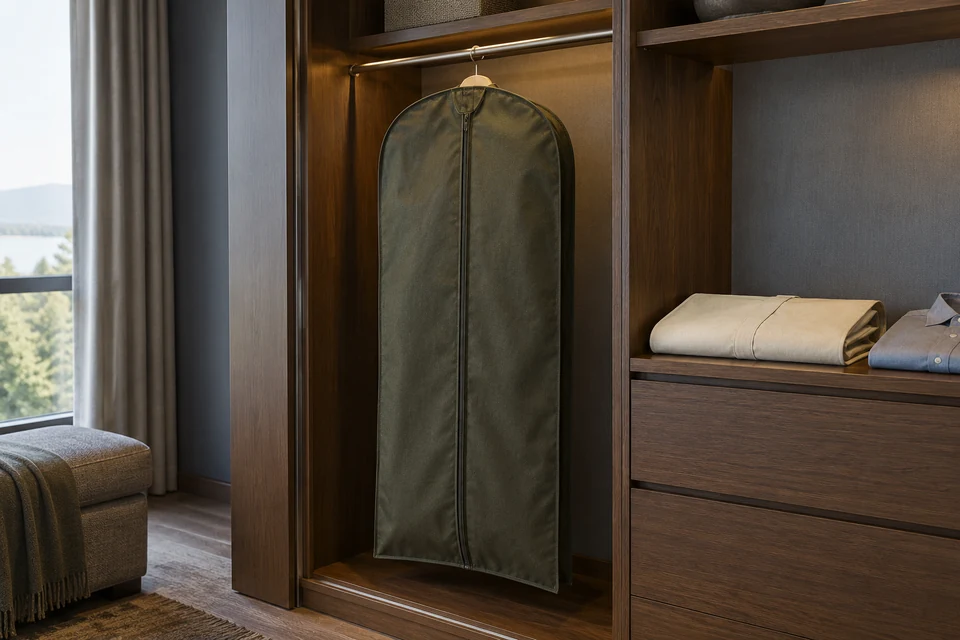
A textile garment bag may serve a hotel's wardrobe presentation, a guest clothing service or an identified transport handoff. Those are not the same brief as a bag used to collect guest laundry. Before comparing fabrics, establish which clothing the bag is expected to enclose, how it hangs and who opens it. A product described only as a suit bag leaves important decisions unresolved about coverage, hanger openings, closures and the delivered unit. This guide addresses the textile enclosure and its operational fit. It does not promise waterproofing, stain prevention, pest protection or a transport guarantee from an ordinary fabric-cover sample.
Choose the use case before the outline
Wardrobe presentation and transport need different decisions
List the clothing types and intended hanger arrangement for the proposed service. Decide whether the bag hangs inside a guest wardrobe, accompanies a handled clothing transfer or is supplied as a retail-style guest item. State whether it encloses one garment or an agreed combination. The guest laundry-bag guide is a useful contrast: a collection bag's capacity and carrying routine do not resolve the garment cover's hanging and enclosure requirements. Keep the two products separate in the purchasing schedule.
Agree which part of the service the hotel is prepared to offer and which claims it does not make. If protection during shipping or exposure to moisture is required, request a suitable design and evidence rather than attach those meanings to a decorative cloth bag. Identify the service owner who will approve the clothing handling and any guest-facing instructions. The sourcing brief should describe observable use conditions so suppliers can propose alternatives without being asked to promise an undefined level of protection.
- Identify the clothing and hanger arrangement.
- Separate wardrobe, service-transfer and guest-item scopes.
- Do not borrow a laundry-collection bag specification.
- Make protection claims an explicit evidence question.
Measure the enclosed clothing envelope
Include shoulders, length and the hanger opening
Review the proposed bag with representative clothing and the intended hangers. Record the finished bag dimensions and the relevant internal envelope, noting shoulder shape, garment length and any thickness that matters to the use. A flat rectangle measurement cannot show every part of a hanging garment. Ask for the pattern and measurement method in the technical pack. Specify whether the dimensions refer to the external bag, the usable enclosure or an agreed point on the actual sample.
Examine the hanger opening and its relationship with the clothing shoulder and bag closure. Confirm that the normal hanger can be positioned and removed without a workaround that damages the textile or forces the guest to change hangers. Review how the bag hangs in the actual wardrobe or service location; excess length can produce a different presentation there than in a tall studio. Keep any proposed folded transport position separate from the hanging approval, with its own recorded method and limitations.
- Use representative garments and actual hangers.
- Define external and usable dimensions separately.
- Observe the hanger opening in normal handling.
- Approve hanging and folded positions independently.
Review enclosure and visibility
Make closure access and identification deliberate
Compare closure locations and directions on a complete sample. Observe whether staff can open the bag, identify its contents under the property's approved routine and close it without trapping clothing. Specify zipper or other component details rather than accept any closure described as equivalent. The zipper-component guide offers related questions about component identity; the garment bag still needs its own full assembly and clothing-contact review. Do not infer attachment or transit performance from easy opening alone.
Decide whether an inspection window, identification holder or guest-service label is genuinely needed. If a window or contrasting panel is proposed, include its material and seam arrangement in the sample; it can change the cover's flexibility and appearance. Keep private guest information out of an uncontrolled permanent print. Where a logo is requested, use the logo approval process to control artwork and placement, but inspect it with the bag hanging because a flat embroidery placement can shift visually around the shoulder shape.
- Trial closure access with the intended clothing.
- Identify closure components in the bill of materials.
- Approve windows and identification features on the whole bag.
- Review branding in the hanging position.
Set the textile and care brief
Appearance must not stand in for protection evidence
Specify the offered composition, construction, finish, color and care route. Review the inside and outside surfaces against the intended clothing, paying attention to visible rough edges, loose sewing ends and trims. The fabric contact and snagging guide can support the discussion, but no casual rub trial should be presented as a universal guarantee for delicate garments. Identify the clothing limitations and any specialist assessment the service owner considers necessary.
When the hotel plans to reuse the bags, agree how they will be cleaned, dried, inspected and returned to service. Review the conditioned sample for dimensional change, closure operation, surface condition and retained presentation. A care instruction from another product made of a similar fiber is not enough. If the fabric supplier changes a finish or the maker replaces an internal trim, assess the effect on contact and care compatibility before accepting the new stock as the same item. Retain the evidence against the precise offered combination.
- Inspect internal as well as visible external surfaces.
- State composition and finish from documentation.
- Define reusable care and return-to-service checks.
- Review material and trim substitutions for clothing contact.
Compare a complete service unit
Clarify components, minimums and handoff ownership
Request prices for the exact purchased unit: bag only, bag with a hanger, or a defined service pack. Separate included accessories from photographs showing props. Specify folding, packing quantity, delivery identification and whether bags arrive prepared for immediate service use or require hotel preparation. The pack-completeness guide provides a related approach to counting what is actually enclosed. Do not compare an accessory-free bag price with an assembled presentation set as though they were equivalent offers.
Discuss sampling and minimum quantities against the approved fabric, size variants, closures and branding. The MOQ guide explains why a minimum must be tied to its actual production basis, not assumed from another accessory order. Retain the accepted bag and service-use record for repeats. Buyers can share a garment-cover brief showing clothing scope, hanger details, handling route and quantities; the availability and terms of an appropriate supply proposal should be confirmed rather than inferred from this article.
- Separate bag-only and accessory-included offers.
- Specify folding, pack count and receiving preparation.
- Tie the minimum to actual material and construction.
- Retain the service-use approval for repeat proposals.
Approve a garment bag as a complete clothing enclosure and service unit. Confirm hanger access, usable coverage, internal contact, care and included components without inventing protection claims from fabric appearance.