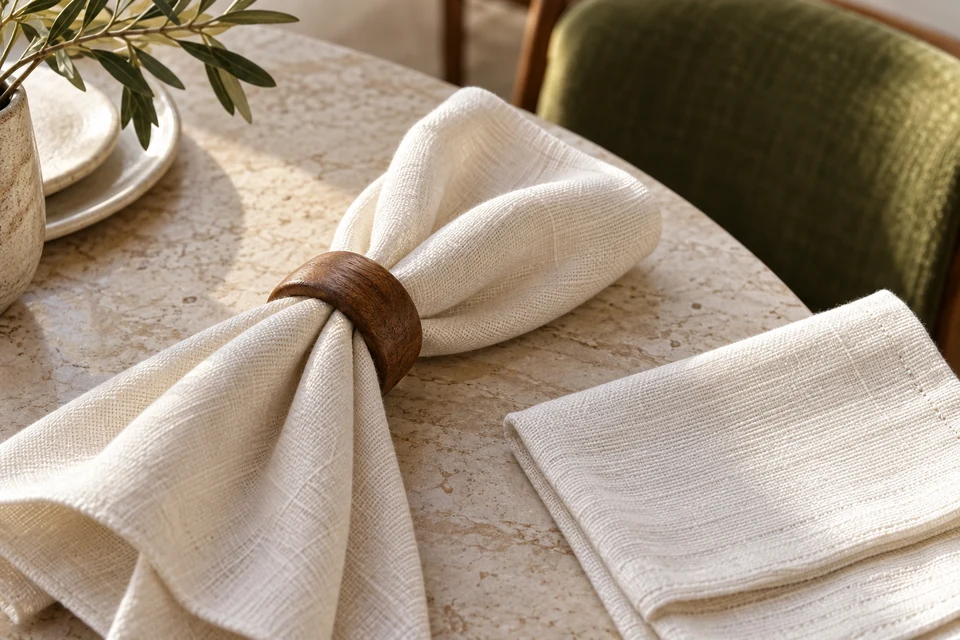
A napkin ring can turn an approved flat napkin into an inconsistent table presentation. The ring opening, surface finish, fabric bulk and time spent in the arrangement all belong in the buying decision. This review addresses the contact between the ring and textile, and the appearance when staff remove or reset it. It does not replace the napkin's dimensional inspection or establish a universal crease-resistance rating. Approve the actual combination used by the property rather than a decorative photograph alone.
Identify the ring and textile
Compare the working opening with the intended fold
Record the ring reference, internal opening, shape and surface in contact with the napkin. Include any joint or edge that the fabric passes across. A nominal outside dimension does not explain the space available for a folded textile. Link the napkin reference to the table-linen specification, including its fabric, finish, finished size and care state. Keep alternative rings separately identified during sample review.
Ask the restaurant team to show the intended fold or gathered arrangement. The same ring may behave differently with a narrow roll and a fuller fan. Do not force an oversize bundle into the opening just to reproduce a styling image. Purchasing should first decide whether the chosen ring and presentation are practical together, before discussing decorative variations or bulk quantities.
- Identify the internal opening.
- Review contact edges and joints.
- Name the exact napkin revision.
- Record the proposed folded arrangement.
Prepare the presentation trial
Use the property's normal preparation sequence
Use finished napkins prepared through the intended care and finishing route. Record whether they were freshly pressed, stored folded or taken directly from a display pack. These starting conditions matter when comparing the contact mark after release. The napkin construction and folding review covers the separate workmanship checks; an uneven hem should not be mistaken for a ring-contact issue.
Have staff assemble the selected arrangement using the ordinary service routine. Record preparation timing and storage before service, including whether settings are arranged shortly before guests arrive or held for a longer planned period. Do not invent an accelerated contact time and then present it as ordinary restaurant performance. If unusual storage is assessed, label it as an additional scenario.
- Record the initial finishing condition.
- Use the ordinary assembly routine.
- Identify the intended holding period.
- Separate extra scenarios from normal service.
Examine removal and reset
Look at the released fabric without hiding the contact area
Remove the ring using the normal service movement and inspect the affected area under consistent lighting. Record local creasing, surface marks, caught yarns or visible colour transfer if present. Do not assume that every visible line is permanent damage. Keep the observation tied to the time and condition at which it was made, with the unringed comparison nearby rather than reconstructed later from memory.
Ask staff to reset the napkin using the approved routine, without adding an unplanned pressing or treatment step. The surface-damage evaluation guide helps distinguish a pulled yarn from a fold mark. If marks raise a material compatibility question, obtain appropriate supplier or testing advice; do not improvise cleaning chemistry to make a sample pass for purchasing.
- Photograph the contact area after release.
- Distinguish creases from surface damage.
- Record any added reset work.
- Keep untreated comparison evidence.
Choose the operational combination
Compare revisions against the same presentation
If the result is unacceptable, compare a different ring opening, a revised fold or another napkin candidate while keeping the other variables identified. A new textile may also change drape and the restaurant's care process. Evaluate those consequences through the wash-trial and operating-cost review. A ring that photographs well but repeatedly requires extra preparation may not suit the intended service routine.
Separate appearance preference from a rejection for damage. The property may accept a relaxed gathered look while rejecting a visible snag. Write those distinctions into the sample decision instead of a single unexplained pass box. Where purchasing selects more than one ring design, keep a combination matrix; approval of one smooth surface should not silently extend to another finish or construction. Include the service reset in the comparison record as a concrete decision field. If one arrangement can be reset through the normal routine while another needs an additional approved finishing step, purchasing should know that difference before selecting solely on appearance. The record can identify the step without inventing a time saving or labour cost. Ask staff whether the proposed arrangement remains practical when multiple tables are prepared, and preserve any limitation they identify. A small sample review does not prove performance at every event, but it can expose a dependency that deserves resolution before the ring and textile are ordered together.
- Change and identify one variable at a time.
- Account for normal reset effort.
- Separate appearance preference from damage.
- Keep distinct combinations in the approval record.
Carry the decision into ordering
Preserve a reference that staff can reproduce
Record the ring, napkin, fold, care state and holding arrangement in the approved sample file. Include the accepted appearance before removal and after the normal reset. Name the property role that accepted the presentation, and keep technical concerns open until the appropriate reviewer resolves them. A styling approval is not a blanket acceptance of all accessory performance.
Use the reorder control process when either component changes. A visually similar replacement ring may have a different opening or contact surface. Send the intended ring and napkin references with a sample request so the sourcing team can assess the actual interface and propose relevant alternatives without guessing the restaurant's setup.
- Preserve before-and-after presentation references.
- Identify the accepting property role.
- Keep unresolved technical issues visible.
- Reassess substituted rings or textiles.
Approve the napkin-ring combination using the intended preparation, holding and reset routine; do not treat a styled photograph as evidence of contact compatibility.