A tablecloth can meet a nominal width and length while still presenting poorly on the actual table. A seam may fall across the guest-facing surface, the finished drop may expose a table base, a square cloth may rotate unevenly on a round top, or laundering may shift the drape enough to affect banquet setup. Buyers should therefore approve table linen as a table-and-cloth system rather than ordering from a generic size name. The project brief needs the real table geometry, intended presentation, fabric direction, seam policy, care route and acceptable setup range before the supplier develops a pattern. A full-size mock-up then connects those written inputs to the way staff center, dress and clear the table. This process does not create a universal drop for every property; it creates evidence that the selected construction works for the named furniture and operating method. The same record also gives quotation, sampling, inspection and repeat-order teams one controlling reference instead of a photograph with no dimensions. It helps the supplier calculate usable width, panel count and labor from the same construction that the property will approve, and it exposes furniture variations before bulk fabric is cut. The following route keeps the approval practical without turning visual preference into an unsupported performance promise.
1. Map the tables, service use and presentation direction
The furniture matrix comes before the cloth size
List every table type covered by the order, including top shape, measured length or diameter, width, height, edge profile, base position and any joining configuration. A banquet round, rectangular conference table and paired buffet module create different drop and seam decisions. Record whether the cloth is used alone, over an undercloth or with a decorative overlay, and identify the guest-facing sides. The broader hospitality program route helps align table linen with the property's operating brief.
Measure representative physical tables rather than copying only a furniture catalog. Tops, protective pads and joining hardware can change the effective size, while mobile tables may vary across inventory. Define the intended setup reference: centered on the top, aligned to a room axis, matched to a motif or positioned around service access. Where a property owns several nominally identical tables, record the observed range and decide which units the mock-up must cover before fixing the finished cloth dimensions.
- Record top shape, dimensions, height, edge profile and base clearance.
- Identify undercloths, overlays, joined tables and guest-facing sides.
- Measure representative furniture and note the actual dimensional range.
- State the centering and presentation reference used during approval.
2. Engineer the panel and seam map
Fabric width and visual direction determine where joins can sit
Compare the required finished dimensions with the usable fabric width, selvedge exclusion, shrinkage allowance and pattern direction. If a multi-panel construction is needed, draw every seam on a top-view map and name its position from stable cloth references. A seam hidden near a table edge can behave differently from one crossing the center, particularly after laundering or when the cloth is viewed under directional light. Link panel identity and cutting direction to the usable-width and cutting-yield guide when quotation assumptions depend on width utilization.
Specify seam type, allowance, stitch route, pressing direction and acceptable bulk at intersections. Mirrored seams may create a more balanced presentation, but symmetry should be defined from the table center rather than assumed from panel widths. For stripes, jacquards or directional surfaces, state the orientation and matching rule separately. Keep seam placement on the bill of materials and pattern revision so a later fabric-width substitution cannot move the join without a new approval.
- Draw all panels, joins, grain directions and finished edges on one map.
- Name seam positions from the cloth centerline or finished edge.
- Specify seam construction, pressing and intersection requirements.
- Reopen approval if fabric width, pattern direction or panel count changes.
3. Approve finished drop and edge behavior
Measure from a defined table reference after the cloth is centered
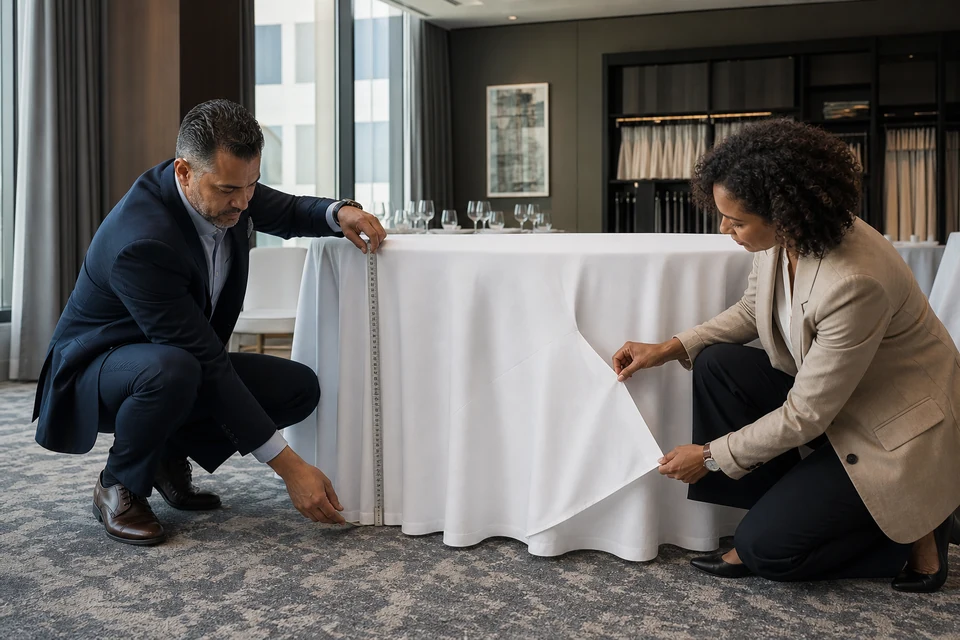
Define finished width and length, measurement condition and tolerance by table direction. Then state how drop is checked: from the top surface, lower edge of the tabletop or another named landmark. Measure each relevant side after centering without stretching the cloth. Review floor clearance, access to the base, seated-guest contact and service-side handling. A numeric drop alone is insufficient when the furniture base or room presentation creates a different functional limit.
Specify edge finish, hem depth, corner method, thread, pressing and visible topstitching. Corners can pull upward or become heavy when seam allowances stack, so inspect them while hanging rather than only flat. For napkins or coordinated pieces, use the mitered-corner and square-fold inspection guide as a related construction reference, but keep the tablecloth acceptance fields specific to its scale and drape.
- Define finished dimensions and the exact cloth-conditioning method.
- Name the table landmark used for every drop measurement.
- Review floor clearance, base access and service-side handling.
- Inspect hem depth, corner bulk, pressing and visible stitch consistency.
4. Run a full-size table mock-up and laundry trial
The approval must survive setup, clearing and the planned care route
Use the intended table, pad and presentation layers to build a full-size mock-up. Ask banquet or housekeeping staff to unfold, center, adjust and clear the cloth using the planned operating method. Photograph the controlled views, but also record table identity, cloth sample, orientation, measured drops and open actions. The hotel textile mock-up approval record provides a useful structure for keeping visual decisions tied to a named physical sample.
Launder trial cloths through the agreed process or a documented simulation, condition them and repeat the same table setup. Use the hotel linen wash-trial guide to preserve load and care-route identity. Review dimensional change, seam puckering, edge torque, corner lift, shade difference between panels and changes in drape. Approve the exact sample and sequence; do not describe one trial as indefinite proof for every laundry condition.
- Record table, pad, cloth orientation and setup method for the mock-up.
- Measure all controlling drops after staff center the cloth normally.
- Repeat the setup after the documented wash and conditioning route.
- Close seam, drape, handling and dimensional actions before bulk release.
5. Inspect bulk lots and preserve the reorder reference
Sample across tables, sizes, lots and production periods
Build the final inspection sheet from the approved table matrix and panel map. Verify cloth identity, finished dimensions, seam position, edge finish and presentation on at least the relevant representative tables. A multi-size order should not be released from measurements of one easy size. Use the final inspection checklist to connect workmanship findings with pack quantity, carton identity and shipment disposition.
Retain the approved specification, pattern revision, fabric reference, washed mock-up sample and inspection summary for repeats. If tables, fabric width, laundry route or presentation direction changes, reopen only the affected decisions and issue a new revision. Buyers can request a full-size table-linen sample before bulk and include table inventory, quantities, delivery phases and destination in the project brief. This makes supplier comparison measurable without hiding property-specific requirements.
- Stratify inspection by size, color lot and relevant production period.
- Verify seam position and drop on the correct representative table.
- Link findings to purchase order, lot, sample and inspector date.
- Reapprove affected fields when furniture, material or care route changes.
Approve tablecloths against real furniture: freeze the table matrix and seam map, define drop and edge references, run the full-size setup and laundry trial, then preserve a lot-linked bulk and reorder record.