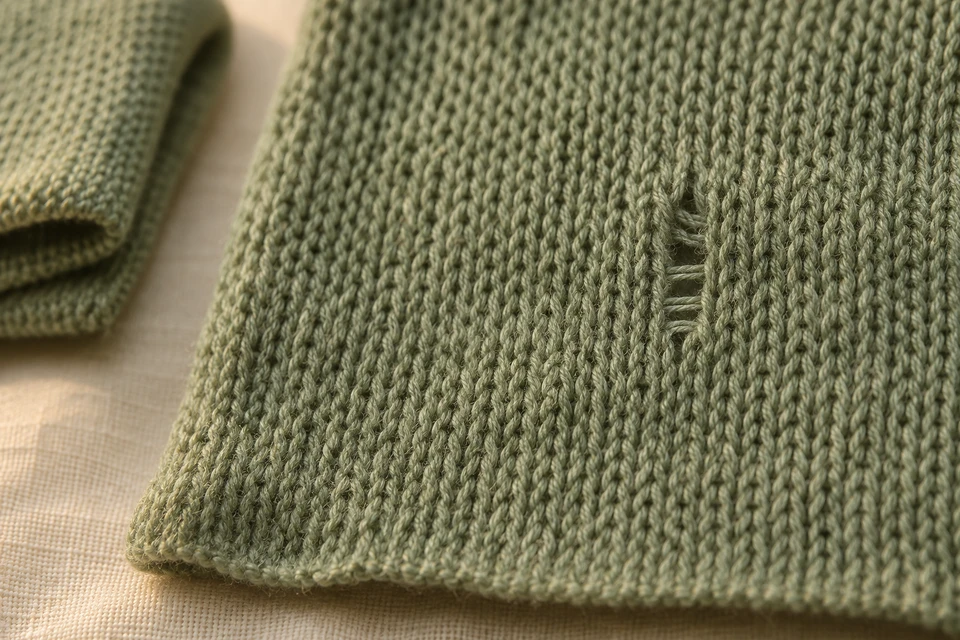
An opening in a knitted bedding panel is not automatically a defect, but calling it part of the design is not enough to approve it either. The buyer needs the accepted stitch pattern and a physical comparison that shows how the loops are supposed to connect. A deliberately open motif and a local loss of loop continuity can look confusingly similar in a quick image. The receiving decision should therefore compare the actual loop path with the approved construction before assigning a cause or allowing a repair.
Start with the approved pattern, not the size of the opening
Deliberate openwork has a defined place in the design
Request a reference that identifies the intended open areas and the surrounding knitting. For a patterned panel, mark where the motif repeats and how it changes near edges or joins. A finished sample is useful, but a clear construction explanation from the maker can help the technical reviewer understand why an opening is present. Do not treat every gap as acceptable simply because other gaps exist elsewhere in the design.
Compare the suspect location with the corresponding position in an accepted repeat or sample. Note whether the same loop arrangement is present, not only whether the openings have similar dimensions. A gap enlarged by handling may have a different explanation from an intentionally formed opening. Record the physical condition before manipulating it and keep the original comparison available for any later investigation.
Follow the local loop path
Surface photographs should support, not replace, examination
Use suitable magnification to examine how the yarn connects around the finding, viewing both sides where that is relevant. Identify the direction of the loop columns and the neighbouring rows. Describe the interruption that is actually visible. Avoid pulling the fabric apart to demonstrate a larger hole or removing a loose end before the technical owner has reviewed it; either action can alter the evidence you need to understand the initial condition.
CottonWorks includes dropped stitches in its examples of double-knit defects. That is a useful technical category, not a diagnosis for every opening in a bedding panel or every knit structure. Ask a qualified textile reviewer to identify the actual construction and whether the observed loop path is missing an intended connection. Keep any proposed machinery or handling cause provisional until there is supporting evidence from the sample and relevant production history.
Distinguish a missing connection from a displaced one
Similar appearances can lead to different responses
Ask the reviewer to explain whether yarn is missing, broken, displaced or arranged as intended by the pattern. The buyer's record can use an annotated photograph and a concise written observation. It should not collapse all unusual openings into a single label such as snag or dropped stitch when those terms imply different conditions. An accurate description makes it easier to ask the supplier for the appropriate investigation.
Record whether the finding lies within the panel, at a joining seam, near a bound edge or beside a deliberate opening. These contexts may require different supporting information. If the area is partly concealed by assembly, ask what examination can be performed without compromising the evidence. Do not infer an internal loop arrangement from the face alone when the relevant connection cannot actually be seen.
Assess how widely the finding occurs
Separate a pattern instruction from a local event
Compare the same motif position across the agreed sample set. If the same loop arrangement appears systematically, request the relevant pattern explanation before deciding whether it is intentional or an incorrectly executed instruction. If the finding is isolated, preserve its location and item identity. Neither repeated occurrence nor rarity determines acceptability by itself; the accepted construction remains the comparison point.
For material still on rolls or in panels, maintain the available production and position references. For finished bedding, record the article version and where the affected area sits in use. Agree how additional examination will establish the scope of the issue. A close-up from one unit cannot justify a claim that an entire shipment is defective, and a clean second unit cannot by itself clear the remainder of the delivery.
Control any proposed repair
A tidy face does not demonstrate the restored construction
If the supplier proposes repair, require the responsible technical team to explain what will be restored and how the result will be evaluated. Identify repaired samples and retain the before condition. A cosmetic treatment that hides an opening is not automatically equivalent to restoring the accepted loop structure. Do not authorise an undocumented repair simply to make the item pass a distant visual check.
Decide whether any further handling or care evaluation is needed for the repaired construction under the project's requirements. Record the method and actual results rather than asserting that a repair is permanent. If the evidence is insufficient, keep the disposition unresolved. The person approving appearance and the person approving technical suitability may need different evidence, and neither decision should silently substitute for the other.
Make the receiving instruction recognisable
Give inspectors examples of both intended and unwanted openings
Retain a small set of clear, identified reference views showing approved openwork and the specific nonconforming condition, where confirmed. Include the same orientation and enough surrounding pattern to locate the comparison. State who reviews ambiguous findings. This is more useful than a broad instruction to reject holes, which may incorrectly reject the design while overlooking a subtle missing connection elsewhere.
For an FY Bedding knit project, provide the intended article, stitch-pattern direction, approved sample information and the receiving concerns you want addressed. Ask which development and inspection evidence can be agreed for the proposed construction. Do not infer a particular knitting capability or performance from a reference image. A purchasing brief should establish what the finished loop structure must be and how it will be recognised, while leaving unsupported claims about cause, repair life or stock availability out of the offer.
Compare an opening with the approved loop arrangement at the same pattern position, preserve the original specimen and obtain technical evidence before naming a cause or accepting a repair.
Method references: CottonWorks: textile-defect examples including dropped stitches.