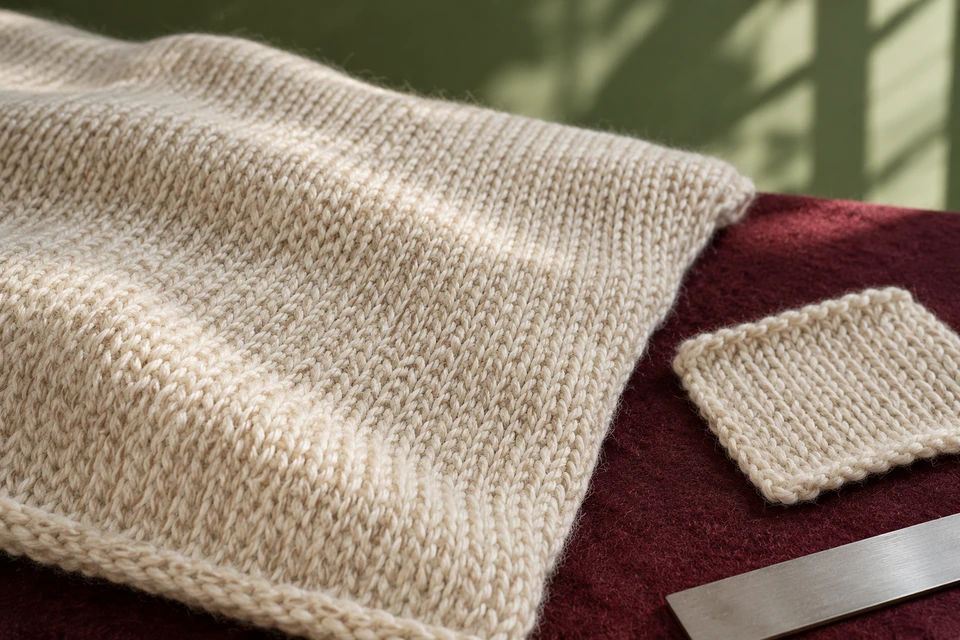
Two knitted cushion covers can use the same named yarn and still finish at different dimensions. The buyer needs a link between the fabric's measured stitch-and-row gauge and the finished cover, including its borders and seams. A small sample stretched until it reaches the requested size does not provide that link, and neither does a yarn label on its own.
Establish what the gauge describes
Use the actual fabric construction
Ask the supplier to identify the yarn, stitch structure and sample preparation represented by the gauge measurement. If the cover combines a plain centre with a different border, keep those areas distinct. A gauge measured through a pulling border or a decorative cable may not represent the plain field used for calculating the panel. Record where the measurement was taken so the result can be reproduced.
The Knitting & Crochet Guild explains gauge review using a representative swatch and notes that relaxation can change an elastic sample's measured dimensions. Its guidance concerns hand-knitting practice; it does not establish a machine-knit factory tolerance or a standard conditioning method for your purchase. Use the underlying distinction between construction and measured state to ask the supplier for an agreed, project-specific measurement procedure.
Measure without stretching the answer
Define the sample state before comparing numbers
Lay the swatch on a flat surface without pulling it to a target width. Agree how long it rests after the specified preparation and whether washing, finishing or another process has already occurred. Record those conditions beside the measured stitch and row counts. If the supplier reports a different gauge after a later finishing stage, retain both results with their different states rather than replacing one number without explanation.
Measure a representative internal area away from distorted edges and repeat the observation at agreed locations. Include partial stitches or rows consistently rather than rounding every observation in whichever direction makes the target easier to meet. The result should describe the sample that exists. A final tolerance must be agreed for the product; this guide does not supply a universal acceptable variation for all yarns, structures or manufacturing methods.
Translate the gauge into a panel proposal
Use arithmetic as a planning check, not a release certificate
For an illustrative calculation only, a plain field measuring twenty stitches over ten centimetres would contain about eighty stitches across a forty-centimetre field. That arithmetic excludes borders, seam allowances, shaping and any other construction feature. It is not a recommended specification for a cushion. The useful question is whether the supplier's proposed panel count follows from the documented fabric gauge and the intended field size.
Make the same check along the row direction, which need not behave like the width. Ask the supplier to show where a complete pattern repeat or border changes the count. If the proposed dimensions require an adjustment, review the resulting panel rather than approving a mathematical answer alone. Rounding to a convenient stitch repeat can change the size or balance of the finished face and should remain visible to the buyer.
Review the assembled cover in its two states
Empty dimensions and filled appearance answer different questions
Measure the completed empty cover according to the agreed method, then insert the identified cushion pad. Examine whether the knit is pulled open, the border is distorted or the closure is placed under unwanted strain. The filled appearance may be intentionally taut, but that choice should not conceal an undersized empty cover that departed from the approved specification. Record the pad used so later comparisons are meaningful.
After the agreed handling or care trial, repeat both observations. Note whether the cover returns to its approved empty shape and whether its filled presentation changes. Do not infer long-term recovery from one informal stretch, and do not substitute a larger or softer pad merely to improve the photograph. A revised insert-to-cover relationship is a design decision that requires its own approval and supply description.
Keep gauge changes in the order record
A yarn substitution needs more than a colour match
Retain the measured swatch, panel proposal and finished-cover sample as a linked set. If yarn, stitch construction or finishing changes, ask whether the original relationship still holds and request the necessary revised samples. A visually similar yarn can be an unsuitable substitution if the maker cannot reproduce the approved dimensions and surface behaviour with the original panel plan.
For a quotation or development enquiry, provide FY Bedding with the intended finished size, desired knit appearance, insert details and sample measurement method. Ask for the supplier's proposed gauge and construction rather than prescribing an unverified machine setting. Confirm minimum quantities and development timing separately. A clear gauge record makes technical discussion more precise, but it does not establish production capability, test performance or delivery availability without project evidence.
Keep the relaxed swatch, stitch-and-row counts, panel construction and identified filled cover linked. Never stretch a sample to obtain the requested number or use gauge arithmetic as a substitute for the completed-cover review.
Method references: Knitting & Crochet Guild: tension-square measurement.