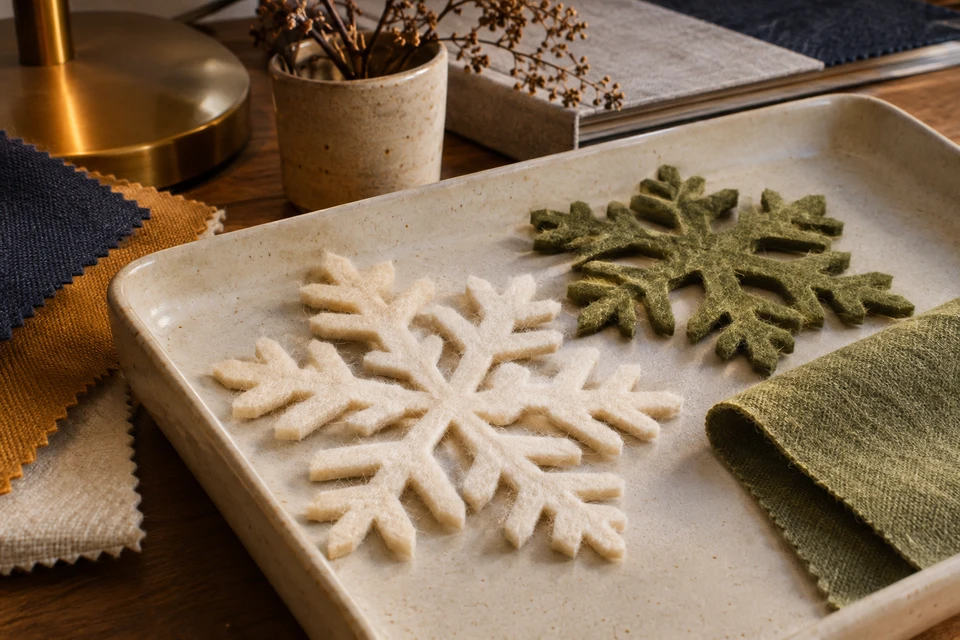
A precise snowflake outline does not tell a buyer whether the edge of a laser-cut felt piece is acceptable. The material, process and final preparation all affect what arrives in the retail pack. For Christmas felt development, approve the actual cut-edge condition rather than treating laser cut as a quality guarantee.
- 1. Identify the complete material before discussing the edge
- 2. Separate through-cuts from surface decoration
- 3. Judge the edge against the chosen colour and texture
- 4. Inspect the delivered preparation state
- 5. Review the edge after the intended use and care evaluation
- 6. Release a material-and-process sample together
Identify the complete material before discussing the edge
Felt is a structure description, not one fibre
Ask for the proposed fibre composition, thickness, colour and any backing, coating or adhesive layer. A wool-rich felt and a synthetic felt should not be assumed to respond identically to laser processing. Trotec's textile guidance distinguishes dark-edge concerns on natural textiles from melting and sealing effects in synthetic materials. That distinction supports a material-specific sample request; it does not establish a universal result for the buyer's proposed felt.
The supplier's competent process owner should confirm compatibility of the exact material with its equipment and safety arrangements. Do not ask purchasing staff to experiment with unidentified textiles or copy machine settings from an online guide. A small sample that looks clean is not proof of safe processing. Keep material identification and process suitability as prerequisites, and leave operating parameters and workplace controls with the responsible qualified personnel.
Separate through-cuts from surface decoration
The drawing needs distinct operation types
Mark which lines are intended to cut completely through the felt and which, if any, are intended as surface engraving. A star outline, an internal opening and a shaded decorative line perform different roles. Ask the maker to identify these operations on the agreed design file. A single unlabelled drawing may otherwise be interpreted as a request to cut away a feature that was meant to remain visible on the surface.
Review a physical sample containing the important line types and tight changes of direction. Record the front and back orientation, especially where the material has different faces or an additional layer. If the maker changes an engraved detail to a cutout, assess the altered product separately. That substitution is not merely a cleaner edge; it changes what material remains in the delivered decoration and may change its visual and assembly behaviour.
Judge the edge against the chosen colour and texture
Do not use one generic clean-edge instruction
View the finished cut boundary under ordinary agreed lighting, then inspect closer where necessary. Note visible darkening, a fused-looking bead, loose fibres, residue or an irregular transition between the face and edge. Record the condition with an uncut swatch beside the finished piece. This comparison helps the team separate the normal appearance of the supplied felt from a change introduced during processing or subsequent handling.
Agree what is acceptable for each material and colourway using named samples. A dark edge may be barely visible on a deep green piece but obvious on cream. Do not approve only the darkest colour and assume the rest of the assortment is covered. Likewise, an edge that feels firmer than the face is an observation requiring a product decision, not automatic evidence of better durability or a reason to describe the article as fray-proof.
Inspect the delivered preparation state
Cleaning and separation must not be left to the retailer
Ask what happens after cutting: how removed pieces are separated, whether the material is cleaned or otherwise finished, and what state is packed. Compare samples in that exact delivered condition. Do not approve a specially groomed display piece while the production offer includes loose fragments or undeclared preparation work. Photograph the narrow recesses and internal openings as well as the broad outer edge so the record covers the difficult areas.
Use a controlled review to check whether ordinary handling reveals residue or loose cut fragments, with the method agreed by the responsible reviewer. Avoid improvising chemical cleaning or scraping a fused edge to make the sample pass. If further preparation is needed, the supplier should define it, repeat the sample and include it in the quotation. A change in post-cut preparation may affect the appearance or dimensions that were previously accepted.
Review the edge after the intended use and care evaluation
Appearance approval is not a protection claim
State the intended decorative use and have the product owner identify any relevant evaluation. A hanging decoration, a tabletop display piece and a component sewn onto a textile do not automatically share the same requirements. Review the cut-edge reference after the agreed care or handling procedure and retain the observations. If an edge stiffens, changes colour or sheds visible fragments, decide whether the material, route or design needs revision.
Do not turn a visual edge check into a statement that the product is heatproof, child-safe or suitable for every surface. Those claims require their own evidence. If a sample includes an engraved area, inspect that area separately from the through-cut boundary. The two operations can produce different conditions, and an acceptable outer outline should not conceal an unresolved surface treatment inside the motif.
Release a material-and-process sample together
Compare offers on the same finished scope
The buying file should connect the authorised Christmas artwork, exact felt reference, operation map, accepted edge samples and delivered preparation. Ask how material changes, cutting complexity and finishing work affect sample charges and minimum quantities. Keep alternative cutting routes clearly identified if the supplier proposes them. A visually similar die-cut or hand-cut sample may be useful, but it is not evidence that the quoted laser route has been approved.
Send FY Bedding the intended product use, colour assortment and critical edge views with the development enquiry. Request confirmation of the proposed supply route and the evidence needed for that article. Agree milestones only after the actual material and finish have been assessed; neither a digital cutting file nor a small decorative size proves immediate production availability. The approved reference should make the delivered edge condition unmistakable to the receiving team.
Identify every material layer, distinguish cuts from engraving, compare each colour's edge with an uncut swatch, and approve the supplier's actual post-cut preparation before ordering.
Method references: Trotec: material-dependent textile laser-cut edges.