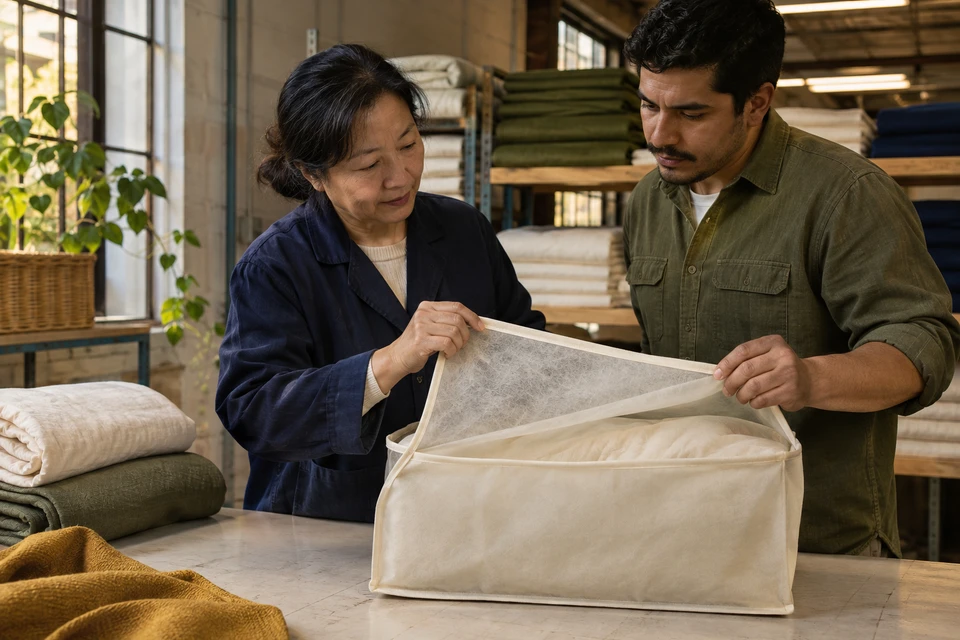
The word spunbond identifies a nonwoven production route, not a complete bedding-bag specification. A buyer still needs to know the material, the web construction and whether other layers or treatments are present. Those details matter when comparing packaging offers that look similar in a photograph. Start by identifying the actual bag substrate, then connect it to the finished seams, closures and any claims proposed for the pack.
Establish what spunbond describes
Process identity is not the whole material identity
STFI's nonwoven process overview places spunbond within filament nonwoven production and describes a range of processing and bonding capabilities. The useful purchasing distinction is the filament web, rather than a woven arrangement of crossing yarns. That technical background does not establish the polymer, strength or barrier properties of an unidentified bag. Ask the proposed source to describe the actual material it intends to supply.
Record the supplier's substrate reference, declared polymer or composition, fabric mass and any other agreed material dimensions. If the offer says only nonwoven, ask whether spunbond is in fact the intended route. If spunbond is named, do not automatically complete the specification with polypropylene or another polymer. The commercial wording and the sample identity should agree before a buyer begins comparing price or discussing finished-bag performance.
Identify every supplied layer
A face texture can conceal a different stack
Ask whether the proposed bag panel is a single web or a combined construction with a film, coating, lining or another nonwoven layer. Have the supplier explain what remains in the finished panel. Inspect both faces and a representative edge, but keep visual observations separate from the written material declaration. A visible bonding pattern or smooth face alone cannot establish the full stack or the identity of a concealed layer.
Keep each construction option under its own reference. If one offer contains an additional layer and another does not, the buyer should see that difference in the comparison rather than treating the same bag colour as evidence of equivalence. Request clarification where the layer description is incomplete. Adding a layer may change the proposal, but it does not by itself establish a specific protective function or justify a claim that has not been evaluated.
Relate the web to the bag assembly
Approve the material where joins actually occur
Review a complete bag made from the identified substrate. Mark which panels use which material and how seams, binding, handles and closures are incorporated. A roll sample cannot demonstrate the condition of a finished corner or handle attachment. Ask the supplier to identify the joining route and inspect representative areas without assuming that every nonwoven bag is sewn, welded or constructed in the same way.
Observe local distortion, visible tearing, open joins or other concerns in the supplied sample and refer them to the technical owner. Do not diagnose a cause from a single photograph or prescribe an equipment setting. The assembly may need revision even when the substrate matches the material record. Keep bag-fit and repacking trials as separate checks: successfully fitting a duvet inside does not approve the filament web, and a correct web description does not establish convenient reuse.
Define claimed functions independently
The process name does not prove protection
List the functions the buyer actually requires, such as presentation, handling or storage, then identify which claims need supporting evidence. Do not infer water resistance, dust exclusion, breathability or repeated-use performance from spunbond alone. Any assessment should address the actual substrate and relevant complete-bag construction. A material observation may be useful without establishing the behaviour of seams, openings and closures in the intended storage arrangement.
If the proposed sales copy includes a protective statement, ask what specific evidence supports it and which conditions it covers. Keep unsupported language out of the approved description while the question is resolved. This is not a recommendation to market the bag as a technical barrier. It is a way to prevent a broad packaging term from turning into an accidental promise about the bedding it contains. No result should be invented to fill a missing supplier document.
Check the delivery material against its reference
A familiar texture is not enough
Retain an identified substrate piece and a finished bag from the approved construction. Agree which incoming checks the buyer and supplier will use to compare delivered material with those references. The checks may include the stated mass, dimensions, surface appearance and relevant assembly features, using methods selected by the responsible team. Record the lot and source information needed to investigate a mismatch without imposing an unsupported universal tolerance.
Ask for notice before changing polymer, web source, additional layers or joining route. A bag that retains the same size and colour may still contain a different material system. Review the affected requirements before accepting the substitution. Where evidence was gathered for the earlier construction, determine whether it remains applicable rather than carrying it forward automatically. The important trace is from the delivered bag back to the exact combination that was approved.
Compare the complete packaging offer
Keep material and commercial scope aligned
Request quotations that identify the substrate, layer stack, bag dimensions, closure, seam construction and pack quantity. Ask how minimums and sample timing apply to the selected combination. If a supplier proposes a lighter material or another construction to change cost or availability, treat it as a separate option with its own sample. A smaller price difference is not meaningful if the offers describe different bag systems under one abbreviated product name.
For an FY Bedding packaging discussion, send the intended contents, handling context and the material information already available. Ask for a representative bag and confirmation of the proposed source and construction. Do not assume that a nonwoven packaging option is in stock or that it provides an unverified protective benefit. Release an order only when the buying team can identify the filament-web proposal, recognise every supplied layer and connect that material to the reviewed finished bag.
Name the actual substrate and polymer, identify additional layers, inspect the complete joins, and require separate evidence for any claimed bag function rather than relying on the word spunbond.
Method references: STFI: filament nonwoven production processes.