A pallet corner board is part of the packed-load interface, not a substitute for a qualified transport design. For bedding buyers, the useful approval question is whether the proposed board contacts the actual cartons as intended without introducing an unacceptable pack condition. A photograph of a tidy pallet cannot answer that question alone. This guide separates corner-board contact review from carton compression ratings, restraint design and claims about transport performance, which require their own competent assessment and evidence.
Identify the contact assembly
Describe the board and the packed cartons together
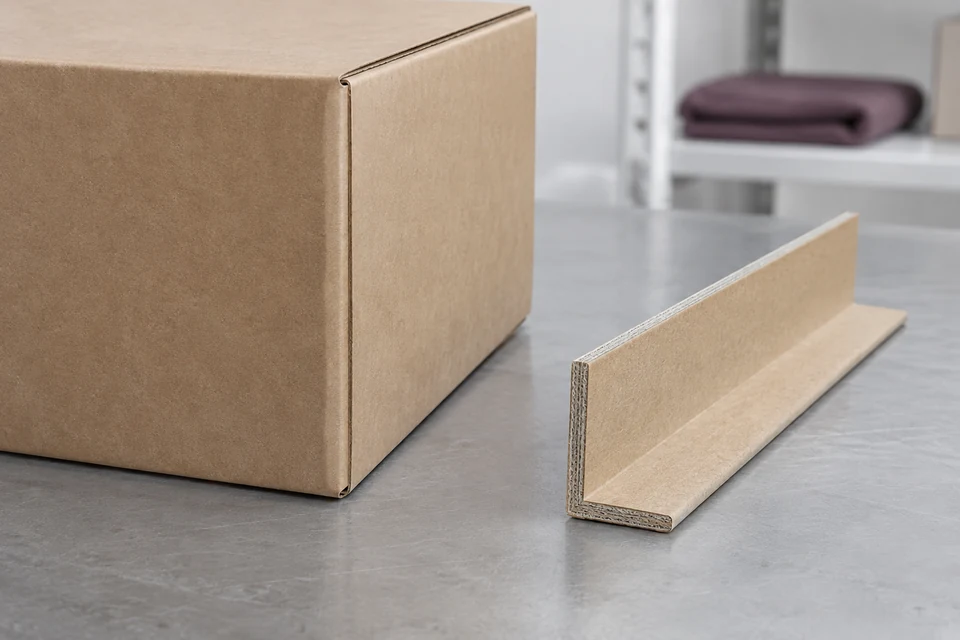
Start with the actual filled carton, pallet arrangement and proposed corner-board reference. Record board length, profile and the supplier's identification rather than approving a generic brown protective strip. The carton stacking review remains a separate input: a corner board does not automatically raise a carton's declared stacking capability. Ask the responsible packaging specialist which parts of the assembly are intended to contact and which dimensions require control.
Map where the board starts and ends relative to carton edges, joins and the top of the load. Photograph those relationships with enough context to identify the location. If the load contains more than one carton format, review each interface rather than treating the pallet as one uniform box. Record the approved arrangement in the specification toolkit so that the next packing team can reconstruct the intended contact without guessing from a distant warehouse image.
- Identify the board reference and profile.
- Use the actual filled carton format.
- Record start and end positions.
- Keep stacking evidence separately controlled.
Review the proposed packing method
Do not improvise restraint settings during procurement
Obtain the packing method from the team responsible for load design and safe handling. Procurement can record the specified sequence, material references and visible acceptance fields, but should not invent strap tensions or handling tests. If a board is proposed as part of a restraint system, ask that team to assess the complete arrangement. The buyer's contact review is not an engineering approval for the pallet or permission to depart from the site's operating procedures.
Use a representative packed unit for the observed trial and identify who assembled it. Record substitutions, temporary materials or hand adjustments that make it different from the proposed routine method. A successful demonstration performed by a specialist may still leave unanswered questions about repeatability on the normal line. Link the trial record to the buyer resource file, retaining the packing instruction and the scope of the observation together for later sourcing decisions.
- Name the responsible packaging reviewer.
- Record the routine packing sequence.
- Flag non-production materials or adjustments.
- Do not infer load approval from appearance.
Examine accessible carton surfaces
Locate impressions before assigning a cause
At the agreed review point, examine accessible contact areas for localized creases, scuffing, punctures or other changes relative to the starting condition. Follow the site's authorized procedure for opening or removing the restraint; do not cut a loaded assembly casually for a photograph. Record the carton position and board reference with each observation. An indentation close to a board is a finding to investigate, not proof that the board alone caused it.
Compare the outside observation with the inner packaging and product condition when an authorized opening is appropriate. Keep a cosmetic carton issue distinct from damage to a reusable consumer pack or the textile itself. The final inspection checklist can hold those separate findings. If the receiving specification allows a defined carton mark, preserve its limits and example; do not extend that decision automatically to different product packs or customers.
- Record the location of each visible change.
- Compare against the starting condition.
- Separate carton, inner pack and product findings.
- Preserve approved appearance examples and limits.
Compare revisions under a controlled scope
Change one identified arrangement at a time
When the team proposes another board profile or position, record the reason and the affected packing instruction. Repeat the relevant review with identifiable samples and comparable observation points. A thicker-looking board is not inherently the correct solution, and a cleaner carton in one trial does not establish performance across a shipping network. Ask for the evidence appropriate to the proposed shipment rather than replacing transport qualification with an informal visual comparison.
Connect the revision to the product and packaging evidence plan, stating which questions the contact trial answered and which remain open. Changes to carton dimensions, filled weight, pallet pattern or restraint materials can alter the approved assembly and should trigger the responsible team's review. Keep earlier observations available so that a later cost-reduction proposal does not silently reintroduce a rejected contact arrangement under the same packaging description.
- Identify each revised assembly.
- State the reason for the proposed change.
- Use comparable observation points.
- Reopen assessment when related packing inputs change.
Release a checkable packing reference
Turn the approved interface into receiving evidence
The release record should show the accepted board reference, placement, carton formats and observable condition criteria, alongside the separately approved load-design documents. Specify how the packing team will record compliance and which exceptions require a hold. Avoid vague instructions such as protect all corners well: they invite different interpretations and make receiving disputes difficult to resolve. The useful outcome is a reproducible interface supported by the appropriate technical decisions.
Send the sourcing team the filled-pack details, intended distribution route and existing packaging evidence when requesting a proposed corner-board arrangement. Ask for a representative sample and an identified packing method, not a promise that protective boards prevent all damage. At reorder, reconcile the material reference and placement against the approved record before treating a visually similar board as equivalent. This preserves a clear boundary between observed pack contact and unproven shipping claims.
- Release material and placement together.
- Define exceptions that require review.
- Preserve the separate load-design approval.
- Reconcile substitutions before routine use.
Approve corner-board contact on an identified packed assembly, while keeping load design, restraint settings and transport qualification under their own competent review.