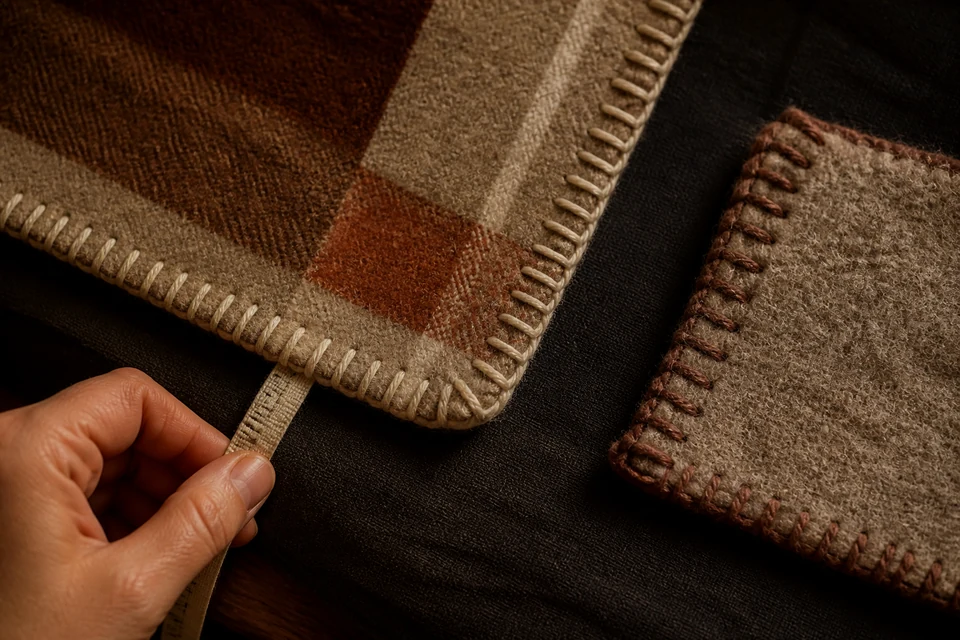
Whipstitch edging is both decorative and structural. Its spacing, penetration and tension define the border rhythm while protecting cut or brushed blanket edges from distortion. A straight section may look uniform while corners bunch, yarn joins protrude, stitches miss the edge or laundering changes the relationship between blanket body and edge yarn. The buyer should approve yarn, machine setup, measurement method, corner appearance and care response, then inspect the full perimeter rather than a convenient short segment. This guide is a procurement-control framework, not a substitute for the buyer's specification, a test standard or a contract. It intentionally avoids invented factory capabilities, certificates, universal tolerances and automatic legal conclusions. The useful outcome is a repeatable approval and evidence route that lets design, production, quality, logistics and receiving teams compare the same item under stated conditions.
1. Release the edge-finish master
Yarn and blanket body must be approved together
A buyer-ready specification names the reference, method and decision owner. Define edge-yarn material, count, twist, color, finish, stitch construction, penetration depth, finished border width and approved face. Without that discipline, Substituting a similar-looking yarn can change abrasion, shrinkage, bulk and color response even if first-piece photographs appear acceptable. The lot-traceability guide can provide the surrounding approval gate, while the article-specific record captures the feature itself. Include production-representative conditions and note any substitute equipment, material or mock-up component that could affect interpretation.
Close the check with traceable evidence rather than a pass stamp. A retained master with yarn reference, fabric lot and annotated close-ups provides the physical comparison. Review it together with the sample request route, record deviations by location and quantity, and show what was reinspected after correction. If buyer and supplier have not agreed a numerical tolerance or test route, report measured findings and request disposition; do not invent a threshold that could be mistaken for a standard or contractual promise.
- Identify edge yarn and color reference.
- Define stitch construction and border width.
- Mark approved face and reverse.
- Retain a production-representative master.
2. Map stitch density and edge penetration
Uniformity should be measured around the perimeter
Build the control around the real end-use sequence. Count stitches over agreed straight sections, measure spacing and penetration, and check whether the blade or needle path remains consistently related to the blanket edge. This matters because A short favorable area can hide density drift caused by feeding, stretch or machine speed elsewhere. Refer to the packaging and carton approval guide for the wider sourcing workflow, then identify sample, method, conditions and reviewer in the feature record. Separate development exploration from the final released rule so production teams know which observations are informative and which are mandatory.
The evidence pack should make the outcome understandable without relying on memory. Record locations, method and observed range without converting it into an unapproved universal tolerance. Cross-reference the buying brief, retain before-and-after views when a trial changes the product, and document the affected lot when a finding appears in bulk. Correction is not closure until the changed quantity is verified again under the same rule and the authorized disposition is recorded.
- Measure several perimeter locations.
- Record spacing and penetration.
- Check face and reverse consistency.
- Use the buyer-approved acceptance rule.
3. Inspect corner turns and yarn joins
Transitions reveal tension and workmanship problems
Review each corner for stitch crowding, skipped penetration, exposed raw edge, puckering, radius consistency and secure yarn continuation. Begin with the released buying specification and the actual sample identity; do not let a convenient workshop convention become an unstated requirement. Knots or joins positioned at a focal corner can become hard, visible or vulnerable during laundering. Buyers can place this control beside the incoming-fabric inspection guide so material, construction and inspection decisions refer to the same revision. Record who checked the point, when it was checked and what product or lot was represented.
Location-coded corner photographs and a join rule should distinguish acceptable reinforcement from repair that changes appearance. The record should distinguish an observation from an acceptance decision and identify any approved deviation. Compare results with the golden-sample approval workflow, then state the hold, correction, recheck or release route. This prevents photographs and measurements from becoming detached files that cannot explain a production or sourcing decision later. Keep commercial disposition with authorized buyer and supplier representatives rather than embedding an automatic claim in the inspection method.
- Inspect all four corners.
- Check raw-edge coverage at turns.
- Locate and secure yarn joins.
- Compare corner radius with the master.
4. Wash and reassess edge recovery
Body and edge yarn may shrink differently
Treat this point as a controlled handoff, not a final visual glance. Launder the finished blanket under the approved care route, condition it and recheck dimensions, edge flatness, stitch tension, yarn appearance and corner shape. The practical risk is specific: Differential movement can cause scalloping, tight borders or rolling that was not visible before care. Use the final-inspection checklist to connect development and bulk controls, and capture the product size, color, lot, production stage and applicable revision. When the condition varies by size or configuration, show the range explicitly instead of approving one convenient specimen for every variant.
Evidence must be sufficient for another reviewer to reproduce the conclusion. Before-and-after perimeter measurements and photographs should remain linked to the tested sample and exact cycle. Link the result to the pre-production sample guide and preserve original measurements as well as any summary. A failed or uncertain result should remain on hold until an authorized disposition identifies affected quantity and the required reinspection. This disciplined route is more useful than adding an unsupported numerical limit after production has already begun.
- Document the complete care cycle.
- Recheck edge flatness and tension.
- Compare corner shape before and after.
- Record yarn color or surface change.
5. Sample the full bulk perimeter
Inspection must include transitions and repaired sections
A buyer-ready specification names the reference, method and decision owner. Select blankets across lots and sewing periods, examine straight edges, all corners, start-stop points and any reworked section, then compare folded presentation. Without that discipline, Inspecting only the top folded edge can miss lower-edge variation and hidden joins. The FY Bedding quality route can provide the surrounding approval gate, while the article-specific record captures the feature itself. Include production-representative conditions and note any substitute equipment, material or mock-up component that could affect interpretation.
Close the check with traceable evidence rather than a pass stamp. Defect maps, repair disposition and reinspected samples create evidence that supports shipment and repeat-order review. Review it together with the AQL sampling guide, record deviations by location and quantity, and show what was reinspected after correction. If buyer and supplier have not agreed a numerical tolerance or test route, report measured findings and request disposition; do not invent a threshold that could be mistaken for a standard or contractual promise.
- Spread samples across production periods.
- Inspect complete perimeters.
- Include start-stop and repair locations.
- Reinspect after authorized correction.
Control the entire decorative edge as one system: approved yarn, measurable stitch rhythm, secure turns and joins, wash recovery and complete-perimeter bulk inspection.