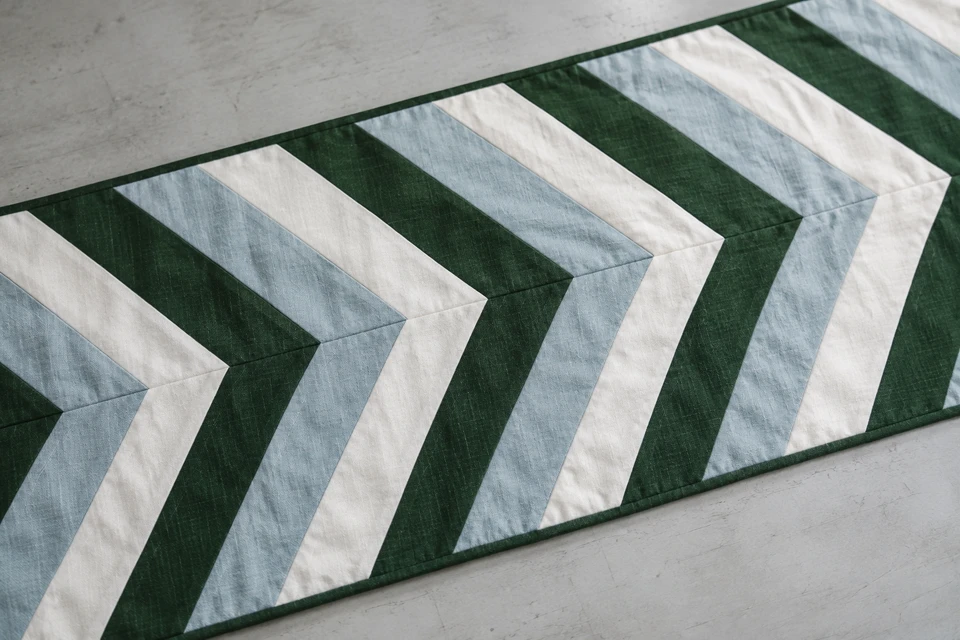
Two orderly rows of diagonal strips can become a broken zigzag when they meet. A Christmas chevron runner needs approval at the centre join, where small differences in strip position are repeated along the most visible line of the product.
Specify a pieced face before assessing its points
The drawing must represent the offered construction
Confirm that the runner is assembled from separate fabric strips rather than printed to resemble piecing. Both can be legitimate products, but they require different quotations and workmanship references. This guide concerns the assembled version. Ask for a face map showing the colour sequence on both sides of the centre line, the intended direction of the V shapes and any border that frames the pattern.
Name the starting end of the runner in the working drawing. A green-blue-ivory sequence described from opposite ends can lead to two different assemblies even when everyone uses the same colour names. If the design is reversible, provide a separate description of the second face rather than assuming it is another pieced surface. Identify backing, intermediate layers and edge finish in the component record so a strong front photograph does not conceal an incomplete specification.
Compare opposed strip assemblies without forcing a match
The join should not depend on stretching the sample into position
Request a development view of the two assembled halves before the centre seam is closed. Check that corresponding colours meet in the intended order and that the pitch of the points remains consistent. The sampler should show the relaxed arrangement, not pull one half until a single junction appears correct. If the proposal needs controlled easing, ask the technical owner to document it and demonstrate the resulting finished surface.
Examine the first, middle and last point groups rather than inspecting only the best central section. A small difference between the two assemblies may become more apparent over the runner's length. Use an agreed measurement method and project-specific tolerance; this article does not prescribe one universal acceptable offset. Keep the fabric identification and cutting direction with the sample because a later material substitution may change how the assembly behaves during handling.
Inspect the finished centre seam as a visible line
A matched colour boundary can still produce a ridge
Lay the finished runner on a plain flat surface without tension. Follow the centre line from end to end, observing point continuity, local puckering and any ridge that interrupts the table presentation. Turn the runner over to inspect how the join has been finished. The desired seam treatment should be confirmed by the responsible maker, not inferred from a photograph that hides the reverse under a centerpiece.
Then view the runner from the seated position and from the end of the table. These perspectives may reveal a displaced point more clearly than a close overhead inspection. Keep design alignment and general seam quality as separate entries in the review. A neat seam can join the wrong colour sequence; a correctly matched sequence can still have unacceptable puckering. Separate comments make the next sample more focused and easier to approve.
Check the zigzag after the intended finishing route
Pressing and care observations need their own record
Ask whether the sample represents the proposed final pressing and finishing, and identify any temporary preparation used for photography. Review a care-trial sample under the agreed method if laundering is part of the intended use. Record its condition before and after the trial, including the centre line, outer edges and the relationship between the face and backing. Do not convert a single development observation into an unsupported wash-life or colourfastness claim.
If the runner develops a twist, investigate the assembly, materials and finishing together instead of simply trimming an edge to make one photograph look square. Compare the relaxed finished sample with the original face map. A revision that changes strip angles or removes part of an outer strip may alter the visible rhythm. Obtain buyer approval for that design change, especially if the retail artwork has already been prepared from an earlier sample.
Work through the shorter and longer versions
Length changes should have an intentional ending
Decide whether each offered length ends with a complete point group or an agreed partial group. Extending a runner by adding an arbitrary strip can create an unbalanced finish at one end. Show the termination in the size-specific drawing and confirm whether the border width stays constant. The usual table-drop decision remains important, but it is separate from how the pieced zigzag resolves at the ends.
Ask the supplier to explain material consumption and setup implications for the actual variants. Different lengths, colour sequences or strip widths may require separate sampling even when they share fabrics. Compare quantities and quotations using those confirmed variants. For a Christmas launch, agree the design-freeze and sample-approval dates before relying on a delivery proposal; seasonal naming does not establish stock availability or a feasible arrival date.
Release a matched reference set
Use both a long view and a close junction view
The final approval should include the full runner, a close view of representative centre-seam points, the reverse construction and the size-specific ending. Annotate the acceptance criteria against the same revision. A close photograph alone cannot establish that the entire zigzag is continuous, while a room photograph may hide the exact junction that inspection staff need to compare.
Share the intended palette, runner lengths, proposed quantities and face map with FY Bedding through the custom project enquiry. The seasonal references can help communicate the Christmas direction without establishing that a pictured construction is already available. Request a confirmed technical proposal and a finished sample before treating the design as ready for bulk release.
Review the centre seam at the beginning, middle and end, then check the complete relaxed runner after finishing. Approve every offered length's ending rather than extrapolating from one sample.