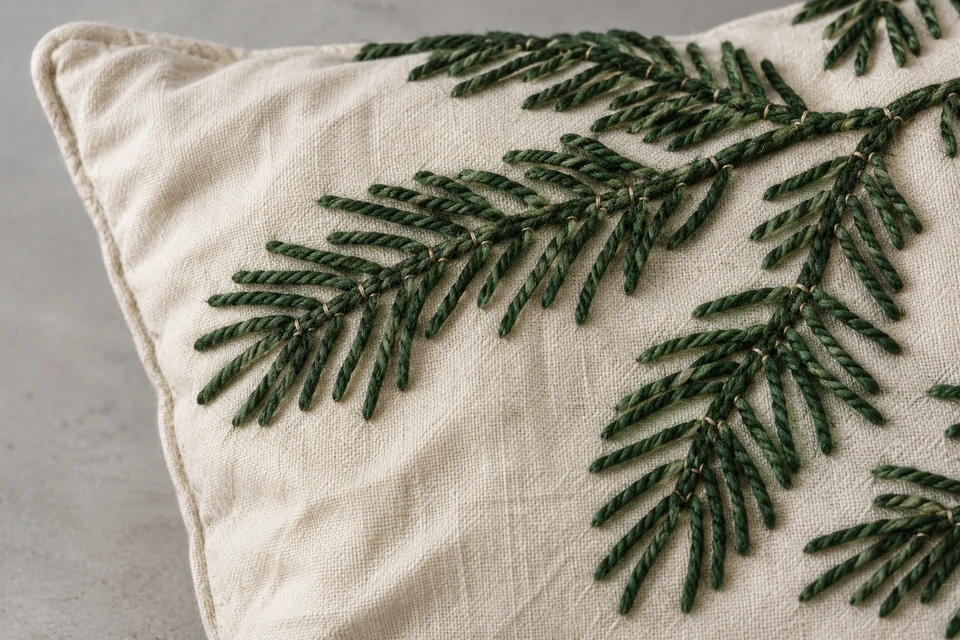
A fir-branch cushion can be drawn with a line of decorative yarn rather than a filled field of embroidery stitches. In couching, the laid yarn or cord is held against the ground by securing stitches. That creates two visual decisions: the route of the decorative material and the appearance of the stitches holding it down. Buyers should review both, particularly where the main stem divides into shorter branches. A beautiful loose yarn sample does not establish how the finished cushion will look or behave.
Identify the two thread roles
Decorative yarn and securing thread are separate components
Ask the supplier to identify the proposed decorative yarn and the thread used to attach it. Record colour, visible thickness and the ground fabric against which they will be reviewed. Matching securing thread may become visually quiet, while a contrasting thread can become part of the design. Decide which effect is intended before judging small differences between samples. Do not describe every raised line simply as embroidery when comparing supplier offers.
Request a short straight-line sample and a representative branch junction in the nominated materials. BERNINA and Brother describe machine couching workflows, but those examples do not establish which equipment or process FY Bedding or a proposed partner will use. Ask the actual supplier to explain its offered route. Keep manual and machine alternatives identified if both are quoted, and judge their samples against the same visual objective rather than assuming they are interchangeable.
Review the branch forks at full scale
Crowding can hide the design hierarchy
Choose the busiest junction in the artwork and reproduce it at the intended cushion scale. Inspect whether several yarn paths pile into a lump, whether a narrow branch disappears and whether the main stem remains legible. Compare the junction from the normal viewing distance as well as close up. Enlarged artwork can make an intricate fork look clear even when the same detail becomes crowded on a small cushion face.
Ask for one purposeful revision at a time. A designer might simplify the number of branches, open the angle of a fork or change the relative prominence of the stem. Record which variable changed and retain the preceding version for comparison. Avoid reducing the whole motif merely to fit a new size without checking the smallest junction again. A successful broad curve does not prove that a compact turn will accept the same yarn and attachment arrangement.
Follow the curved path
Secure appearance must be assessed without destructive pulling
Review the sample along gentle bends and tighter returns. Look for places where the laid yarn leaves the intended line, sits above the ground or is flattened differently by the securing stitches. Note the location and viewing condition of each observation. Do not pull on the yarn to improvise an attachment test. Where resistance to snagging or other performance matters, the technical owner should define a relevant method and acceptance criteria separately.
Check the reverse and any proposed backing or lining. The public face is only part of a removable cushion cover: internal finishing must also suit the intended construction and handling. Record whether the lining is included in the offered sample and quotation. A loose decorated panel can be useful for artwork approval, but it cannot confirm the complete cover's interior or the way the decoration behaves near the side seams and opening.
Resolve starts, stops and cut ends
Give the production team explicit visual references
Mark where yarn paths begin and finish in the approved drawing. Inspect visible ends on the sample and ask how the supplier proposes to finish them. The objective is to avoid an unexplained tuft, an abrupt thick spot or a conspicuous join in an otherwise continuous branch. Keep the required result clear while allowing the technical team to specify an appropriate construction. Do not infer durability solely from an end that looks tidy on its first inspection.
Approve the cushion with its intended insert and compare front and oblique views. Curvature can make a join prominent or move a branch into a shadowed side area. If a cover-only programme uses an insert for photography, identify that styling component separately. The image should not imply that the filling is supplied unless that is the commercial offer. Keep the flat decorated panel and the assembled sample linked under the same artwork revision.
Bring care and commercial scope into the approval
Release the construction, not just the drawing
Arrange the agreed care and handling review for the complete materials and assembly. Compare yarn position, ground appearance, securing stitches and internal finishing before and after the documented process. Record what was actually tested, including the sample identity and any finishing step. A change in yarn, ground or lining may require the affected review to be repeated; do not transfer an earlier result automatically to a different combination.
For a FY Bedding enquiry, include the full-size branch artwork, close views of critical forks, intended cover dimensions and quantity by colour. Ask the quotation to distinguish artwork preparation, sampling and any separate component minimums. Confirm development feasibility and timing before setting a seasonal launch commitment. The release reference should show the accepted junctions and ends, the complete cover and the agreed post-care appearance so purchasing and inspection can follow the same decision.
Approve the decorative yarn path, securing thread, branch junctions and finished ends on a complete cover, not on an enlarged artwork file alone.
Method references: BERNINA: Mixed Media Stitching; Brother: Couching.