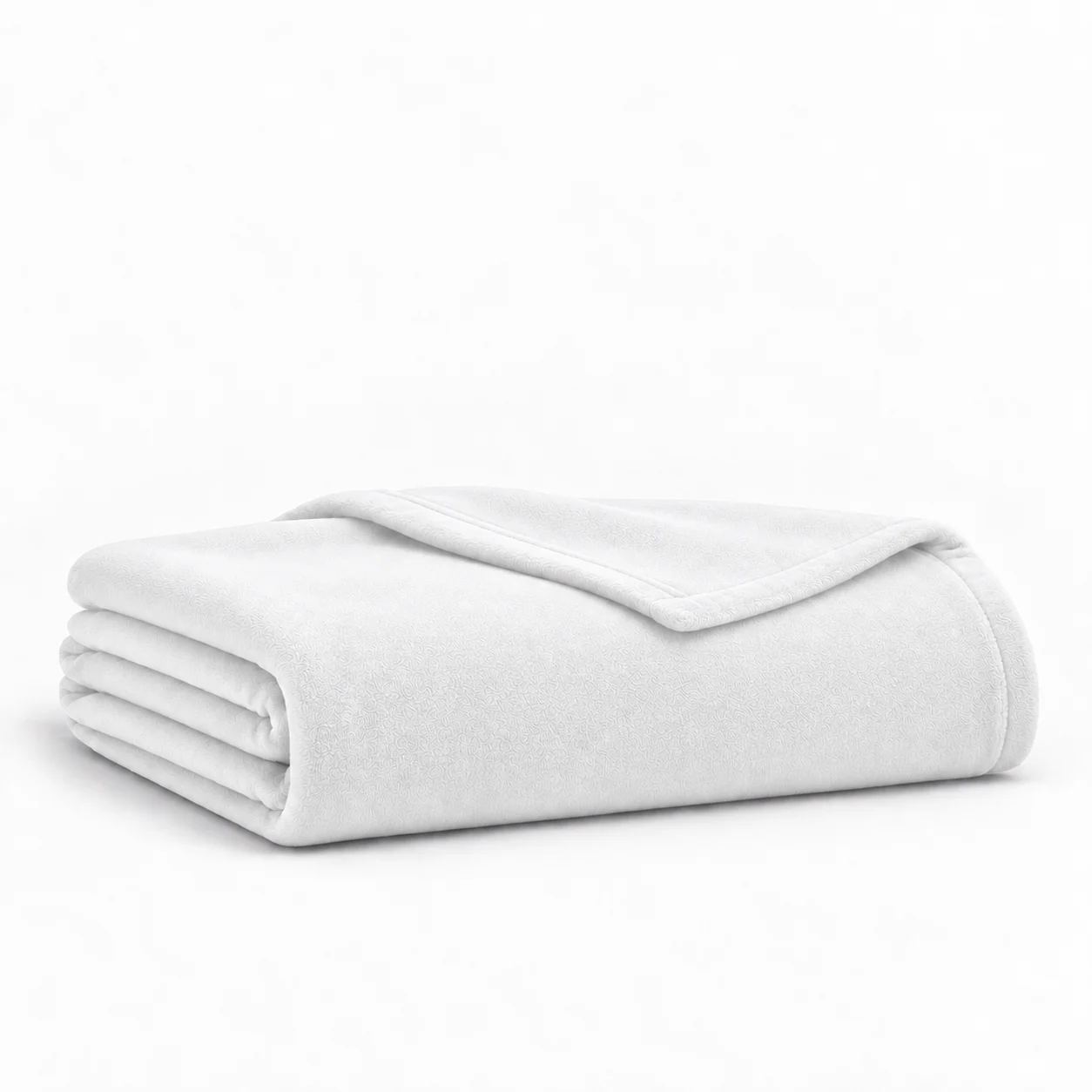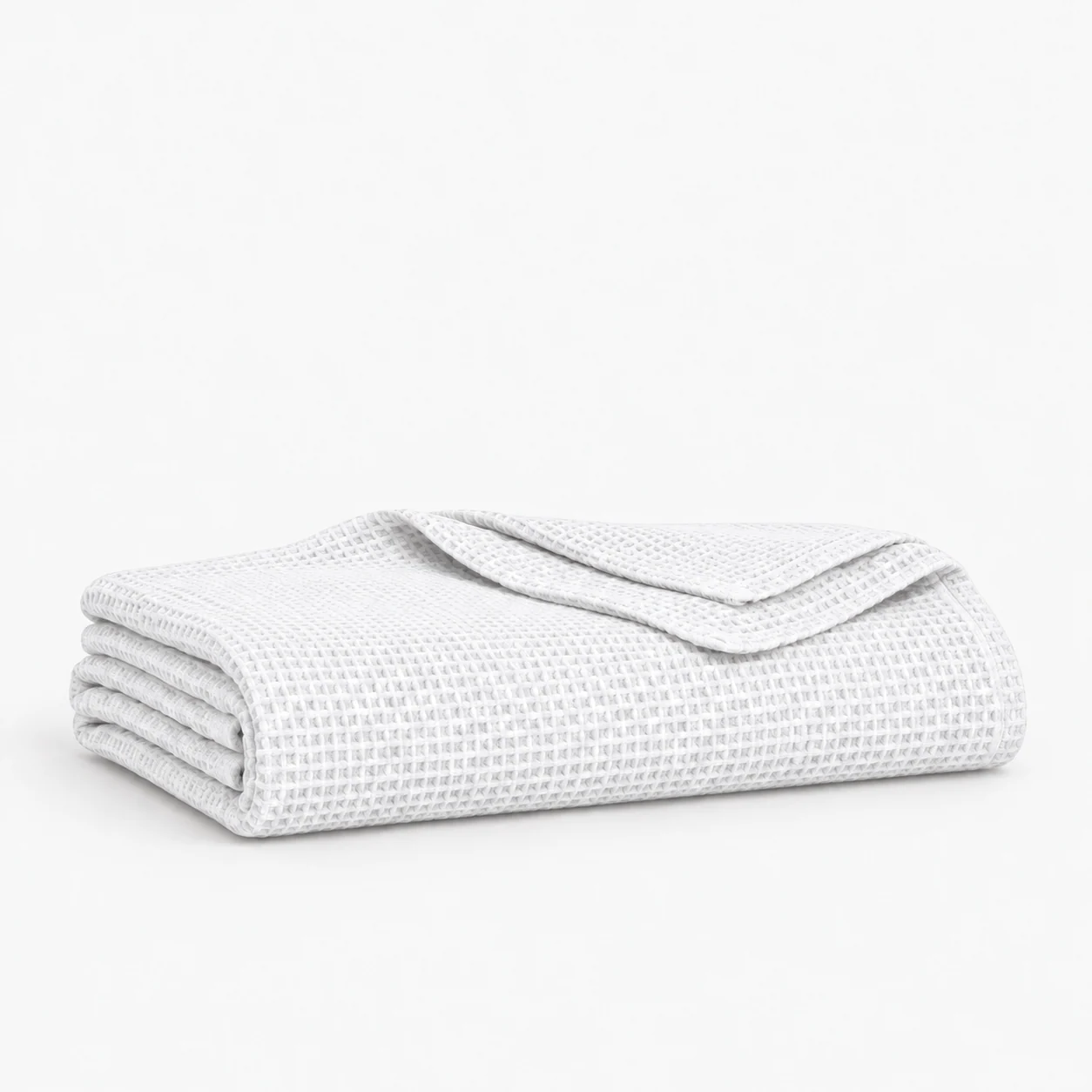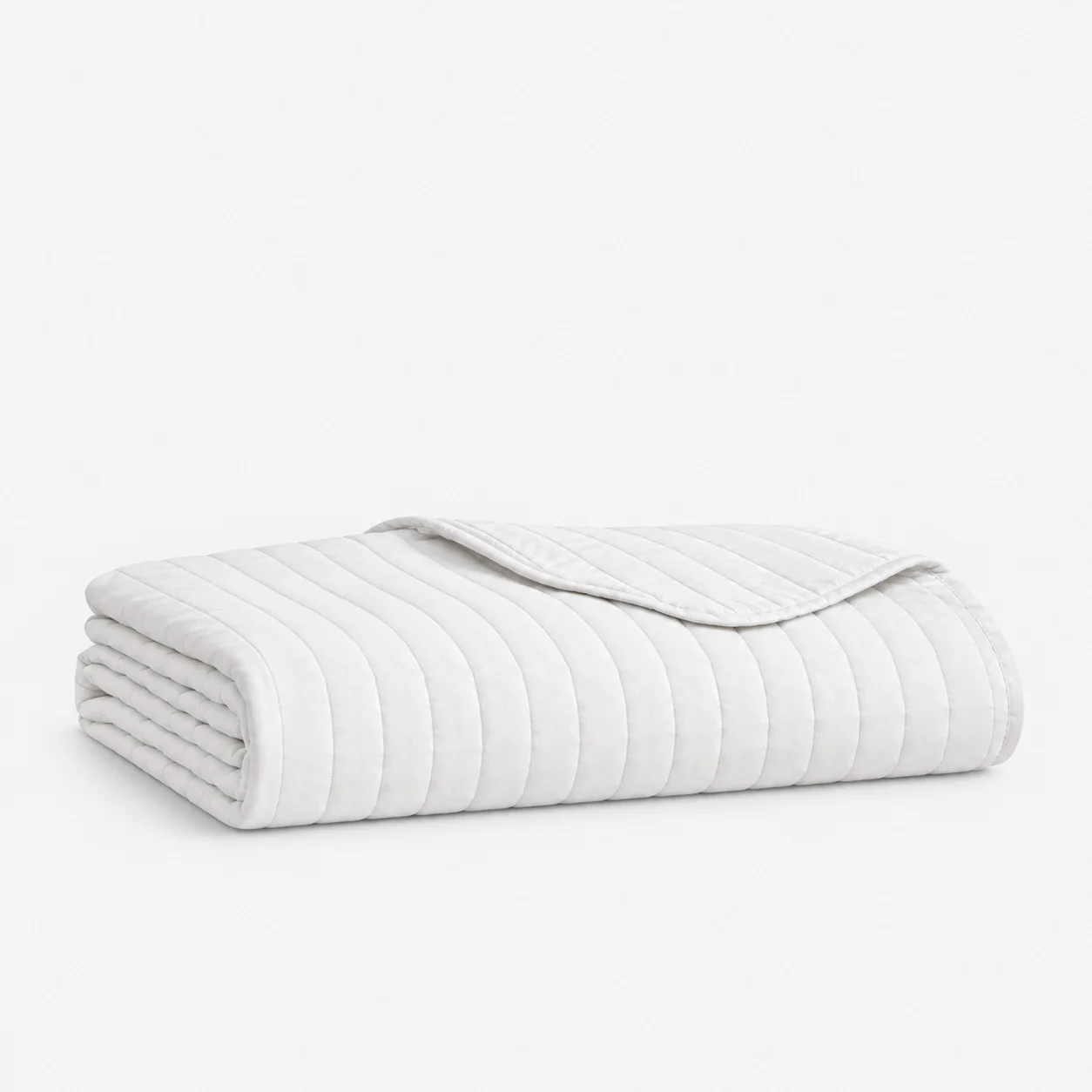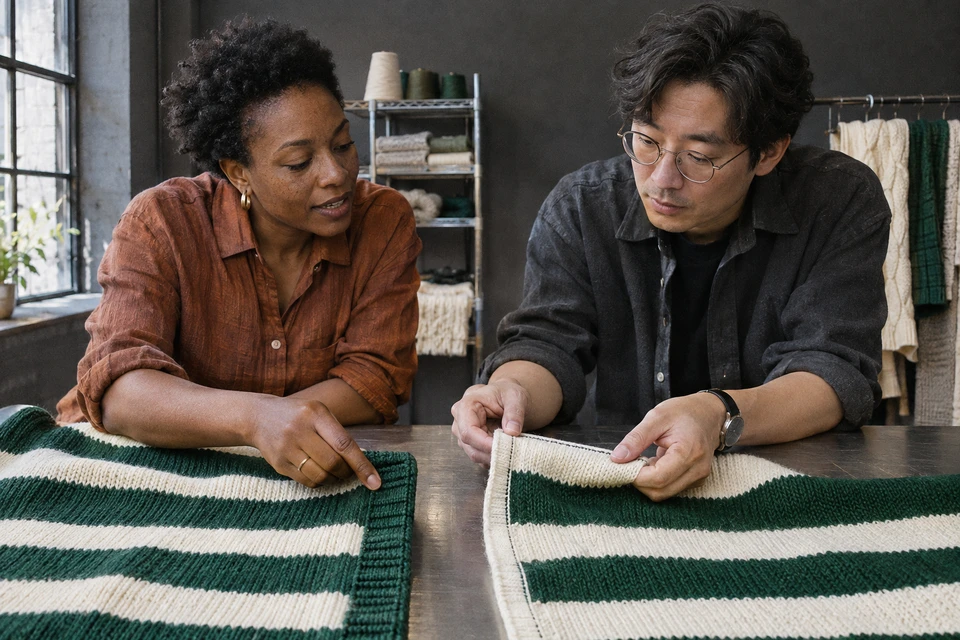
Two Christmas throws can share the same striped face while having quite different edges. One may be cut from a larger knitted fabric and finished around its perimeter; another may be knitted as an individual panel with its intended dimensions established during knitting. A folded retail photograph rarely settles the distinction. Before agreeing a seasonal range, ask how the proposed panel becomes the finished throw and which edges still need sewing or another finishing operation.
Ask for the panel route, not a machine nickname
Separate the body from the perimeter
CottonWorks describes flat-bed knitting routes that produce blanks for cutting as well as shaped pieces knitted to size. Its examples concern garment manufacture; they explain a useful construction distinction, not the availability or performance of a particular throw. For the purchasing brief, ask the supplier whether the proposed throw body is cut from yardage, cut from a larger blank, or knitted as an individual panel. Then ask what happens to each edge after knitting. A statement that a product is flat knitted does not answer those questions.
Do not use fully fashioned as a decorative synonym for premium. A rectangular throw may have no shaped garment-style panel at all. Have the maker describe the actual construction in ordinary words, including any separately attached border. A knitted-to-size body can still require finishing and assembly, while a well-executed sewn edge is not automatically a defect. The decision concerns the appearance and construction you intend to buy, rather than awarding one method a general quality ranking before samples exist.
Draw all four edges on the seasonal layout
Stripes can conceal a change of construction
Mark the two long sides and two ends on a complete throw drawing. For each, identify the proposed knitted border, folded hem, overlocked edge, binding or other declared finish. Show where a contrasting Christmas stripe meets the perimeter. The same red or green band can make different edge constructions look alike from the front; a reverse view and a corner view are therefore useful parts of the sample request. Keep these views linked to one identified panel, not to unrelated photographs from several collections.
At a corner, ask where one edge treatment stops and the next begins. Record any folded overlap, join or change in bulk that the actual construction requires. If a border is knitted separately and attached, name it as a component rather than implying that it emerged continuously with the body. Where fringe is proposed, clarify whether it is part of the knitted panel or a later attachment. Do not add fringe merely to hide an unresolved cut edge. Review the offered junction before deciding whether it belongs in the design.
Compare complete edges before expanding the size range
A swatch centre cannot approve a blanket perimeter
Request a production-intent corner sample large enough to include the body, both adjoining edges and their junction. Follow with a full throw once the edge route is selected. Lay the sample down without stretching it into a rectangle and look for the intended border width, smoothness of the junction and visible changes in the stripe. Record what you observe without diagnosing machine settings from a photograph. If the edge turns, pulls in or flares, ask the technical owner to explain and revise the proposed construction.
For a larger or smaller size, request confirmation of how the panel and border change together. A supplier may add body repeats, alter the border or propose a different manufacturing route. Those are not equivalent changes just because the final length and width are similar. The accepted sample should show which adjustment is intended. Keep gauge and dimensional testing as separate specifications; this review identifies the edge construction and its appearance, not a universal rule for stitch counts, shrinkage or finished-size tolerance.
Carry the edge decision into care and presentation
Keep observations attached to the same specimen
If the project includes care assessment, identify the complete throw and the agreed procedure before comparing its edges afterward. Examine the same corners and stripe-to-border relationships, recording dimensional change separately from altered edge shape. Do not press or stretch a sample into its original form before documenting its condition unless that preparation is part of the agreed review. A photograph of one neat corner after handling is not evidence that every construction will retain its appearance through an unspecified service life.
Trial the intended retail fold with the actual throw. Decide which edge customers see when the pack is opened and whether a close-up shows a representative construction. A photograph of a knitted border should not be used to sell a cut-and-sewn alternative under one undifferentiated item code. If alternatives are offered, keep their descriptions and photographs separate. Packaging dimensions and folded bulk also need confirmation against the final sample rather than against a preliminary panel without its completed perimeter.
Ask suppliers to quote the identified construction
Keep route changes visible after approval
Send the edge map, size list, seasonal colour references and complete sample identity with the enquiry. Ask the supplier to identify the scope of knitting, cutting, edge finishing and any separately supplied components in its offer. Request actual minimum quantities, sample stages and delivery conditions for that proposal. A route with less visible sewing does not automatically mean a lower minimum, shorter lead time or less material use. Those commercial and environmental statements require their own evidence and must not be inferred from the face photograph.
At release, keep a corner reference alongside the full throw and the agreed drawing. If the proposed route later changes, reopen the relevant edge review even when the central stripe remains unchanged. FY Bedding can discuss a development brief that clearly separates body construction from perimeter treatment; send both the desired presentation and the questions the sample must answer. Confirm feasibility and timing for the actual order. Neither this construction comparison nor a Christmas colour scheme establishes stock availability or a promise of arrival before the holiday.
Identify how the body is made, map each edge and corner, and compare quotations against the same complete construction rather than a shared striped face.
Method references: CottonWorks: flat-bed knitting, fabric blanks and knitted panels.