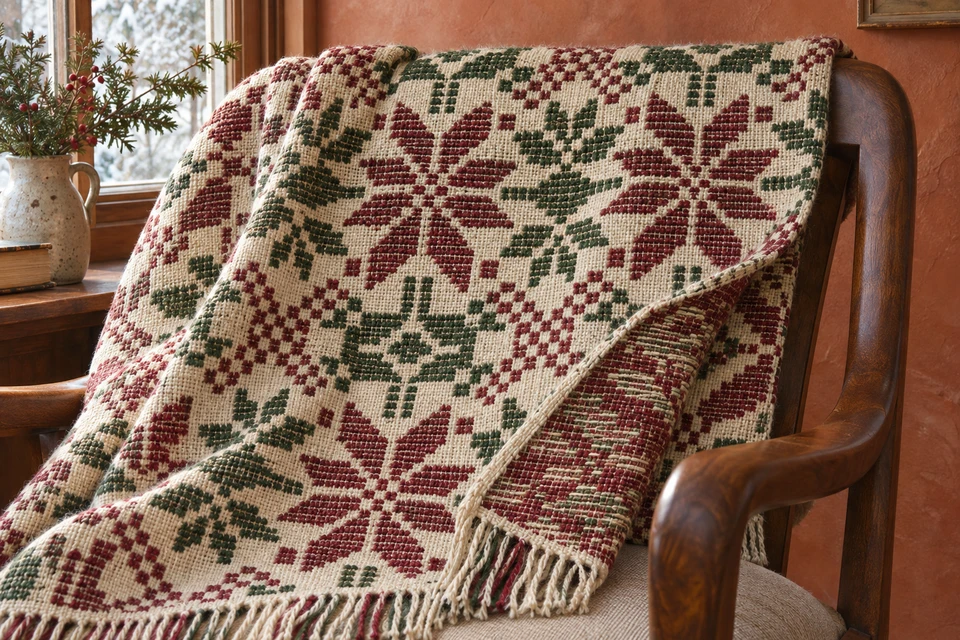
A patterned Christmas throw can look substantial in a photograph while leaving important construction questions unanswered. In overshot, the visible decorative yarn is not the whole cloth. Buyers need to identify the ground that supports it and the pattern weft that creates the larger figures. This distinction changes what belongs in the material brief and what must be inspected on an actual sample.
Ask for the construction behind the name
A visual resemblance is not a weave identification
The Icelandic Textile Center's overshot description distinguishes a plain-weave ground from supplementary pattern weft that floats across parts of the surface. Use that distinction to ask the proposed weaver for a construction description. A printed geometric pattern, a different figured weave and an overshot construction should not enter the same comparison merely because their photographs contain similar stars or stepped shapes.
Request a short explanation of the yarn systems in the actual offer, with a sample reference attached. Ask which yarn forms the ground and which makes the visible pattern. The supplier should identify any differences between a design-development swatch and the proposed production construction. A familiar weave name does not establish a particular fibre content, production method, place of origin or manufacturing capability at FY Bedding.
Separate the yarn roles in the specification
Colour names alone leave the material decision open
Give the ground and pattern yarns their own component entries. Record the supplier's stated fibre composition, yarn reference and colour for each, and request the relevant evidence where a composition statement is needed. A creamy ground with an evergreen motif does not tell the buyer whether both systems use the same material. A substitution in one can change the finished result even when the other remains unchanged.
Ask how the warp fits into that description rather than reducing the construction to two colour labels. The purpose is an understandable material map, not a buyer-written loom recipe. Let the competent weaving team specify its working details. Purchasing should be able to connect the accepted sample, the supplier's construction record and the quoted article without relying on the decorative face alone.
Inspect the pattern floats at the chosen scale
Look beyond the largest motif
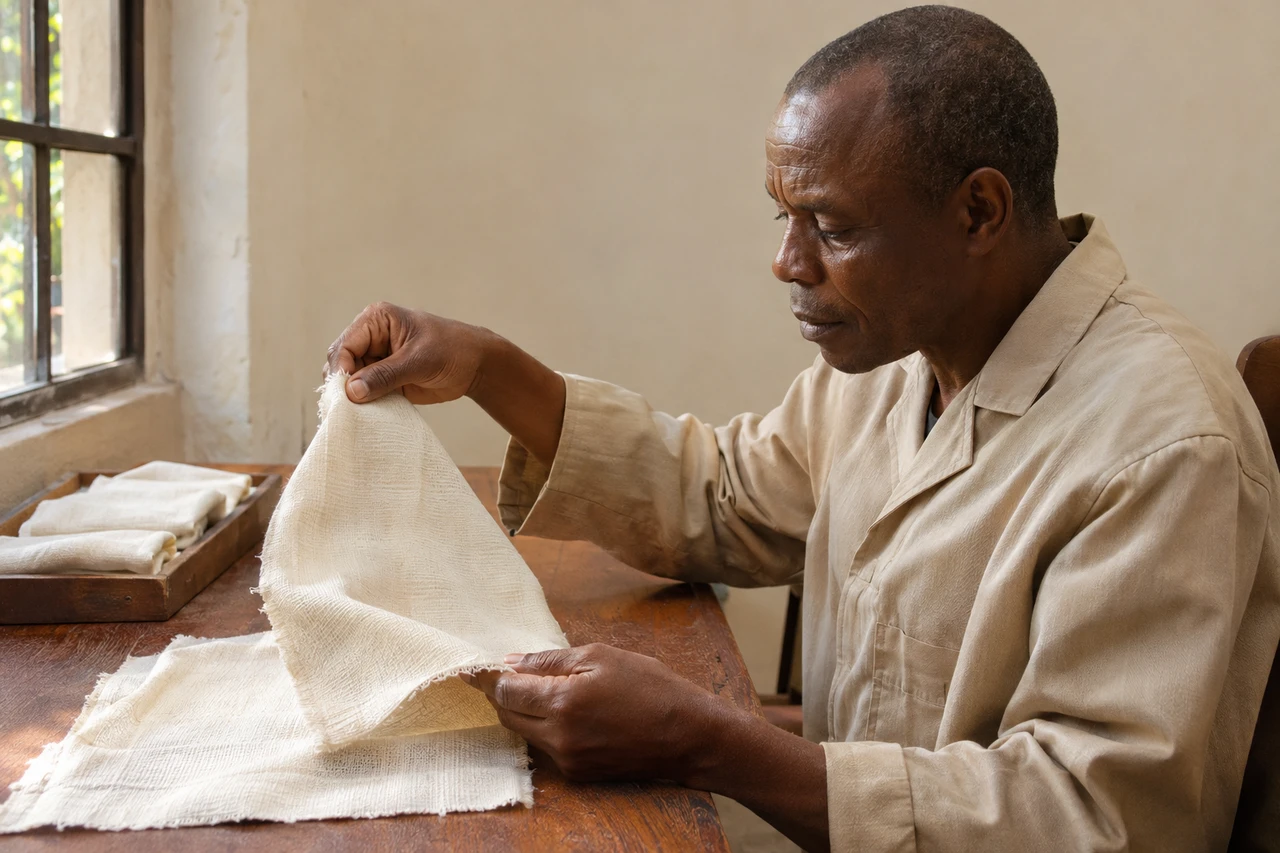
Examine the portions where the supplementary yarn crosses the ground between interlacings. Note their location and apparent length on the actual cloth, especially around small stars, narrow connecting areas and broad blocks of seasonal colour. A reduced photograph can hide a long exposed span. Enlarging or simplifying a motif can also change the relationships within the structure, so a design revision should return to physical sampling where needed.
Observe the sample with ordinary handling appropriate to a throw. Do not pull individual floats to invent a strength test. If snagging, abrasion or other performance is important for the intended setting, ask the technical owner for a suitable assessment and acceptance criteria. The visible arrangement helps define that request, but does not itself prove performance. Keep observations separate from claims that a construction is pet-proof, child-safe or unusually durable.
Turn the sample over deliberately
The reverse is part of a loose throw
A throw may be folded, draped or picked up from either side. View the reverse alongside the intended presentation face and record which appearance the customer should expect. Ask whether the article is offered as reversible or simply has an acceptable reverse. Do not use the first description automatically because both sides contain a recognisable pattern. The yarn distribution and visible effect need to match the proposed product story.
Inspect edges and transitions where the patterned field ends. Record the relationship between the ground, border and any fringe or separate edge finish. An isolated central swatch cannot establish how these areas will be completed. Request a larger development piece or finished sample that includes the relevant boundaries before agreeing the complete construction. Avoid treating an attractive improvised sample edge as an approved production detail.
Review the seasonal arrangement on the whole throw
A small repeat does not approve the border balance
Place the sample in the intended retail or hospitality presentation. Check whether the Christmas palette reads clearly when part of the throw is folded over a chair or bed. Mark the intended relationship between the central pattern and the borders rather than letting the packing fold become the only visible design reference. If several sizes are offered, confirm how the repeat fits each finished field.
Keep this layout decision separate from the basic weave identification. A sample can use the agreed yarn systems but place an incomplete figure awkwardly at an edge. Conversely, an appealing layout may have been made in a different construction. Record both findings under the same sample revision. Where a supplier proposes another yarn or construction for feasibility, compare it as an explicit alternative instead of quietly accepting it under the original description.
Release the complete woven offer
Keep care and commercial scope attached
Arrange the agreed care review for the actual combination of yarns, finishing and edge construction. Compare the ground, pattern floats, dimensions and reverse afterwards, noting what procedure was used. Do not assume that a result from one yarn pairing transfers to another seasonal colourway or fibre blend. Any public care or performance statement must stay within the evidence for the article being supplied.
For an enquiry to FY Bedding, share the intended throw dimensions, seasonal palette, use setting and construction reference. Ask for a proposal that identifies material roles, sampling scope, quantity by variant and any unresolved technical points. Confirm production and transport arrangements before committing a launch date. The most useful approval pack combines the whole-throw view with close construction references, so a later inspection can recognise both the design and the cloth that was purchased.
Identify the ground and supplementary pattern weft separately, inspect representative floats and the reverse, and approve the finished throw rather than accepting a geometric photograph as proof of overshot construction.
Method references: Icelandic Textile Center: overshot ground and supplementary pattern weft.