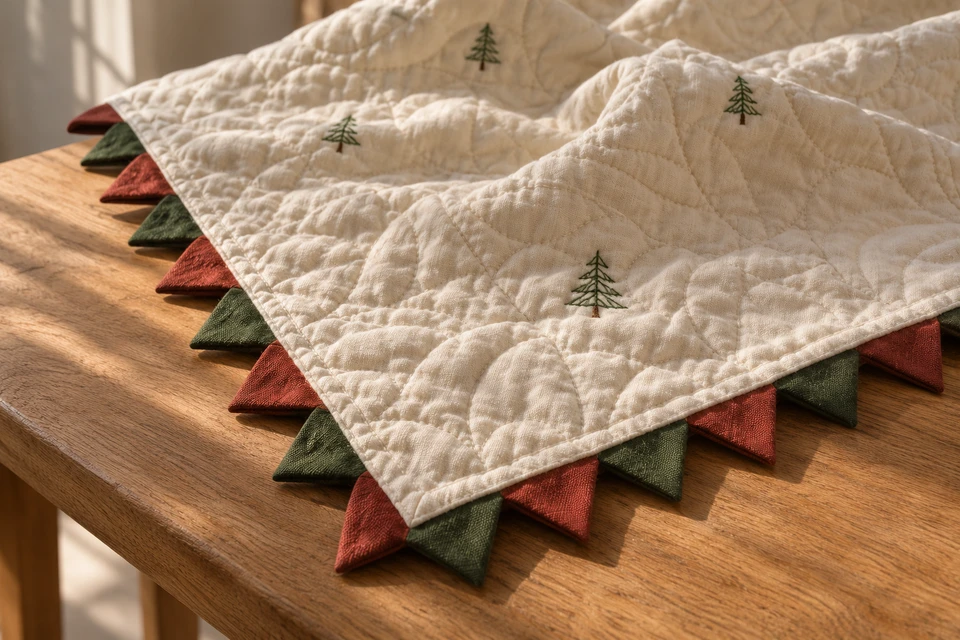
A row of folded triangles can give a Christmas quilt its character, but a colour sketch does not show how those triangles overlap or meet at a corner. The purchasing decision is a complete edge arrangement that remains recognisable around the finished quilt.
Name the proposed triangle construction
Individual points and a continuous band are different offers
Utah State University Extension describes prairie points made from individually folded pieces as well as methods that produce a continuous band. For a buyer, this is a useful distinction between construction proposals, not an instruction to select one method automatically. Ask the maker which route is being quoted and request a physical edge section. A continuous strip and a series of separate red and green pieces may require different decisions about colour order, fabric allocation and where the sequence can be interrupted.
Keep the edge construction separate from the quilt face and its quilting pattern. A printed triangle border is not a folded prairie-point edge, even if the catalogue view looks similar. Record which side of the quilt carries the exposed points and how the attachment is finished on the reverse. Do not describe the project as handmade or assign an origin story merely because it uses a traditional-looking detail. The production description must come from the proposed supplier and refer to the actual offered item.
Write the colour order as a sequence
A palette does not identify which point comes next
Start at a named corner and list the point colours in the order in which they appear. If the sequence is red, green, cream, green, show a complete repeat rather than four loose swatches. Decide whether the order continues around the entire perimeter or restarts on each side. Both can be intentional, but they produce different corner relationships. Include the face and reverse of any patterned source cloth so the maker knows which visible surface has been approved for each folded component.
Show how one point sits beside or inside the next. The overlap affects how much of each colour is exposed and can make the same palette look dense or widely spaced. Ask for a sample long enough to reveal repeated relationships, not only one attractive triangle. Photograph it in a relaxed state from above and at a shallow angle. The second view makes hidden layers and lifted tips easier to discuss without confusing shadows with differences in the actual fabric colour.
Resolve all four corners before costing the range
Do not leave the last point to assembly judgement
A straight edge sample cannot settle a corner. Request a corner mock-up showing the quilt layers, the attachment and the proposed approach to the change of direction. Identify whether the corner is intended to show a single prominent point, two meeting points or another approved arrangement. Avoid a vague instruction to make the corners neat: it does not tell the maker which colour should be visible or whether a partial triangle is acceptable at the transition.
Review the fourth corner as carefully as the first. A sequence that starts well can finish with an unintended double colour or a crowded final gap. Ask the maker to explain how the arrangement will be laid out for the complete size. This is particularly important when the range contains several quilt dimensions. Do not assume that enlarging the body leaves the edge unchanged. The maker may need a revised count, spacing proposal or corner treatment, each of which should be visible before the buyer approves the assortment.
Define dimensions with and without the points
The outer tips are not the quilt body's edge
Give the quilt body dimensions and the overall tip-to-tip dimensions distinct names. Identify the measurement condition and the landmarks used, with the textile lying naturally rather than pulled into shape. A buyer comparing two quotations needs to know whether a stated width includes the projecting triangles. This difference also matters for shelf presentation, photography and how the quilt falls at the side of a bed or sofa. Do not let a decorative edge silently inflate the useful body size.
Choose the intended display arrangement and check the edge there. On a bed, some points may face down while others rest on the surface; on a folded retail stack, only a short section may remain visible. Record which appearance the buyer is approving. The review is not an infant-use, snag-resistance or durability assessment. If the product is proposed for a use with additional safety or performance requirements, route those questions through the responsible technical reviewer instead of deriving suitability from an appealing seasonal presentation.
Evaluate the finished edge through the proposed care route
A loose folded square is not the finished assembly
Agree the care and preparation conditions with the maker for the actual quilt construction. Then compare the point sequence, exposed tips, corner shape and attachment on the same identified sample before and after that procedure. Record any pressing or arrangement needed to restore the accepted appearance. Do not invent a universal wash temperature or promise that every folded point will remain perfectly sharp. The evidence should describe the sample, the procedure and the observed result rather than a claim about prairie points in general.
Inspect the reverse attachment and the spaces between adjacent points as well as the visible face. A buyer should distinguish an intentional overlap from an unsecured component or a change in the agreed spacing. Mark concerns on photographs and retain the physical sample for discussion. If a correction changes the fabric, folding route or attachment, ask for the affected area to be resampled. An isolated replacement triangle does not prove that the revised detail works through a complete corner and its neighbouring sequence.
Release an edge map with the order
Keep component counts and commercial assumptions connected
The purchasing record should include the body reference, colour sequence, point construction, corner views, measurement basis and accepted care-state photographs. Ask the supplier which elements drive minimum quantities and sampling cost: the source fabrics, individually prepared components or the full finished assortment. A multi-size collection needs a separate confirmed edge map for each relevant size. Where the same fabric is used on the quilt face and the points, connect both uses to one controlled material reference without assuming identical cutting yield.
For packing, trial the actual fold with the edge visible as intended and inspect it after unpacking. Avoid pressing or tying the package so tightly that the triangles cannot return to the approved presentation. Share the edge map, target quantities and market requirements with FY Bedding for a scoped development discussion. Confirm construction feasibility, sample stages and delivery arrangements for the specific order. A complete Christmas sample is an approval milestone, not evidence that production or transport can meet an unconfirmed holiday arrival date.
Before release, identify the individual-point or continuous-band route, colour order, overlap, four corner arrangements and body-versus-tip dimensions. Keep the full edge reference with the accepted quilt so later samples are judged against the same sequence.
Method references: Utah State University Extension: folded prairie-point edging methods.