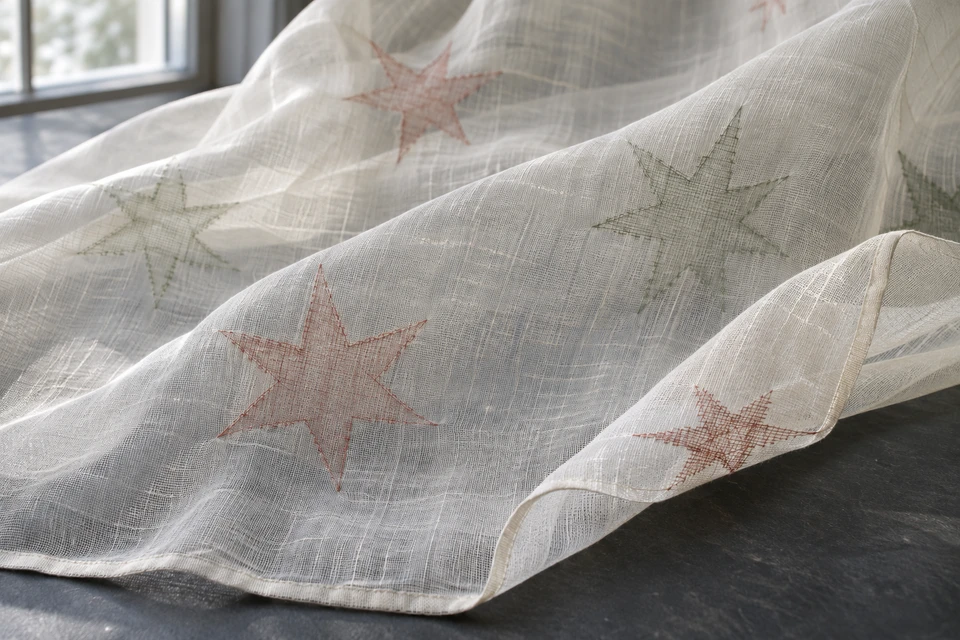
Shadow-work embroidery can give Christmas table linen a quiet colour effect that changes when the cloth is turned or placed on another surface. The purchasing decision is not simply whether the star or leaf looks attractive. It is whether the proposed ground, rear stitching and finished arrangement allow the intended motif to remain visible from the chosen face. Approve that relationship before a supplier adds a lining or changes the cloth for convenience.
Establish which face the guest will see
The back contributes to the front
The Royal School of Needlework describes shadow work as embroidery whose stitches on the reverse show through a fine ground. Use that distinction when discussing a proposed Christmas runner, overlay or napkin. A drawing of a pale star does not identify how its colour is made. Ask the supplier to show the sample from both sides and explain which parts of the visible effect come from rear stitches, front outlines or another decorative process.
A printed imitation may be a legitimate alternative for the project, but it is a different offer. Keep it separately named and sampled. Likewise, visible embroidery on a sheer cloth is not automatically shadow work merely because the ground is translucent. Establish the actual construction before comparing quotations or writing customer-facing copy. No specific FY design should be described as using this technique until the relevant project specification and approved sample support that description.
Select the ground with the stitched motif
A plain swatch answers only half the question
Ask for a representative stitched area on the proposed ground, not only a loose thread beside an unworked fabric swatch. Review a broad part of the star, a narrow point and a small gap between motifs. These locations show whether the desired colour is readable without losing the fine character of the ground. Keep the reference attached to a fabric identifier so a visually similar substitution cannot silently replace the cloth used for approval.
Compare proposed alternatives under the same lighting and over the same neutral surface. Do not let one sample benefit from bright backlighting while another lies on a dark bench. Note the viewing condition with the approval photograph. A delicate effect may be entirely appropriate for an intimate holiday table, while a larger venue needs a different design treatment. Make that choice deliberately rather than asking the supplier for an undefined stronger shadow at a late stage.
Review the Christmas motif at its finished scale
Points and open spaces need their own decision
A small star may become a soft patch if the intended points cannot be read through the chosen ground. An enlarged screen drawing can conceal that issue. Request the motif at the exact proposed size, including its neighbouring motifs and empty space. Check whether a cluster of stars remains a cluster rather than merging into a continuous colour area. For a leaf or berry arrangement, identify which separations matter to recognising the seasonal design.
Discuss changes in terms of the intended result: a clearer point, more open ground between motifs or a quieter colour field. Let the embroidery specialist propose a suitable construction adjustment and return a new sample. Purchasing should not assume that more thread or denser stitches will always improve the appearance. Any change to the ground, thread or stitch arrangement should be assessed as a new combination, with the earlier reference retained for a direct comparison.
Decide whether a backing belongs in the finished article
An opaque layer may defeat the selected effect
Before approval, request a simple construction description covering any lining, stabilising material or additional cloth that remains in the finished item. Separate temporary production support from permanent layers. A lining may serve a project need, but it can also change how the reverse stitching is seen through the ground. Evaluate the actual proposed assembly instead of approving the embroidery alone and allowing the finished product to be built around it afterwards.
If the supplier proposes a backing change, ask for a completed sample showing that change. Record why it is proposed and which appearance is expected to remain. Do not describe all backing as unacceptable: the decision depends on the approved assembly. Equally, do not accept a technically tidy reverse as sufficient evidence when the chosen front effect has disappeared. Front presentation and reverse construction must be reviewed together, without treating either as a universal pass on its own.
Recreate the intended table presentation
Display conditions are part of the appearance reference
Place the finished sample on the table or undercloth colour planned for the Christmas display. For an overlay, include the overlap and edge position; for a runner, include a section that extends beyond the tabletop if that is the intended use. Photograph the complete arrangement as well as a detail. State that the photograph is an appearance reference for this combination, not a performance result or a promise that every venue will look identical.
Check the effect again after the agreed sample-care procedure, using the same viewing arrangement. Record any observed change without claiming a particular washing performance in advance. The buyer and supplier should agree the care evidence needed for the intended use, including whether the item is decorative or will be repeatedly laundered in service. An attractive initial sample does not establish suitability for a commercial laundry route that has not been evaluated.
Keep the effect intact through packaging and approval
The opening presentation should explain the product
Work out how the cloth will be folded so the relevant motif is visible when the package is opened or the sample is presented. A dark insert, an opaque sheet or an unfortunate fold can hide the effect and make the article appear incorrectly supplied. Review one representative packed sample with the people responsible for merchandising. Keep any explanatory copy accurate and restrained: describe the approved embroidery construction, not an unsupported heritage, handmade or material claim.
For a quotation discussion, provide the product type, finished dimensions, authorised seasonal motif, chosen ground reference, intended table background, proposed quantities and sample-review destination. Ask for confirmation of development availability and timing rather than assuming holiday delivery. FY Bedding can use this brief to discuss a suitable sampling route; the agreed project documents must establish the actual materials, process and finished result. Release the order only when the visible shadow effect and the complete assembly have been accepted together.
Approve the selected face, stitched-ground combination, finished motif scale, retained layers and intended table presentation as one identified sample. Hold any substitution that changes the visible shadow effect until a revised sample is reviewed.
Method references: Royal School of Needlework Stitch Bank: shadow-work embroidery.