A stencilled Christmas bell can have a deliberately textured painted surface while still needing a clear outer edge. Buyers should not confuse that character with unintended paint spreading beyond the approved motif. The useful specification describes which irregularities belong to the design and which change it. Make that decision on the proposed cloth, with the actual finishing route, before treating a decorative sample as production-ready.
- 1. Describe the edge the design actually needs
- 2. Establish the proposed materials and application route
- 3. Ask for a trial that exposes the difficult edges
- 4. Review the finished napkin rather than the painted blank
- 5. Keep fixing and care evidence separate from appearance
- 6. Write acceptance comments a maker can act on
Describe the edge the design actually needs
Handmade appearance is not an unlimited tolerance
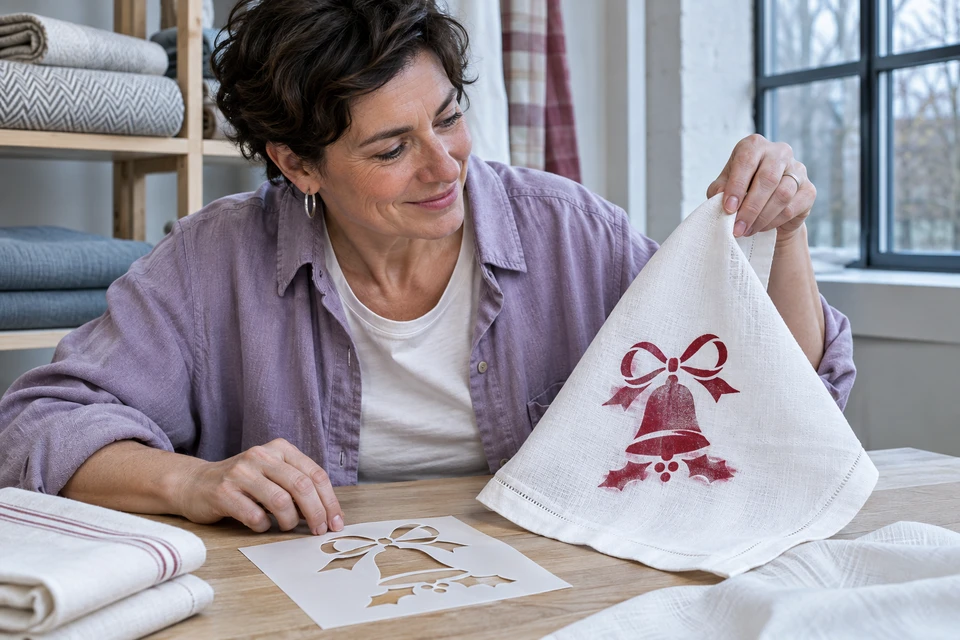
Start with a clean appearance reference at the finished motif size. Identify the bell outline, the gap beneath its rim and any narrow spaces inside a bow. Decide whether the design intends a crisp boundary, a visibly brushed edge or another controlled effect. Avoid a vague instruction to make the print rustic. Such wording does not tell a receiving inspector whether a red haze outside the bell was intended.
Keep the internal paint texture separate from the perimeter decision. A slightly mottled fill may be part of the approved design while a filled-in gap is not. Choose a few named locations that make this distinction clear and include them in the sample comments. The buyer should not have to demand a perfectly flat graphic if the collection's appeal is hand-applied character; the requirement is a recognisable and consistently interpreted design.
Establish the proposed materials and application route
A colour name does not define the process
Ask the supplier to identify the napkin ground, proposed paint system, stencil and finishing procedure. Marabu's textile-paint guidance gives material-specific preparation, application and fixing instructions. That is a useful reminder that process requirements belong to the actual products used, not a generic instruction that all fabric paint behaves alike. Do not transfer a craft product's instructions or performance statements to an unidentified commercial textile process.
The maker should confirm compatibility with the selected cloth and explain how the finished sample was prepared. Record any difference between the sample ground and the cloth in the quotation. If a substitute fabric is proposed, review the edge again on that material rather than assuming the original stencil guarantees the same result. The stencil determines the intended opening; it does not, by itself, establish how paint behaves on every surface.
Ask for a trial that exposes the difficult edges
Broad filled shapes can hide the problem
Request a sample containing the narrowest intended gap, a sharp turn and a longer curved edge from the actual Christmas motif. A large solid rectangle of red paint cannot answer those questions. Inspect the complete motif first, then use a closer view to locate unintended spread or lost openings. Keep photographs at a consistent scale so the team does not mistake a larger image for a worse sample.
When an edge differs, ask the maker to identify and control the relevant process variables. Procurement should not prescribe improvised chemical mixtures or a universal brush loading. Compare a revised sample that changes a stated part of the process and record the result. If the process cannot reproduce a tiny gap reliably, decide whether to revise the artwork or choose another route; do not silently redefine the gap as optional after approval.
Review the finished napkin rather than the painted blank
Placement and handle can change the decision
Measure the motif from the finished edges and review it in the intended table fold. A clean stencil print can still be badly placed if the most recognisable part disappears beneath a fold. Check the decorated region's feel alongside the plain cloth and identify any unexpected local stiffness. These observations should be tied to the offered construction, not turned into unsupported claims about comfort or long-term performance.
Look at the reverse and the surrounding undecorated fabric. Record any unintended transfer, marks or changes that affect the sold unit. If the motif is applied before final hemming, confirm the sequence used for the approved sample and its relationship to final dimensions. A process-stage change may affect the visible result, so the order should not rely on an early blank when the customer will receive a finished, folded napkin.
Keep fixing and care evidence separate from appearance
A dry surface is not a completed approval
Ask the technical owner to confirm the required finishing and the appropriate care assessment for the actual paint and cloth combination. Do not assume that a surface which feels dry has completed every necessary stage. After the agreed procedure, inspect the important edge locations, fill appearance and cloth condition. Record the sample, process and observation without presenting a single visual check as a universal wash-fastness certification.
Repeat the ordinary unpacking review using the intended fold and pack. Check whether decorated faces contact each other and whether the delivered presentation differs from the loose sample. Where packing or preparation is revised, retain that change with the final reference. A buyer comparing supplier offers should know whether each offer includes the same finished, ready-to-present state or whether extra work is expected after receipt.
Write acceptance comments a maker can act on
Replace vague preference with located observations
An actionable comment identifies the motif area, intended boundary and observed difference. For example, distinguish a lost opening beneath the bell from an intentionally textured red fill. Pair that description with the accepted reference and a consistent close view. Do not approve an entire assortment through one attractive napkin if other designs introduce smaller gaps, more complex outlines or a different application area that has not been sampled.
Send FY Bedding the authorised Christmas motif, napkin size, chosen fold and desired edge character when discussing development. Request confirmation of the proposed route, samples, minimums and schedule for that project. No displayed concept establishes stock, a specific paint system or delivery before Christmas. A useful release decision names the cloth, finished process and visible edge that the actual maker has demonstrated and the buyer has accepted.
Keep the motif's outer boundary, internal openings and intended paint texture as separate approval points. Judge them on a finished napkin after the proposed process, care review and ordinary unpacking.
Method references: Marabu: textile stencilling and system-specific preparation.