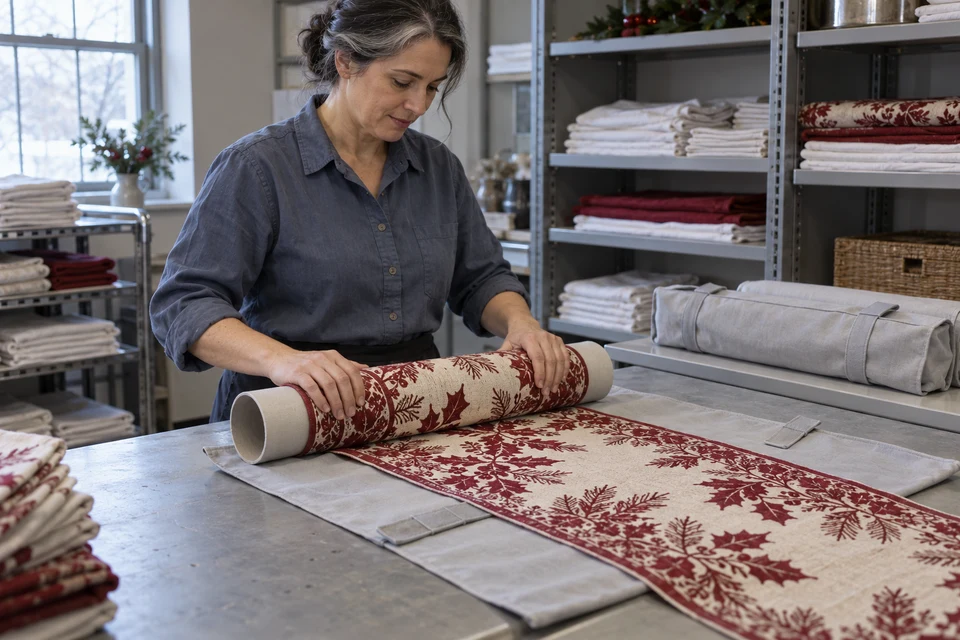
At the end of a seasonal display, a venue needs to identify, pack and later retrieve its decorative table runners without turning the linen room into a guessing exercise. A cloth wrap and tube can be developed as a runner-specific storage kit, but the dimensions and handling sequence must come from the actual textile. The purchase is a defined storage accessory, not a guarantee that every runner will remain crease-free or ready for immediate reuse.
Define the item stored in each roll
One runner and a whole table set are different scopes
List the runner reference, size, construction and any trims that will be stored. State whether one roll holds one runner or an explicitly defined group. Keep mats, napkins and other items separate unless they are part of the approved arrangement. Record the condition in which the textile enters storage; used or damp linen should follow the venue's cleaning and drying procedure before it joins a dry storage kit.
Place the contents list in the accessory specification. Do not describe a cloth wrap as waterproof, archival or protective against pests without suitable evidence for the complete system. Its immediate purpose can be modest and useful: keeping an identified, prepared runner together in an agreed handling format.
- Name the exact runner and number of pieces per roll.
- Separate the used-linen route from the dry storage workflow.
Trial the tube and wrap around the actual cloth
Diameter and length are development inputs
Ask the supplier to propose a tube length and diameter for the real runner, including any fringe or bulky decoration. Review where those details sit when rolled and whether the wrap closes without forcing them into an awkward position. Avoid selecting a tube solely because it fits an existing shipping carton. The venue's storage shelf and the prepared textile both belong in the size decision.
Use the physical sample review to document the empty kit and occupied roll. Inspect exposed tube ends, wrap overlap and closure placement. The buyer should retain the accepted arrangement rather than relying on a vague instruction to roll loosely, which different staff may interpret very differently.
- Check tube ends and closure positions with the runner inside.
- Record the occupied roll dimensions, not only the flat wrap.
Design identification for a busy changeback
Read the identity without opening every roll
Decide which reference the linen team needs at the shelf: runner design, size, room or table group, quantity and current condition. Choose an identification method that can be maintained by the venue without confusing it with decoration on the runner. A replaceable record pocket may be useful, but its location and attachment still need a sample review.
Use buyer resources to structure the working record and distinguish the storage accessory from the linen it contains. Test the identification while several rolls are placed on the actual shelf. If the label is hidden by the normal stacking direction, change the location or storage arrangement before ordering a full set of identical wraps.
- Make the runner identity visible in the intended shelf position.
- Separate the accessory reference from the contained linen reference.
Run the remove-store-return sequence
A single staged photograph misses operational details
Have the venue team remove a prepared runner from the display, pack it using the agreed method and return it to the nominated shelf. Later, retrieve the same reference and set it out again using the permitted preparation. Record handling difficulties, misplaced ties, confusing identities and any unwanted appearance change. This trial supports the working method; it is not a validated long-term preservation test.
If the buyer wants claims about storage performance, define an appropriate evidence scope through the testing-plan discussion. Otherwise describe only the confirmed arrangement and instructions. Keep the runner's own care requirements separate from cleaning instructions for the wrap so staff do not assume that all components can be processed together.
- Trial retrieval as well as packing with ordinary staff.
- Record preparation and observed appearance without inventing a lifetime claim.
Quote the kit and replenishment parts clearly
Replacement wraps may not need new tubes
Request separate scope for tube, cloth wrap, closure, identification component and any instructions. Ask whether replacement wraps or identification parts can be ordered independently and what minimums apply. The quotation checklist helps prevent a low accessory price from hiding excluded parts or an untested occupied size.
Agree how many kits the venue needs for the actual runner inventory and spare handling allowance. Keep the approved packing sequence and retained occupied sample for later reorders. Confirm lead times from the offered supply plan rather than assuming a simple-looking accessory is immediately available. The most useful result is a clear seasonal changeback process supported by appropriately sized components.
- Identify replacement-part availability and applicable minimums.
- Link kit quantities to the actual runner inventory and storage arrangement.
Share the runner samples, shelf dimensions and changeback workflow with FY Bedding. Request a complete occupied-roll trial and a component-level quotation before choosing quantities for the linen room.