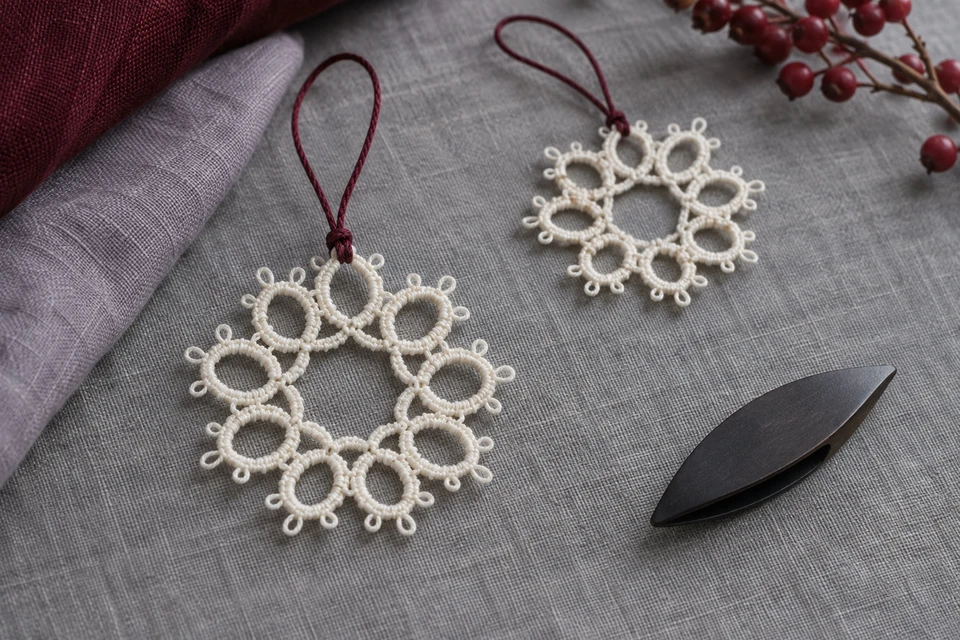
A small loop on a lace ornament can be decoration or a connection holding the design together. That distinction matters when a buyer approves tatted Christmas ornaments. Start with the ring-and-join structure rather than treating every openwork decoration as the same lace product.
Identify the knotted-lace proposal
A circular motif does not establish tatting
The University of York's Digital Museum of Dress Accessories describes tatting as knots worked along a thread and drawn into rings or arcs. It distinguishes little picot loops used decoratively from those used to link sections. That limited construction explanation gives buyers useful vocabulary; it does not establish the technique, origin or maker of an item shown in a catalogue. Request a physical reference and the supplier's description of how the offered ornament is constructed.
A crochet rosette, machine-embroidered lace disc and tatted ring arrangement can share a similar outline while representing different offers. Keep those alternatives separately named. Ask whether the quotation concerns completed ornaments, unfinished lace units or a kit requiring assembly. For a seasonal retail project, the purchased unit should be clear before the team compares motif counts, sample charges or packing options. An appealing group photograph cannot resolve those commercial differences.
Map rings and their connecting points
Separate a decorative loop from a structural join
Lay the approved sample flat without stretching and identify its closed rings, connecting arcs and points where neighbouring sections meet. Give the maker a simple annotated photograph that distinguishes decorative picots from joining picots. The buyer need not prescribe a knotting recipe. The purpose is to show which connections must exist in the delivered design and which small loops are merely part of its appearance.
Inspect the same locations on several submitted pieces. A missing decorative loop and an unconnected ring are different findings and should not be recorded under one vague label such as untidy lace. Note whether a connection is made during the lace construction or added later, using the supplier's explanation. Where the proposed route changes, request a revised sample and update the map. Retaining only the overall diameter could allow an unintended structural change to go unnoticed.
Agree how a closed ring should appear
Review junctions without pulling the lace apart
Examine where each ring closes and how the thread ends are finished. Compare against the identified reference, looking for an unintended gap, a loose-looking tail or a bulky junction that changes the motif. Ask the maker to explain questionable areas rather than asking receiving staff to tug repeatedly on the lace. A visual review can document construction differences; it does not supply a tensile rating or establish that an ornament is suitable for a child's use.
Use consistent viewing conditions and retain an ordinary-size photograph alongside any enlargement. Very close photography can make a tiny thread end dominate the judgement while hiding a much more important missing connection. Conversely, a distant festive display can conceal both. Agree which observations cause rejection, which require technical review and which are accepted variation. If the collection is described as handmade, that wording still needs support and does not remove the need for an agreed construction reference.
Keep the hanging attachment separate from picot decoration
The suspension point needs its own decision
Choose the intended top of the ornament and show exactly where the supplied hanging cord attaches. Do not assume that any decorative picot is an acceptable suspension point. Ask the maker to propose the attachment for the actual lace structure and have the responsible reviewer assess it for the intended display. Record whether the cord is included, its approved appearance and whether it arrives attached or loose. This is a specific component decision, not a general load-bearing promise.
Suspend the finished sample as it will be displayed and observe which rings turn, overlap or pull out of their normal arrangement. Photograph the front and reverse. If the design hangs differently from the flat approval, decide whether the change is intentional before approving photography and packaging. A revised cord position can alter the visual centre even when the lace itself is unchanged. Keep the hanging view with the flat ring map so both reviewers are judging the same ornament.
Describe thread and finishing condition with the lace
A crisp showroom sample may include additional preparation
Request the actual thread reference, declared composition and any finishing or shaping treatment used on the sample. Identify the preparation state that the supplier intends to deliver. A crisp ring arrangement does not prove a particular fibre or a permanent stiffness. If the proposal includes a finish, ask for the relevant product and care information for that construction. Leave unresolved material or destination-market questions with the appropriate technical owner rather than substituting a generic safe or washable claim.
Review the completed ornament after the agreed preparation and ordinary unpacking procedure. Look specifically at ring closure and joining points as well as overall appearance. Keep any consumer reshaping instructions realistic and supported by the supplied sample. If the supplier changes thread thickness, finishing treatment or join method to address an issue, compare the affected design again. A replacement piece with a tidier outline may still differ at the connections that defined the original approval.
Order by a named ring-and-join reference
Make assortment changes visible before production
List each design, colour and quantity in the selling unit, and connect it to its own approved lace map. Two ornaments with the same external size may require different numbers of rings or joins. Ask how those differences affect the supplier's minimum quantities, sample stages and quotation. Do not assume that all white lace motifs can be pooled under one minimum or substituted freely. The packing record should identify the actual designs and counts, not simply a decorative assortment description.
For an FY Bedding enquiry, send the authorised design direction, ring-and-join reference, intended display, selling-unit contents and target quantities. Request confirmation of the feasible construction and evidence needed for the proposed market. Agree production and shipping milestones only after the actual sampling scope is understood; a small ornament is not evidence of confirmed holiday delivery. The release pack should let another person identify a missing connection without needing to reconstruct the designer's intention.
Check a named sample's closed rings, structural joins, decorative picots, thread ends and separate hanging attachment. Retain flat and suspended views together, and count each approved design explicitly in the retail assortment.
Method references: University of York: tatting rings, arcs and picots.