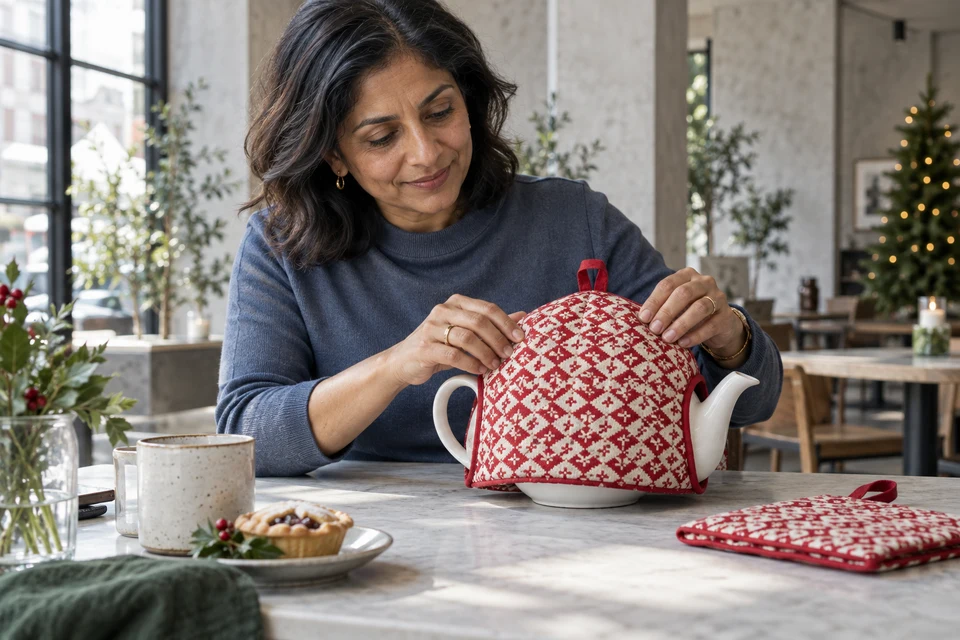
A Christmas tea cosy can look correct on a styled table while fitting the wrong teapot. The most useful buying reference is the actual pot, including its lid knob, handle and spout, not an approximate capacity description. Separate a decorative fitting sample from any thermal-performance claim. Start the geometry review with an empty, unheated pot and define the intended removal and use procedure before discussing functional evidence.
Name the exact teapot used for approval
Capacity alone does not define the shape
Record the body height and widest diameter, the lid-knob height, the handle projection and the position of the spout. Photograph the pot from both sides with a scale reference outside the product image. Two pots described by the same volume may have very different outlines. If the retailer offers a range, identify which models need individual fitting trials rather than claiming a universal fit.
Use the sampling brief to state whether the cosy is an enclosing dome that is removed before use or a fitted design with side openings. These are different constructions and should not share one ambiguous drawing. Confirm that the pot itself is excluded unless it is explicitly part of the supply agreement.
- Record the pot model and the complete external profile.
- Choose enclosing or open-sided construction deliberately.
Place openings around real access points
Keep decorative borders out of the working clearance
For an open-sided proposal, position the handle and spout openings on the actual pot, then review them with the intended lining and edge finish. A generous cut opening can become restrictive after binding or turning. Check the lower edge as well as the upper curve and observe whether the cosy moves when it is fitted and removed. Do not use stretching to make a mismatched size appear correct.
The edge-finish checklist helps describe the construction around these curved openings. Approve embroidery and print borders in the fitted state, since a motif near an opening may disappear around its edge. Keep the final handling procedure within a separately reviewed use brief rather than implying that an attractive opening makes any pouring method safe.
- Measure usable clearance after the openings are finished.
- Approve motif position on the fitted, lined sample.
Separate outer cloth, lining and filling
A seasonal pattern is not thermal evidence
Ask for the composition and construction of every layer, including any padding, lining or proposed barrier. Review an unfinished section so the quoted layers can be compared with the sample. A thicker appearance does not by itself establish insulation performance, heat resistance or safe contact with a hot surface. Avoid carrying generic claims from another kitchen textile into this product description.
The evidence and claims matrix can record the intended claim, the relevant sample and the evidence still required. If thermal performance is part of the buying brief, obtain a suitable evaluation plan from a competent provider for the actual design and use. This article supplies neither a test result nor a universal temperature or time limit.
- Identify every layer and any material substitution.
- Keep decorative approval separate from thermal claim approval.
Review removal and cleaning as customer tasks
Use instructions that match the supplied construction
Demonstrate how the empty fitting sample is placed over and removed from the unheated pot. Note whether the lid knob catches the lining or whether the top tab is merely decorative. If a tab is intended to be used during removal, state that in the construction brief and ask how it is attached. Do not leave the function to be inferred from a styled photograph.
The care-label approval workflow is useful for coordinating instructions with the actual materials and evidence. Following the agreed care trial, repeat the fitting check and compare the openings, lower edge and lining position. A successful outer-fabric swatch trial does not demonstrate that the complete multilayer item will retain the same shape.
- Repeat the fitting trial after the agreed care process.
- State the function of any tab or loop rather than assuming it.
Quote the confirmed fit range and retail pack
Do not promise compatibility from a generic size name
List the approved pot models or dimensional range in the purchase specification and decide how compatibility will be communicated to customers. Include outer cloth, lining, filling, opening finish, label and packaging in the quote comparison. Ask whether custom Christmas artwork changes sampling charges or material minimums. Keep a decorative-only option distinct from an offer supported by additional functional evidence.
The quotation scope checklist helps make exclusions visible. Open the proposed retail pack and check whether folds distort the side openings. Confirm the production and dispatch milestones after sample approval and any required evidence review. Neither an editorial image nor a seasonal name establishes stock availability or arrival before a holiday.
- Approve compatibility wording against the actual sample records.
- Confirm pack condition, minimums and evidence responsibilities.
Share the exact teapot geometry and intended cosy use with FY Bedding. Begin with an unheated fitting sample, then define the construction, care review and any functional evidence required before approving customer-facing claims.