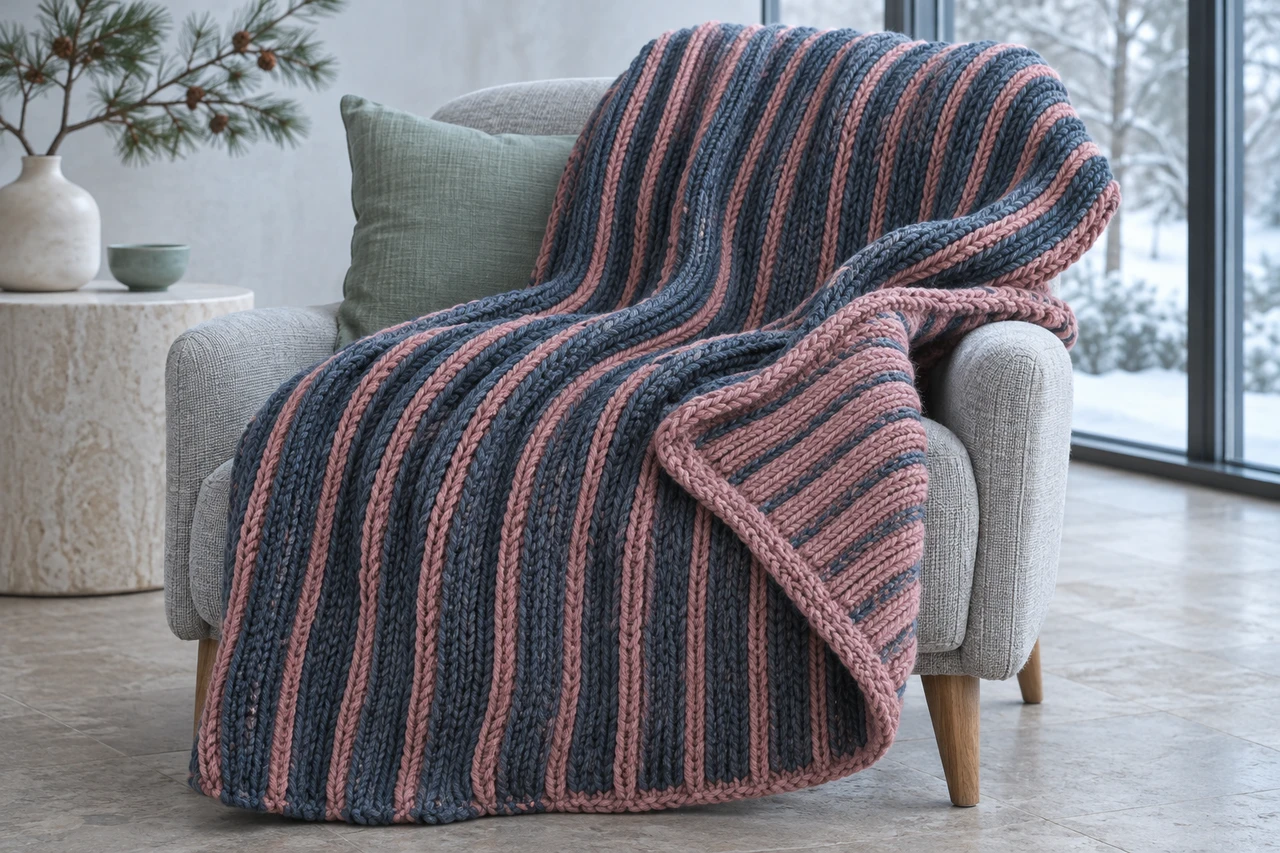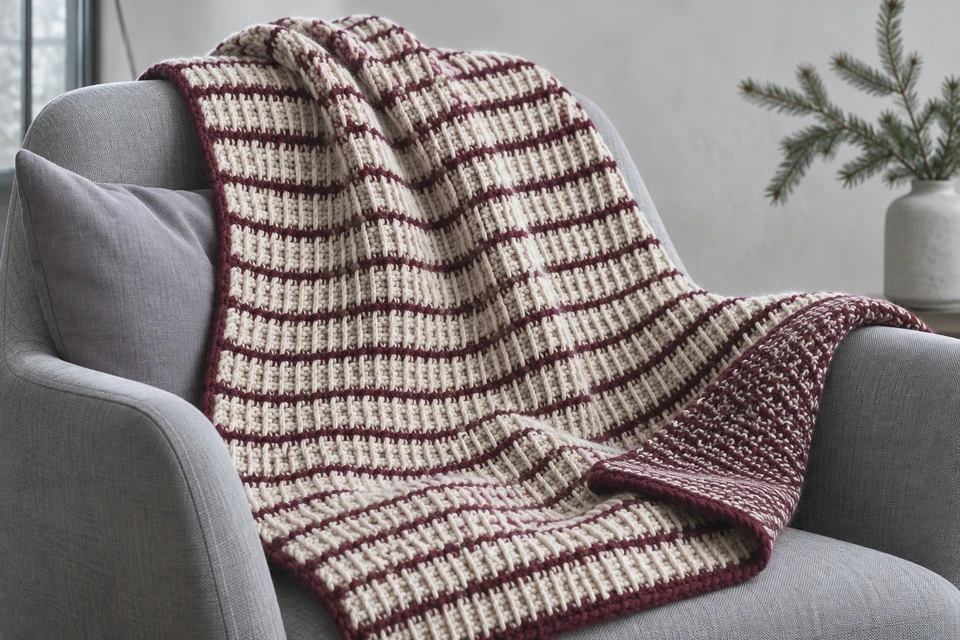
Two yarn colours can create more than two simple stripes in a Tunisian crochet throw. Their placement within the working sequence changes the visible mixture. A Christmas buyer should approve the actual worked colour arrangement, not assume that red and cream yarn cards define the finished textile.
- 1. Establish what the maker means by a row
- 2. Compare colour assignments on one stitch construction
- 3. Specify colour changes at the side edges
- 4. Review the reverse as a deliberate retail surface
- 5. Keep the worked reference through care and packing review
- 6. Price the exact colour sequence and sample scope
Establish what the maker means by a row
Use forward and return as separate approval fields
Yarnspirations' introductory guide explains Tunisian crochet through a forward pass that collects loops and a return pass that works them off. This distinction is useful when discussing colour, but it is not a complete specification for every Tunisian stitch. Ask the maker to identify the proposed stitch and show a worked sample with its forward and return colour choices recorded. Keep the terminology consistent between the design brief, sample notes and quotation.
Do not accept a loose statement such as alternate red and white rows without clarification. It may refer to a complete pair of passes, a single pass or a broader decorative band. Ask the supplier to show exactly what the statement means on the proposed sample. A short annotated record of the colour assignments is more reliable than trying to infer the sequence from a compressed photograph, especially when one colour is partly concealed by another.
Compare colour assignments on one stitch construction
Change one decision at a time
Request a small comparison in which the chosen yarn references and stitch construction remain identified while the pass assignments change. For example, the maker might show one version with cream dominant in the upright features and another with red more visible. These are development alternatives, not instructions that any stitch must produce a particular result. Judge the actual samples and retain the selected arrangement with its maker-confirmed record.
Observe the cloth under ordinary lighting and at the distance expected in a retail display. A close-up may make the return colour look prominent when it blends into the surface from across a room. Decide whether the Christmas identity should read as strong contrast, a quieter mixed tone or defined bands. If the chosen yarn is later changed in thickness, twist or sheen, review the result again. Identical colour names cannot preserve a physical interaction that depends on a different yarn.
Specify colour changes at the side edges
A tidy face can conceal an unresolved transition
Ask how the proposed colour sequence is managed at the sides of the throw. Examine thread ends, carried colours and any border that covers the transition. The buyer should record the finished appearance expected at those locations without prescribing an improvised joining method. If the sample has hidden ends or temporary preparation that differs from production, have the supplier identify it before the reference is accepted.
Compare both long edges and the beginning and finishing ends. A repeated colour transition may accumulate differently on one side, or a border may introduce a third visible colour that was absent from the yarn-card approval. Decide whether that effect belongs in the design. Keep edge observations separate from measurements of the main field so a colour correction does not silently change the finished size or the amount of contrasting border supplied.
Review the reverse as a deliberate retail surface
Different is not automatically defective
Turn the sample over and record what the reverse looks like in the selected construction. It may show a different balance of the same colours and a different texture. Determine whether the reverse is intended to be visible, concealed in normal presentation or simply described as the reverse of a single-face design. Do not call the throw reversible merely because both sides look attractive in a small swatch; that product description needs agreement for the complete article.
Use a full-size production-intent sample for draping, folding and photography approval. A sofa throw will expose corners and parts of its reverse as it moves, while a tightly folded shelf presentation may show only the face. Identify the ordinary presentation being sold and check that the retail images describe it fairly. The colour review does not establish warmth, abrasion resistance, wash performance or suitability for infant bedding. Those questions require their own product-specific evidence.
Keep the worked reference through care and packing review
The supplied state must remain recognisable
Agree a care and preparation assessment for the actual yarns, construction and intended use. Compare the same identified colour arrangement before and after that procedure, noting the face, reverse and transition areas separately. Do not choose a generic wash instruction from the word crochet. If the sample needs a particular preparation to achieve its approved appearance, ask the supplier to explain what will be done before delivery and what, if anything, the customer is expected to do later.
Fold the throw in the proposed retail format and examine it after unpacking without restyling first. Check whether the visible colour band matches the approved shelf view and whether the reverse unexpectedly becomes the dominant surface. A packaging change can alter the first impression without changing a stitch. Where a belly band or tie is proposed, verify its position on the actual folded throw and confirm that it does not obscure the colour feature chosen to distinguish the Christmas range.
Price the exact colour sequence and sample scope
A palette does not define the labour or assortment
Ask the supplier to quote the confirmed construction, dimensions, border and colour sequence, identifying the sample work and finished units included. Clarify whether minimum quantities are assessed by yarn colour, complete design or another basis. A two-colour throw with frequent changes is not necessarily the same offer as a two-colour throw made in broad blocks. Compare actual proposals instead of assigning a cost or lead-time rule from the number of colours alone.
Send FY Bedding the intended Christmas palette, worked reference, forward-and-return assignment, preferred reverse presentation and quantities. Ask for a feasible sampling route and clearly scoped terms. Keep production and delivery dates subject to confirmation for that proposal, with no presumed holiday arrival. At reorder, preserve the approved stitch and pass record alongside the physical sample so a familiar product name does not allow a different colour arrangement to enter the assortment unnoticed.
Approve the stitch, forward colour, return colour, edge transitions and reverse as one worked reference. Confirm the same construction in the full throw, care assessment and retail fold before releasing quantities.
Method references: Yarnspirations: forward and return passes in Tunisian crochet.