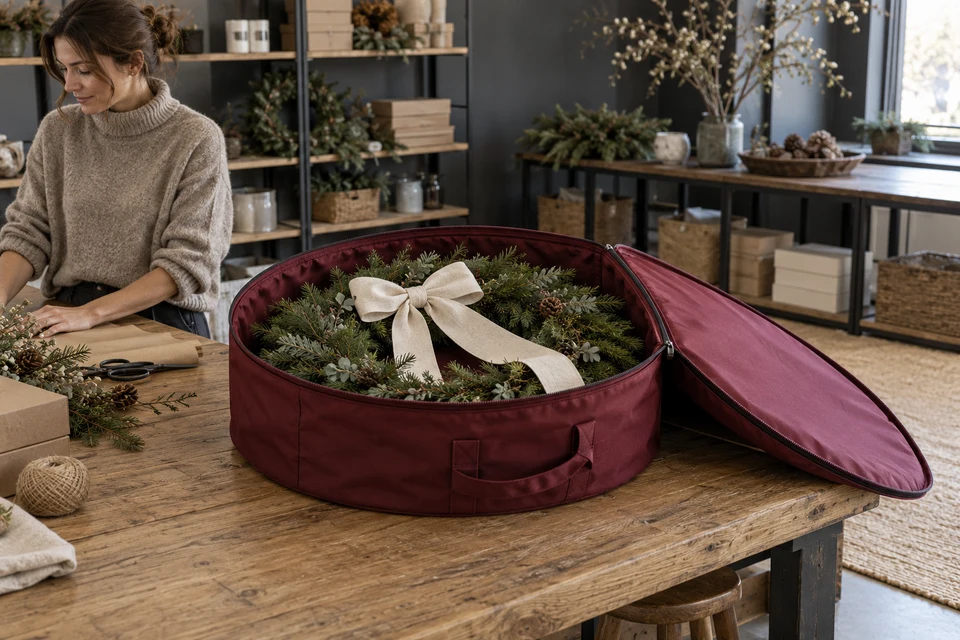
The diameter printed on a wreath storage bag is only a starting point. A decorated wreath has depth, projecting ornaments and a removal path that a flat ring does not. Retail buyers should approve the case around representative decorated contents, then separate that fit approval from any carrying or protective claim. The goal is a storage product that customers can load, close and reopen as described, without having to flatten the decoration to make the sample fit.
Describe the decorated ring envelope
Include the parts that extend beyond the base
Request the outer diameter, inner opening and maximum decorated depth of the intended wreath range. Record the highest bow, projecting stems and any rigid attachments that affect the storage envelope. If the retail programme is sold for several wreath sizes, select representative examples at the limits instead of approving only the smallest. Keep the contents list with the sample so a later reviewer knows exactly what was fitted.
Distinguish nominal wreath size from the actual internal space of the bag. A supplier's flat cutting dimension or external diameter is not an internal fit measurement. State where the internal dimensions are taken and whether padding, seams or a divider occupies space. The tech-pack essentials can hold a section drawing that makes the difference clear before quotation.
- Measure decorated depth at its highest point.
- Identify fragile or rigid projections that must not be forced through the opening.
Test the opening before the closed shape
Follow a complete loading and removal route
Open the proposed zipper fully and place the representative wreath into the bag without bending the ring or pushing decorations under a narrow lip. Then remove it using the intended customer action. Watch where the lid, zipper tape and side wall contact the decoration. A bag can have enough internal diameter but still have an inconvenient opening if the lid does not fold away or the closure stops short.
Record whether the opening is around the perimeter, across the top or arranged in another approved configuration. Compare those options with an actual sample rather than choosing solely from a flat drawing. The zipper component approval guide helps identify the closure parts to specify. An accepted loading trial should state the contents used and any handling conditions, not claim universal fit for all wreaths carrying the same nominal size.
- Film one normal load, closure and removal sequence.
- Note any snag point or part that requires a second person.
Review the side wall under realistic contents
Avoid using compression to hide a shallow case
Close the case gently around the decorated ring and inspect the lid profile. Decide whether contact with the decoration is acceptable for this particular range and record the decision. If the lid must be pulled down to reach the zipper, investigate the available depth rather than accepting the strain as normal. Inspect the base and side-wall seams after the trial for distortion that the empty sample did not reveal.
Choose any internal support, padding or restraint through an explicit design decision. Do not add a divider because an unrelated ornament-storage product uses one. The ornament compartment guide addresses a different storage problem; a wreath case needs its own ring-shaped clearance review. If a supplier proposes a reinforced base, ask for the material, removability and effect on packing to be documented before accepting the change.
- Record whether the decorated top may contact the lid.
- Check closed depth without pulling the case into shape.
Separate carrying from storage fit
Specify the intended handle use and evidence
A handle is part of the construction, not evidence of an approved load capacity. Clarify whether it is for repositioning an empty bag, moving the packed product or another defined use. Ask the responsible technical reviewer to establish the appropriate load, handling and attachment checks for that intended use. Keep their evidence linked to the same fabric, seam and handle arrangement as the production sample.
Inspect the route from handle attachment into the bag body, including the reverse side of the stitched area. If the product will hang during storage, treat that as a separate brief rather than assuming a carrying handle covers it. The storage-bag repacking guide offers a useful way to document repeated handling, but it does not supply a universal rating. Leave unsupported protective or load claims out of the retail copy.
- State the intended handle action on the specification.
- Do not print a load rating without the supporting evaluation.
Approve the empty retail pack and the filled use example
Make the supplied contents unmistakable
Most photographs will show a wreath to explain the product, while the retail unit may contain only an empty bag. Make that distinction clear in the approved listing and pack text. Check how the empty case folds, whether the zipper or handles create an awkward lump, and whether the customer can restore the intended shape after opening. Approve the actual retail fold and outer dimensions rather than an illustrator's pack mock-up.
Keep the supplied component list, internal fit range and any evidence-backed claims in one release record. Use retail folding and pack approval to connect the textile to its packaging. Discuss the confirmed quantity and delivery plan after the sample scope is clear. Send FY Bedding the decorated-ring measurements, opening preference and retail format for a project review; the illustration does not establish inventory or seasonal arrival.
- State whether the wreath and any removable support are included.
- Retain both an empty packed sample and a filled fit reference.
A useful approval record demonstrates that the intended decorated wreath enters, closes inside and leaves the bag normally. External diameter alone cannot settle that decision, and fit approval must not be presented as proof of a protective or carrying claim.