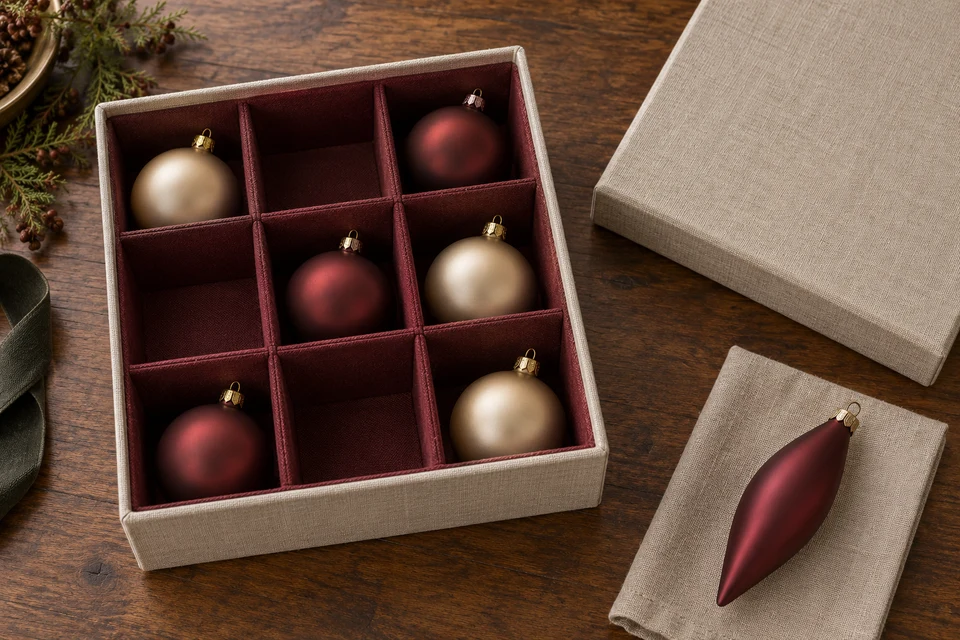
A fabric compartment grid can organize Christmas ornaments, but a box described as holding a certain number of pieces may not fit the collection a buyer actually sells. Round baubles, long pendants and projecting caps occupy different envelopes. Specify the divider against those shapes and the outer container, then decide what the product may honestly claim. Separating objects visually is not the same as demonstrating protection during shipping or handling.
Build a representative ornament list
Count follows geometry, not the other way round
Select the ornament families that the storage program is intended to accommodate. Record the complete outline of each example, including cap, loop, stem or projecting decoration. A long pendant should not be treated as a small bauble simply because its widest diameter is modest. Decide whether the collection needs one uniform grid, several cell sizes or a separate area for unusual shapes before choosing a headline capacity.
Use the technical pack to attach photographs and dimensions of the reference objects. Identify whether ornaments are supplied with the storage product or are shown only to demonstrate fit. If the buyer cannot provide the intended collection, request an explicitly bounded fit range rather than a universal promise that every Christmas ornament will fit.
- Measure caps and projections as part of each object.
- Decide which shapes need separate or enlarged compartments.
Specify the usable cell after assembly
Partition thickness consumes internal space
Measure the clear opening between finished divider faces, not the distance between drawn centre lines. Record cell depth and the position of any base layer. If partitions overlap, slot together or are sewn at intersections, inspect how the junction changes the usable area. A grid that looks regular from above can still have tight corners or a raised crossing that affects the object placed inside.
The insert contact review provides a way to document where packaging meets a product. Apply it to the actual textile-covered partition and ornament surfaces. Ask for the divider construction, facing cloth and any internal stiffener to be identified. Do not infer cushioning or abrasion performance from the soft appearance of the outer fabric.
- Measure finished clear cells at the points that constrain the object.
- Identify the construction beneath the textile facing.
Fit the grid to the outer container
A removable divider needs a defined seated position
Trial the divider inside the proposed box rather than approving it on a table alone. Check its position against the side walls and base, then close the actual lid with the representative objects inside. Record whether the grid can shift, lift or compress during the intended opening and closing sequence. Any allowed movement should be deliberate, not an unexplained consequence of a loosely specified box.
Use the box-lid review for closure details while keeping the compartment trial as a separate record. If the grid is removable, demonstrate removal without pulling on the ornaments. Decide how the user will identify its orientation when reinstalling it and whether the product will be sold with replacement partitions.
- Approve the divider inside the actual box with its lid.
- Record the seated orientation and removal sequence.
Separate organisation from protection
The sales claim determines the evidence needed
An organiser may keep objects in named positions, but that alone does not establish impact resistance, scratch prevention or parcel-shipping suitability. List the intended claims and the actual handling scenario. If the product is intended for household storage only, avoid showing it as a qualified shipping pack. If distribution protection is part of the offer, obtain a suitable test plan for the complete loaded system rather than for an empty cloth divider.
The transit validation guide explains why the actual packed configuration matters. Record any separate wrapping or outer packaging used in evaluation. Do not remove those components from the retail offer while retaining the same protection claim. Fragile ornaments and their surface finishes may need different evidence even when they fit the same cell.
- List organisation and protection claims separately.
- Keep all evaluated packing components linked to the evidence.
Price the grid architecture and pack-out
Capacity changes can alter more than cloth usage
Ask the supplier to quote the same cell layout, depth, construction and box interface. A twelve-cell drawing is not commercially equivalent to nine larger cells, even if the outer box size is unchanged. Confirm whether the price includes the box, lid, base pad, divider assembly and any instructions. Compare packed and unassembled supply options only after reviewing how reliably the buyer can assemble the grid.
Use the quotation comparison record to expose these differences. Request actual sample stages, minimum quantities and production timing. Preserve a loaded reference set through the order so a later material or partition change can be checked against the same objects. That makes the advertised capacity a meaningful description rather than a decorative number.
- Compare identical cell architectures and included components.
- Retain the reference objects used for the capacity decision.
Before committing a storage capacity, approve the clear cells, the loaded box and the exact claim scope. Send FY Bedding the ornament profiles and container dimensions to review a textile-divider brief without assuming that a soft surface proves transit protection.