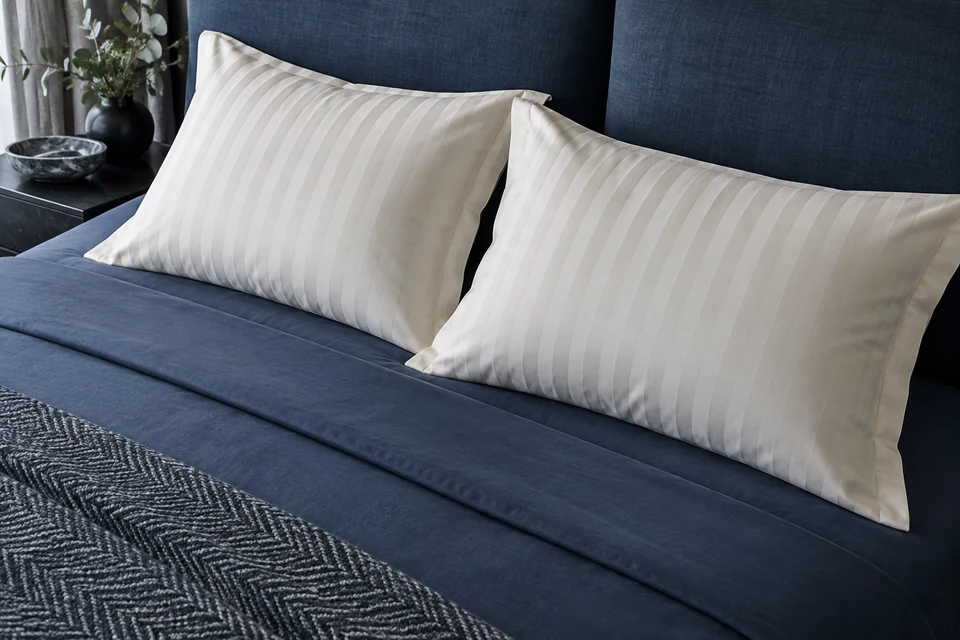
Directional woven stripes can make two pillowcases look inconsistent on the bed even when each has an acceptable fabric appearance on its own. The buyer needs a pair-orientation reference that shows how the stripe direction, opening and visible face relate to the intended arrangement. This is not a printed-pattern registration test or a general color approval. It is a finished-product presentation decision that must remain linked to the actual fabric and pillowcase construction.
Define the intended stripe direction
Use a complete product reference
Start with the approved fabric identity and describe the intended stripe direction relative to the finished pillowcase edges. Do not rely on a loose swatch whose orientation has not been recorded. Include the closure or opening side, visible face and any border that affects presentation. The technical pack should carry this relationship so the factory does not have to infer it from a styled photograph without dimensions or orientation notes.
Distinguish a woven stripe from a printed repeat in the project record. The pattern-placement guide provides related coordination principles, but the exact construction and acceptance question differ. If the buyer wants a particular relationship between the two pillowcases, state it explicitly. A requirement for the same directional presentation is not automatically a requirement for an exact stripe count or edge phase unless those details are separately defined. Label the left and right positions in the reference drawing where the design requires a specific arrangement, and explain whether those labels describe the guest view or the operator view.
- Identify the fabric and finished pillowcase reference.
- State stripe direction relative to the product edges.
- Record the visible face and opening side.
- Define any additional matching requirement explicitly.
Assemble the proposed pair
Keep components consistent
Use the intended pillowcase sizes and compatible pillows for the review. Record whether the cases are new or prepared through an agreed care process and keep both sides in comparable condition. If one pillow is fuller or differently positioned, the resulting surface angle may complicate the stripe comparison. The insert-and-cover proportion review addresses that related setup question, but it does not replace the directional textile requirement.
Place the cases according to the intended room arrangement, including the normal opening orientation. The opening and overlap reference should remain active; do not reverse a case solely to improve the photograph if doing so conflicts with the approved use. Record any alternative arrangement as a proposal requiring review, rather than silently accepting it as the same product presentation.
- Use identified compatible pillows for both cases.
- Record the care state of the pair.
- Preserve the approved opening orientation.
- Mark proposed alternative arrangements as revisions.
Review ordinary viewing conditions
Avoid judging a single highlight
Observe the pair from normal guest-view positions under the agreed room lighting. Woven surface appearance can be directional, so retain the same lighting and viewpoint when comparing alternatives. Record whether the intended stripe relationship remains clear across the chosen views without claiming consistency under every possible light. A close-up can explain a detail, but it should sit beside a wider paired view that shows the actual presentation question.
If the buyer suspects a color difference, route that question through the color-reference method rather than diagnosing it from one angled stripe highlight. Likewise, a change in stripe direction should not be dismissed automatically as a lighting effect. Describe what was observed, confirm the sample orientation and identify which additional comparison is needed. Keeping those steps separate makes the decision more useful than a vague statement that the pair looks different.
- Use recorded normal viewing positions.
- Keep comparison lighting consistent.
- Retain both paired and detail images.
- Separate orientation findings from color questions.
Confirm the production instruction
Connect appearance to cutting and sewing
Translate the approved arrangement into a practical orientation reference for cutting, bundling and sewing. Identify the controlling fabric face and direction and show how the finished opening relates to them. The face-and-back control can support this handover, but the pair requirement needs its own finished-product illustration. A correct roll label does not automatically demonstrate that every completed case has the required orientation.
Review an identified first finished pair against the instruction before assuming the reference is clear to production. If the order includes several sizes or border constructions, state which variants are covered by that review. Do not extend a single pair's approval to unexamined variations simply because they share the collection name. Keep any relevant cutting or construction change visible in the revision record so the approved direction is not lost during a later adjustment.
- Show direction from fabric through finished opening.
- Provide a finished-pair reference to production.
- Review an identified first pair against the instruction.
- State the covered sizes and construction variants.
Release the paired reference
Preserve it for reorders
The approval should identify the fabric, pillowcase construction, pair arrangement and viewing conditions, with any additional matching criteria stated separately. Retain the physical or photographic references required by the project and identify the authorized decision owner. A later fabric change, alternate opening or revised border should prompt review of the affected assumptions. Do not rely on a collection name to communicate a directional requirement that only exists in one old image.
Send the intended bed arrangement, fabric reference and pillowcase drawing to FY through the hospitality procurement enquiry. Ask for a finished-pair sample discussion with clear orientation notes. The result should help purchasing specify the desired visual relationship without inventing a universal stripe-matching tolerance or treating a styled photograph as proof of every fabric property. That keeps the design decision practical and traceable through production and replenishment.
- Identify the approved directional relationship in writing.
- Keep separate criteria separate in the record.
- Preserve the first-pair evidence with its revision.
- Reassess affected changes on future orders.
Approve directional woven-stripe pillowcases as an identified finished pair, with face, opening and bed orientation explicit rather than inferred from a loose swatch.