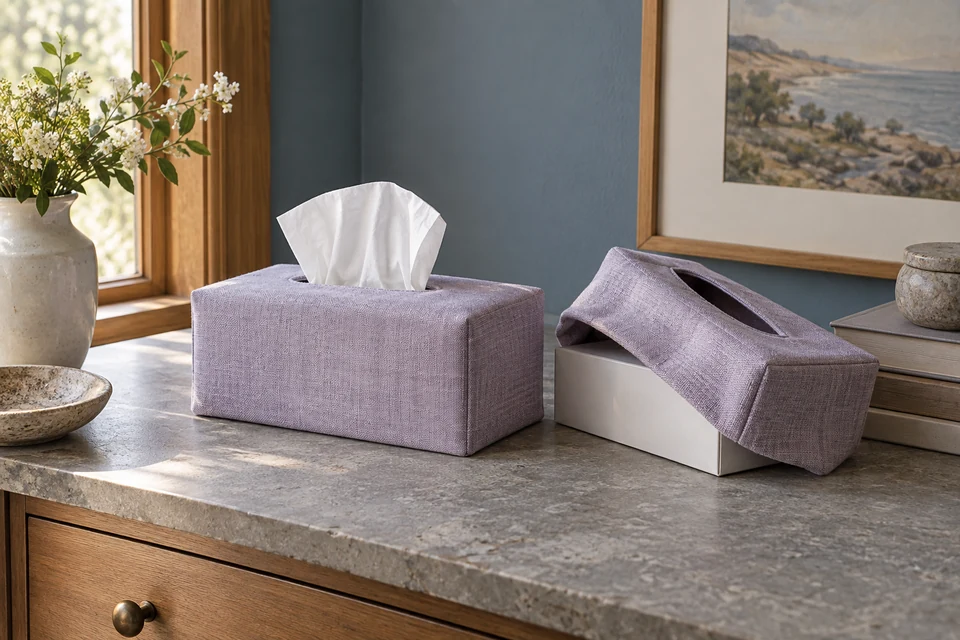
A fabric tissue-box cover can coordinate an ordinary consumable with a room's textile scheme, but the cover should not make changing the box or withdrawing a tissue unnecessarily difficult. The buyer is purchasing a fitted decorative enclosure, not the paper tissues inside it. Its useful specification begins with the boxes actually used or intended for sale, including differences that a generic cube or rectangular label may conceal. This guide focuses on enclosure geometry, access and presentation. It makes no cleanliness, moisture-protection or dispensing-performance guarantee and does not treat a styled room image as evidence that a cover fits every box format.
Build a real box-variant record
Nominal format names are insufficient
Measure identified box references, including height, footprint, corner shape and the position of the tissue opening. Note where a lid or carton seam changes the outer profile. Use unopened and partly used boxes when the agreed review needs to show ordinary dispensing conditions, while keeping observations limited to those actual references. The dimensioned brief should state which consumable box each cover is intended to accept. A supplier should not guess compatibility from a hotel room photograph that conceals most of the carton.
Count meaningful variants separately and decide whether the business can standardize the underlying consumable or genuinely needs more than one cover. Consider proposed replacement box sources rather than assuming the current carton will never change. Do not force a single pattern across incompatible heights by presenting a loose corner as the intended relaxed style. If one cover is proposed for several boxes, demonstrate and record that scope specifically. The purchasing decision includes the covered appearance and refill method for each accepted variant, not only an outer-size table.
- Identify the actual box references.
- Record carton profile and opening location.
- Prove any multi-variant compatibility.
Draw the access route before choosing decoration
The opening and lower closure work together
Specify how the cover goes onto the box, how a replacement box is inserted and how the tissue aperture aligns afterward. Show the lower opening or closure and the intended orientation in the pattern record. Review whether fitting requires a twist, tuck or adjustment that is absent from the supplied instruction. The closure component guide is relevant if a zipper is proposed, but there is no requirement to use one. Choose the actual arrangement through the enclosure's access needs rather than borrowing a closure because it appears on another accessory.
Inspect the aperture finish from above and below. Check that the proposed seam, binding or folded edge does not obscure the opening unexpectedly in the intended fitted position. Assess dispensing only with the identified box and tissue arrangement, under the stated review conditions. A trouble-free withdrawal in a demonstration is a useful observation, not a guarantee for all tissue brands or every depletion level. If the opening is changed after the appearance review, repeat fitting and refill access instead of approving only the decorative top panel.
- Map fitting, orientation and refill steps.
- Review both sides of the aperture finish.
- Retest access when the opening changes.
Choose the intended filled and empty silhouettes
Structure should be an explicit design choice
Review the cover on its accepted box and separately without the box. Decide whether the empty cover is expected to stand, fold softly or be stored flat, and describe that state honestly. Request a component description for any lining, stiffener or padding used to obtain the proposed shape. The component record prevents a structural-looking presentation sample from concealing an extra insert that is missing from the bulk offer. A cover-only item should not be photographed as freestanding if it depends on an unmentioned internal box.
View each guest-facing side and the top in the intended room location. Judge fabric direction, pattern relationship, seam placement and whether the underlying carton shows through unexpectedly. The pattern-placement guide can support a repeat map, but the box enclosure needs its own panel orientation and aperture relationship. Decorative approval should include the tucked or lower areas that may become visible during refilling. Do not silently reshape or hide them between photographs to simulate an effortless fitted result.
- Define filled and empty presentation states.
- Identify structural components in the offer.
- Review aperture and pattern as one layout.
Let the staff or customer perform the refill
Normal handling exposes hidden pattern problems
Give the reviewer the proposed instruction and accepted replacement box rather than an already fitted display. Observe removal, insertion, alignment and return to the intended location. Record difficult corners, inaccessible closures and unnecessary pressure on the carton. If staff must remove nearby objects or move the box to operate the closure, let the room owner decide whether that is workable. The room trial record keeps the observed result connected to the actual installation without claiming a universal time saving or service improvement.
Repeat the agreed review after the cover's intended care process. Recheck aperture position, seam appearance, lining and any component used to support the shape. The dimensional review guide supplies related evidence questions; it does not establish a generic allowance for every lined enclosure. If an item can be cleaned only by a route unsuitable for the planned setting, reconsider the construction or service decision before bulk purchasing. A decorative advantage should not obscure an operational mismatch.
- Observe a refill from the unfitted state.
- Disclose movement and adjustment required.
- Repeat access after the agreed care route.
State exactly what the customer receives
A coordinated room is not a sold-unit inventory
Confirm whether the retail or property purchase contains the textile cover alone, a reusable inner holder or another named component. Make the exclusion of tissues and disposable boxes clear where they are merely photographic props. The consistent-offer record can keep packaging, product data and imagery aligned. Remove unsupported statements about hygiene or product protection. Coordinate box dimensions and compatibility language with the accepted variant record rather than simplifying it into a broad fits-most promise.
Quote the agreed variant count, material, supporting layers, closure, aperture finish and packing state together. Confirm actual minimum quantities and whether pattern or lining changes create separate development work. Buyers can share a tissue-cover enclosure brief with measured boxes, refill observations and room photographs for a scoped discussion. The appropriate supply route still requires confirmation. Retain the accepted box reference or a controlled dimensional record so a future consumable substitution triggers a compatibility check instead of an unexplained complaint about the cover's old pattern.
- Identify cover-only and holder-included units.
- Keep props separate from supplied contents.
- Preserve consumable compatibility for repeats.
Treat a fabric tissue-box cover as a decorative enclosure with a working refill route. Approve verified box variants, aperture alignment, honest empty-state presentation and the exact sold contents before selecting an appealing room photograph.