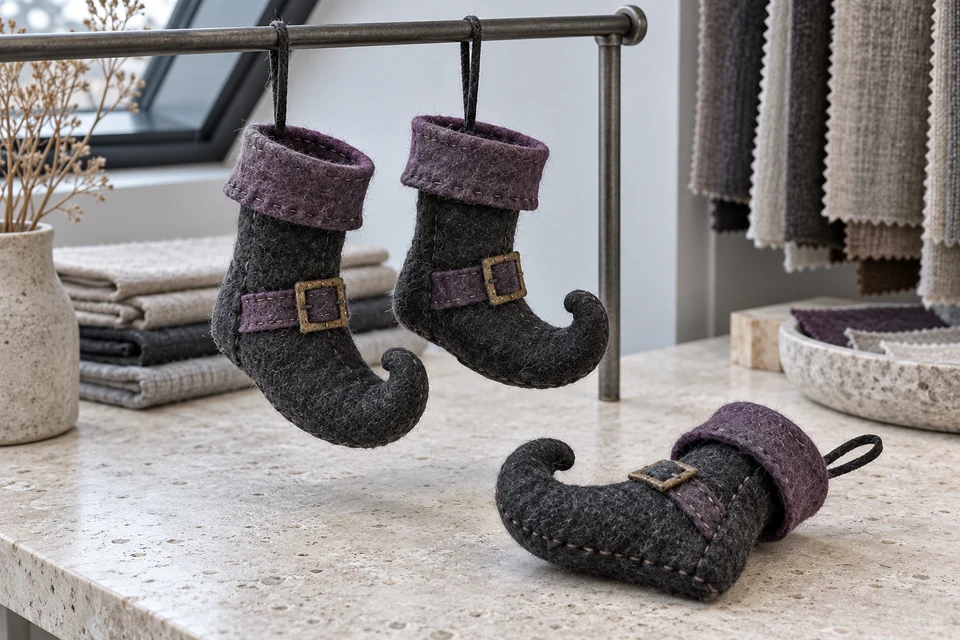
A curled toe is the feature that makes a miniature witch boot recognizable, yet it is also the feature most likely to be reshaped by stuffing, stitching or a tight pack. Buyers should treat a hanging boot as a small sculpted textile assembly. The approval reference needs to show its side profile and suspended position, not merely a front-facing decoration photographed with the curl held in place.
Describe the side profile before the trim
Use the curl as a measurable design reference
Choose the intended boot height, shaft width and reach of the toe. Record where the toe begins to rise and how much open space should remain inside the curl when the piece hangs freely. A dramatic upward curve and a gently pointed toe may look similar in a supplier thumbnail but require different patterns and filling decisions. Keep a full-size side outline with the physical reference.
The dimensional tolerance discussion can help establish agreed measurement language. Do not apply apparel footwear sizing to a decorative miniature. Measure the ornament consistently without stretching the tip, and distinguish the overall silhouette from the separate height of the folded cuff. State whether a pair should face the same way or form a deliberately mirrored display.
- Keep a side-profile drawing at the approved scale.
- Name the intended orientation of every boot in a pair.
Identify the felt and the visible seam
Surface texture is part of the design
Ask what the proposed material actually is rather than treating all felt-looking cloth as the same fiber or construction. Obtain a swatch and a sewn edge sample. A fuzzy surface may soften the silhouette, while a firmer sheet may hold the toe more clearly but show turning bulk. Review how the material bends at the cuff and around the inside of the curl.
Use the seam specification guide to document whether the edge is turned inward, visibly overstitched or assembled by another agreed method. Decorative stitching can be intentionally prominent; skipped or loose segments should not be confused with that aesthetic. Inspect both sides of the boot because the reverse may face the customer when the ornament rotates.
- Approve the felt swatch together with a curved seam sample.
- Specify whether the reverse receives the same trim treatment.
Test the suspension as a separate feature
A good silhouette can still hang at the wrong angle
Show the position and usable length of the hanging loop. Suspend the completed sample from the proposed display support and observe whether the cuff remains upright or the toe pulls the whole piece forward. Move the attachment point only through a documented sample revision; shifting it to solve balance can also change the look of a paired set.
The decorative attachment review offers useful questions about securing textile trims, but this ornament needs its own construction reference. Confirm how buckles, straps and loops are attached and ask for appropriate evidence for the intended market and use. An ornament-shaped boot is not wearable footwear, and its playful styling does not establish child or toy suitability.
- Review hanging balance without supporting the toe.
- Record attachment construction for loops and small trims.
Protect the curl during packing
Compare recovery with the approved display
Place the approved sample in the actual proposed pack rather than judging an unpackaged sales sample alone. The curled toe and folded cuff may need different space allowances. Open the pack using the intended customer steps, then photograph the boot before reshaping it. Agree any reasonable presentation adjustment explicitly, including whether the cuff should be unfolded and refolded by the buyer.
The sample receipt record can keep dispatch condition and arrival condition separate. A damaged courier sample may not reveal the intended bulk packing design, so ask what changed before drawing conclusions. Avoid specifying a recovery time that has never been demonstrated with the selected material and pack.
- Record the toe profile immediately after opening.
- Do not approve packaging only from a flat empty carton.
Order pairs and finishes without ambiguity
Keep the unit of sale visible
Confirm whether the quoted unit is one ornament, a matched pair or a mixed set. List cuff colors, buckle appearance, orientation and loop color on each purchase line. If the seller proposes an assortment, identify which variations are allowed and how many of each should appear. A photo containing three boots should not accidentally become the packing instruction for a two-piece product.
Use set-completeness checks before releasing the shipment. Ask about the minimums and sampling implications of custom felt shades or trim pieces. Retain the accepted suspended pair and the pack layout as separate references. Confirm the seasonal schedule only after the actual construction and component availability have been reviewed.
- State pieces per consumer pack and packs per carton.
- Link the curl, hanging and packed references to one revision.
Send FY Bedding the desired witch-boot profile, hanging arrangement and pair orientation. Ask for a suspended sample and a packed sample so the curled toe, cuff and set count can be approved together.