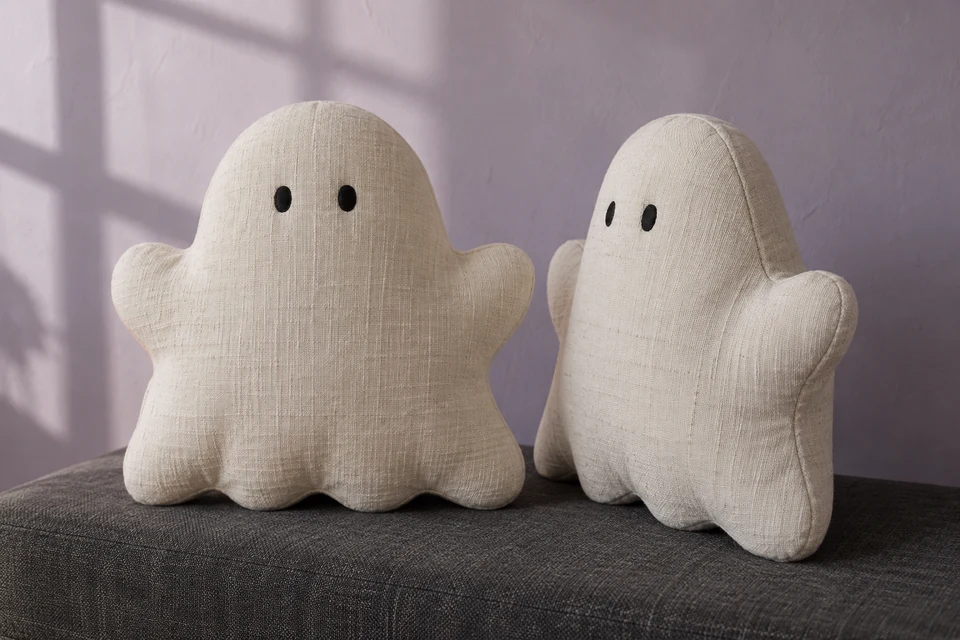
The character of a ghost-shaped cushion depends on small transitions: where the arms meet the body, how the head rounds over and how the lower scallops settle. A rectangular cushion specification cannot capture those details. Buyers need to decide which contours must be consistent and which soft variations are acceptable before placing a seasonal order. This guide concerns decorative accessories for adult interiors. It does not establish toy classification or suitability for infants or children; the intended market and users require separate review before the product is described or sold.
Start with the complete silhouette
Define landmarks before facial decoration
Create a front outline showing the head crown, arm tips, underarm transitions and lower scallops. Mark the overall width and height together with the distance between the arm tips. Add a side view showing the intended filled thickness. The technical-pack guide helps organize those references, but the outline must describe this shaped object rather than a generic square cover.
Decide whether the arms are intentionally asymmetrical. If the pose is meant to be balanced, do not let an early sample's accidental twist become the only production reference. Record the body condition during approval: empty shell, newly filled sample or settled finished cushion. Measurements from those states are not interchangeable. Retain the accepted outline and photographs under the same revision as the construction specification.
- Show arm tips, underarms and lower scallops.
- Identify the sample state used for each measurement.
Review narrow extensions after turning
A good paper shape may not survive sewing
Ask for an inside view of the sample around the underarms and scalloped base. Inspect how the offered construction turns through those curves and how the seam sits after filling. Look for a visibly pinched underarm, uneven arm depth or a seam that pulls the body out of shape. These are observations to discuss against the approved silhouette, not reasons to prescribe an improvised cutting method to the factory.
Use the seam-allowance review to document the manufacturer's accepted solution. Compare both arms in the same resting position. If a narrow extension cannot be reproduced reliably with the selected fabric, revise the shape or material before approving artwork and packaging. Do not hide the limitation by photographing the cushion from the one angle that makes it look balanced.
- Inspect the turned underarms on the finished sample.
- Resolve unstable contours before final photography.
Place the face on the filled object
Small marks can change the perceived expression
Locate each eye or other approved facial element from defined body landmarks. Compare spacing, height and orientation after filling, because curved surfaces can make a flat placement look different. Record whether details are stitched, printed or made by another declared method. Keep the facial components in the component list rather than leaving the word face as an unspecified decoration allowance.
Choose a restrained reference expression and inspect several units together. A slight eye rotation may read as a different character even when the overall cushion dimensions are correct. Do not infer attachment performance from appearance. Any component-security or intended-user requirements need an appropriate assessment agreed with the responsible product specialist, and the commercial description must match that assessed scope.
- Approve eye position on a filled sample.
- State the actual decoration method and materials.
Separate fill distribution from outline approval
Arms and body must be evaluated together
Compare the feel and profile of the arms, head and main body. Record whether the approved design is softly rounded or deliberately flatter. Adding fill until an arm looks fuller can distort another area, so evaluate the whole object after each development revision. The fill-weight guide supports quantity control, but a total weight alone does not describe distribution through a shaped cushion.
Ask how the final closing area is finished and inspect it in the intended display position. Check whether the lower scallops sit naturally or whether one area is overfilled and lifts the base. Agree the care process for the complete offered assembly and compare the same landmarks afterward. A change in shell, fill or decoration should trigger a review of the affected evidence rather than automatic reuse of the earlier approval.
- Observe distribution in every shaped extension.
- Keep total fill weight separate from the accepted profile.
Approve a realistic shelf and pack view
Do not build the range around hidden supports
Display the cushion as the customer is expected to use it: resting against a seat back, lying flat or standing with support explicitly shown. Do not claim unsupported freestanding behavior from a photograph that uses concealed props. For a family of sizes, sample the smallest version where turning and facial spacing may behave differently. The size-set approval guide helps identify which variations still need physical review.
Open the intended retail pack and compare both arms, face and base with the accepted sample. Record any permitted settling or reshaping instructions. Share the outline family, decoration method, intended users, material preferences and size mix with FY Bedding for a scoped feasibility discussion. Keep the final quote, pack contents and product page tied to those details, with no assumed holiday stock or unconfirmed arrival promise.
- Show the actual support used in display photography.
- Check the smallest shape and the unpacked arm positions.
Approve the ghost as a filled contour with controlled arm transitions and face placement. Keep visual consistency, attachment evidence and intended-user review as separate release decisions.