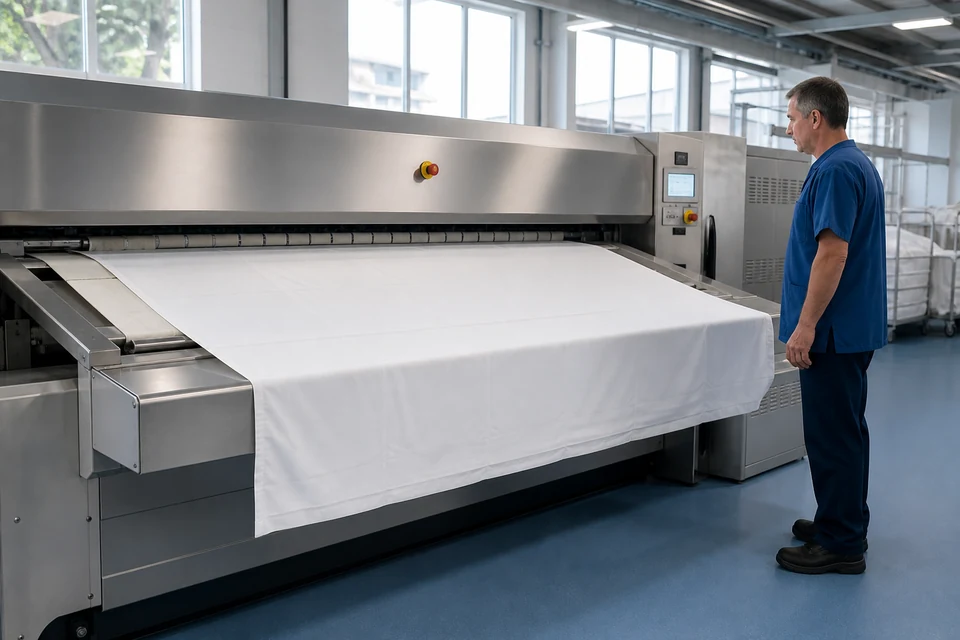
Hotel sheets and duvet covers are bought for guest rooms but often judged every day in a laundry finishing line. A product that fits the bed can still feed awkwardly, fold inconsistently or require repeated finishing because its dimensions, hems or construction do not suit the installed equipment and working method. This guide treats the flatwork-ironer interface as an approval subject in its own right. It is not an operating manual: machine settings, guarding and safe work procedures must come from the equipment maker and the laundry's trained team. The procurement decision is whether the proposed linen works through that approved route with acceptable presentation and handling.
Map the actual finishing route
Use installed equipment, not a generic laundry assumption
Ask the laundry to describe the receiving, washing, extraction, drying or preconditioning, feeding, ironing and folding sequence used for the proposed item. Record the equipment models and the relevant usable dimensions confirmed by the operator or manufacturer. The controlled laundry programme guide helps connect these stages. Do not choose a fabric solely because a supplier says it is suitable for commercial laundry; that phrase does not identify the local finishing process.
Identify which linen categories bypass the ironer and which need a different route. A duvet cover, flat sheet and pillowcase can present different edges and layer arrangements even when they use the same fabric. Record the bed-size range and the intended finished dimensions beside the equipment constraints. Where the laundry is outsourced, bring the actual service provider into the sample review before placing a large order, rather than discovering a mismatch after the property has opened.
- Record the installed finishing route.
- Confirm usable dimensions with the laundry.
- Separate items with different process paths.
- Include the outsourced operator early.
Review feed geometry, hems and closures
Construction details can change handling
Present production-representative samples with the proposed hems, labels, closures and panel arrangement. Ask the trained team which edge is normally fed and whether the item lies consistently without special intervention. The flat-sheet hem and orientation guide supports that discussion. A drawing should show the final edge geometry after the agreed care route, not merely the cut dimensions before sewing and shrinkage.
For duvet covers, review the closure and any internal features through the laundry's approved handling procedure. Do not improvise a new feeding method to make a problematic sample pass. If a closure or bulky edge requires a separate process, identify the operational consequence and ask whether it is acceptable for the programme. The duvet-cover construction guide provides the product context, while the equipment operator decides how the item may safely be processed.
- Use final hems and labels in samples.
- Identify the normal leading edge.
- Review post-care finished geometry.
- Document any required separate handling.
Run the trial under an approved operating procedure
Observe safely and avoid changing several variables at once
Have the laundry team process the candidate and the current reference through a documented, permitted route. Record relevant process conditions without publishing universal temperatures, speeds or moisture settings. Procurement staff should observe from safe positions and never reach into feed or roller areas to improve the appearance. The purpose is to evaluate the textile under a valid process, not to redesign machinery or bypass a guard for the sake of a sample demonstration.
Track each candidate through enough agreed repetitions to expose the issues that matter to the property. Record feed interruptions, misalignment, folds, surface appearance and any rework as separate observations. The wash-trial framework can hold the care history, but add a finishing-specific record rather than hiding the result in a general durability score. If conditions change during the trial, mark the affected samples and avoid a direct comparison until the difference is understood.
- Use the laundry-approved operating procedure.
- Observe without entering hazardous areas.
- Track interruptions and rework separately.
- Record changes in trial conditions.
Assess finished presentation and labour implications
A fast pass is not useful if it needs rework
Review the finished pieces at the point where housekeeping receives them. Note creasing, edge presentation, folding consistency and whether the product can be stored and distributed in the normal way. Compare the same categories of observations for every candidate. A particularly skilled operator should not be the only person capable of producing an acceptable result; ask whether the trial reflects the staffing and workflow that the property will actually use.
Measure handling or rework time only when the trial setup allows a fair comparison, and state the sample scope. Do not turn a small demonstration into a guaranteed percentage saving. The laundry handover checklist helps define the receiving boundary between laundry and housekeeping. A candidate may remain attractive if a documented process difference is acceptable, but the commercial comparison should include that difference rather than treating all items as operationally identical.
- Review linen at the housekeeping handover point.
- Separate first-pass output from rework.
- State the scope of any time comparison.
- Include agreed process differences in selection.
Lock the approved product-to-process interface
Recheck when either the textile or laundry route changes
Release the approved fabric, dimensions, hems and closure details together with the trial record. Record which changes require another finishing check, including a new fabric construction, revised edge detail or different laundry provider. The supplier change-control guide can carry the textile side of this decision. A laundry equipment change should also prompt review even if the purchase specification itself remains unchanged.
Use the accepted sample as a reference for incoming supply and train the receiving team to spot the features that affect processing. Send FY Bedding a hotel linen brief with the equipment route, bed sizes and current finishing problem so sample planning can address the actual interface. The result should be a clear approval or a defined further trial, not an unqualified claim that one fabric or hem design works with every flatwork ironer.
- Release the product and trial record together.
- Define textile and process change triggers.
- Retain the accepted operational reference.
- Share the actual laundry route in the brief.
Can the linen follow the laundry-approved route and reach housekeeping with acceptable presentation, without hidden special handling or repeated rework?